EMA Crossover Strategy with Stop Loss and Take Profit Optimization System

Overview
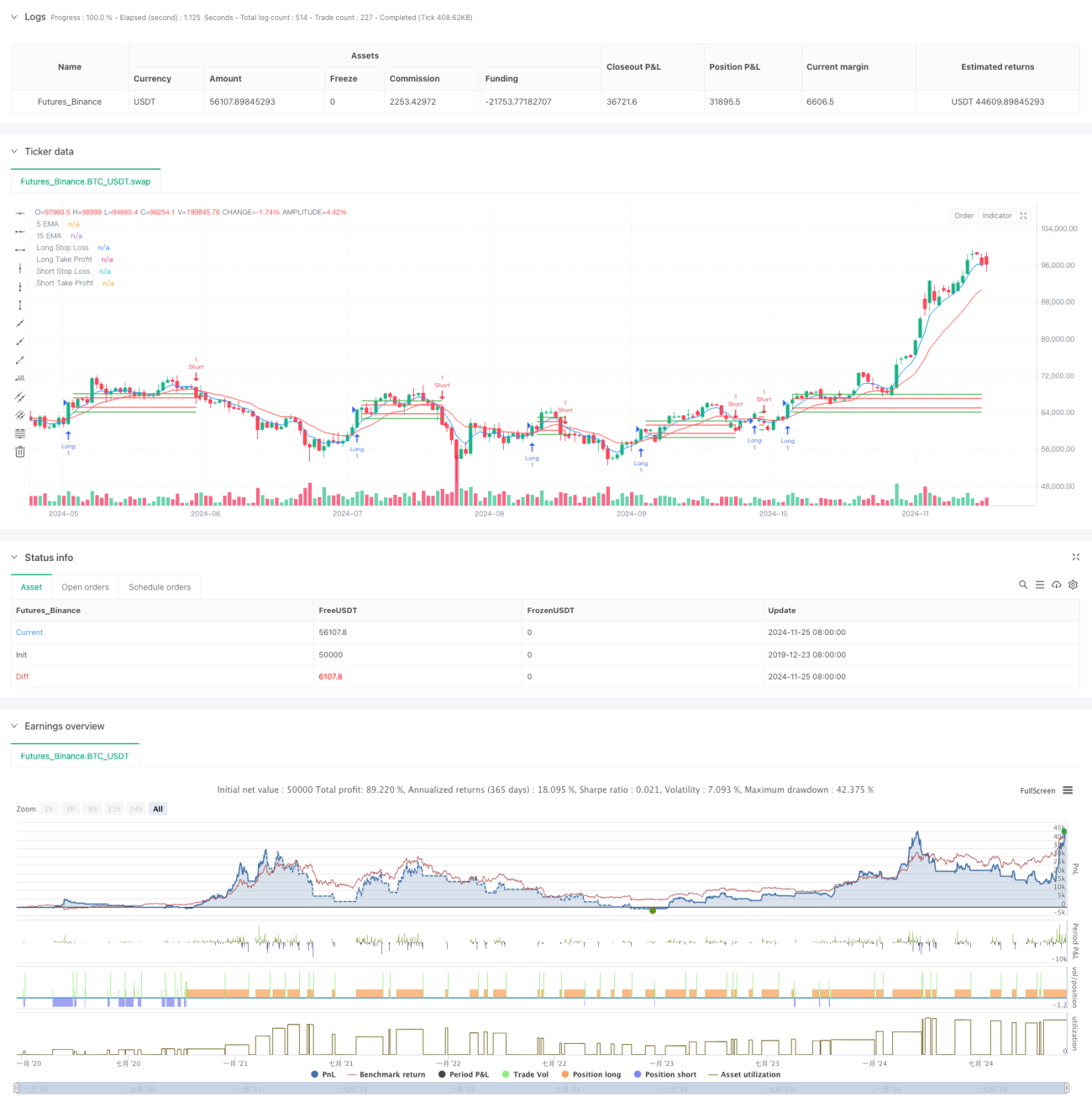
This strategy is a quantitative trading system based on the crossover of 5-period and 15-period Exponential Moving Averages (EMA). It aims to achieve stable returns while protecting capital through reasonable stop-loss and take-profit levels. The strategy uses classic moving average crossover signals to identify market trend changes and combines them with risk management mechanisms to control the risk-reward ratio of each trade.
Strategy Principles
The core of the strategy is monitoring the crossover between the fast-moving average (5-period EMA) and the slow-moving average (15-period EMA). A long signal is generated when the 5-period EMA crosses above the 15-period EMA, while a short signal is generated when the 5-period EMA crosses below the 15-period EMA. For each trading signal, the system automatically sets a 1.5% stop-loss level and a 3% take-profit level, ensuring a favorable risk-reward ratio. The stop-loss and take-profit levels are calculated based on the entry price, effectively controlling risk exposure.
Strategy Advantages
- Signal generation mechanism is objective and easy to understand, not affected by subjective judgment
- Uses exponential moving averages to reduce the impact of false breakouts
- Fixed percentage stop-loss and take-profit levels facilitate capital management
- Risk-reward ratio of 1:2 follows professional trading principles
- Simple strategy logic, easy to implement and maintain
- Applicable to multiple markets and timeframes
Strategy Risks
- May generate frequent false signals in ranging markets, increasing transaction costs
- Fixed stop-loss and take-profit settings may not suit all market conditions
- Fast EMA is sensitive to price movements, potentially leading to overtrading
- Does not consider market volatility changes, risk control lacks flexibility
- Stop-loss execution may be delayed in extreme market conditions
Strategy Optimization Directions
- Introduce volatility indicators to dynamically adjust stop-loss and take-profit levels
- Add trend filters to reduce false signals in ranging markets
- Dynamically adjust EMA periods based on different market characteristics
- Add volume confirmation mechanism to improve signal reliability
- Implement time filters to avoid trading during unfavorable periods
- Consider adding trailing stop mechanism to optimize profit-taking
Summary
This is a well-structured quantitative trading strategy with clear logic. It captures trend reversal points through moving average crossovers and implements risk control with fixed stop-loss and take-profit levels. The strategy is simple to use, suitable for beginners, and provides a good foundation for further optimization. Traders are advised to conduct thorough backtesting before live implementation and optimize parameters according to specific market characteristics.
- 1