Dual Moving Average Trend Following Trading System with Risk-Reward Ratio Optimization Strategy

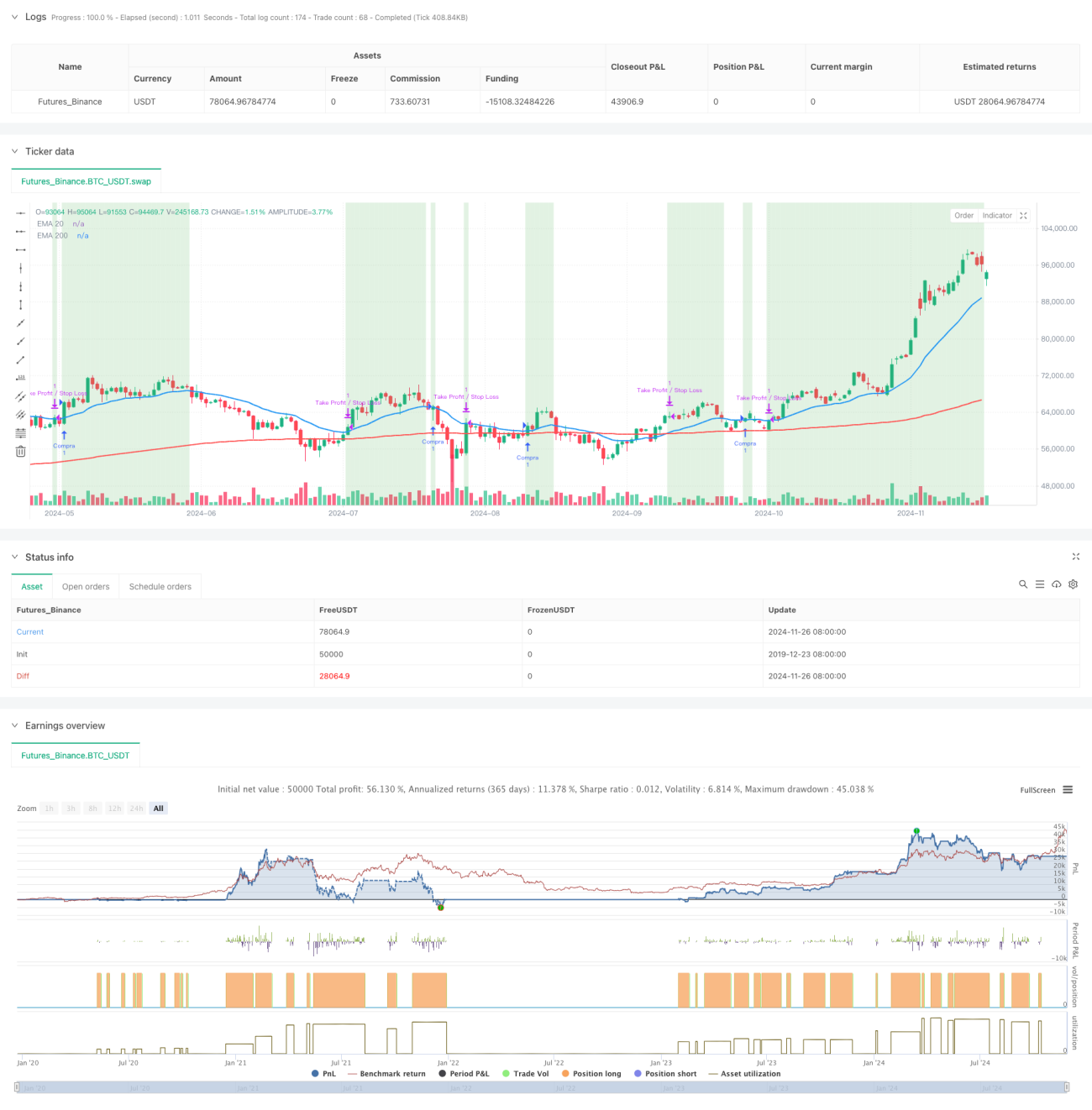
In the field of quantitative trading, trend following strategies have always been one of the most popular trading methods. This article introduces a trend following strategy based on a dual moving average system, which improves trading efficiency through optimized risk-reward ratios.
Strategy Overview
This strategy uses 20-day and 200-day exponential moving averages (EMA) as primary indicators, combined with a 3:1 risk-reward ratio for trading decisions. Buy signals are generated when the price breaks above the 20-day EMA and the 20-day EMA is above the 200-day EMA. Each trade has fixed stop-loss (-0.5%) and take-profit (1.5%) levels to ensure controlled risk.
Strategy Principles
The core logic includes several key elements:
- Uses 20-day and 200-day EMAs to judge market trends, with the 200-day EMA representing long-term trend and 20-day EMA reflecting short-term movements
- A buy signal is generated when price breaks above the 20-day EMA and the 20-day EMA is above the 200-day EMA, indicating an upward trend
- Employs a 3:1 risk-reward ratio, with take-profit level (1.5%) being three times the stop-loss level (0.5%)
- Uses variables to track trade status and avoid duplicate entries
- Resets trade status when price falls below 20-day EMA, preparing for the next trade
Strategy Advantages
- Dual moving average system effectively filters market noise and improves signal reliability
- Fixed risk-reward ratio supports long-term profitable trading
- Clear entry and exit rules reduce subjective judgment
- High degree of automation, easy to implement and backtest
- Comprehensive risk control mechanism with clear stop-loss levels for each trade
Strategy Risks
- May generate frequent false signals in ranging markets
- Fixed stop-loss and take-profit levels may not suit all market conditions
- Trading costs not considered may affect actual returns
- Stop-loss placement may be too close to entry in high-volatility markets
- Market liquidity factors not considered
Optimization Directions
- Introduce volume indicators to improve trend judgment accuracy
- Dynamically adjust stop-loss and take-profit levels based on market volatility
- Add trend strength filters to reduce false signals
- Consider incorporating market sentiment indicators
- Optimize position management system for better money management
Summary
This is a well-structured trend following strategy with clear logic. By combining a dual moving average system with fixed risk-reward ratios, the strategy achieves good returns while maintaining risk control. Though there are areas for optimization, it's overall a trading system worthy of further research and improvement.
- 1