Five EMA RSI Trend-Following Dynamic Channel Trading System

Overview
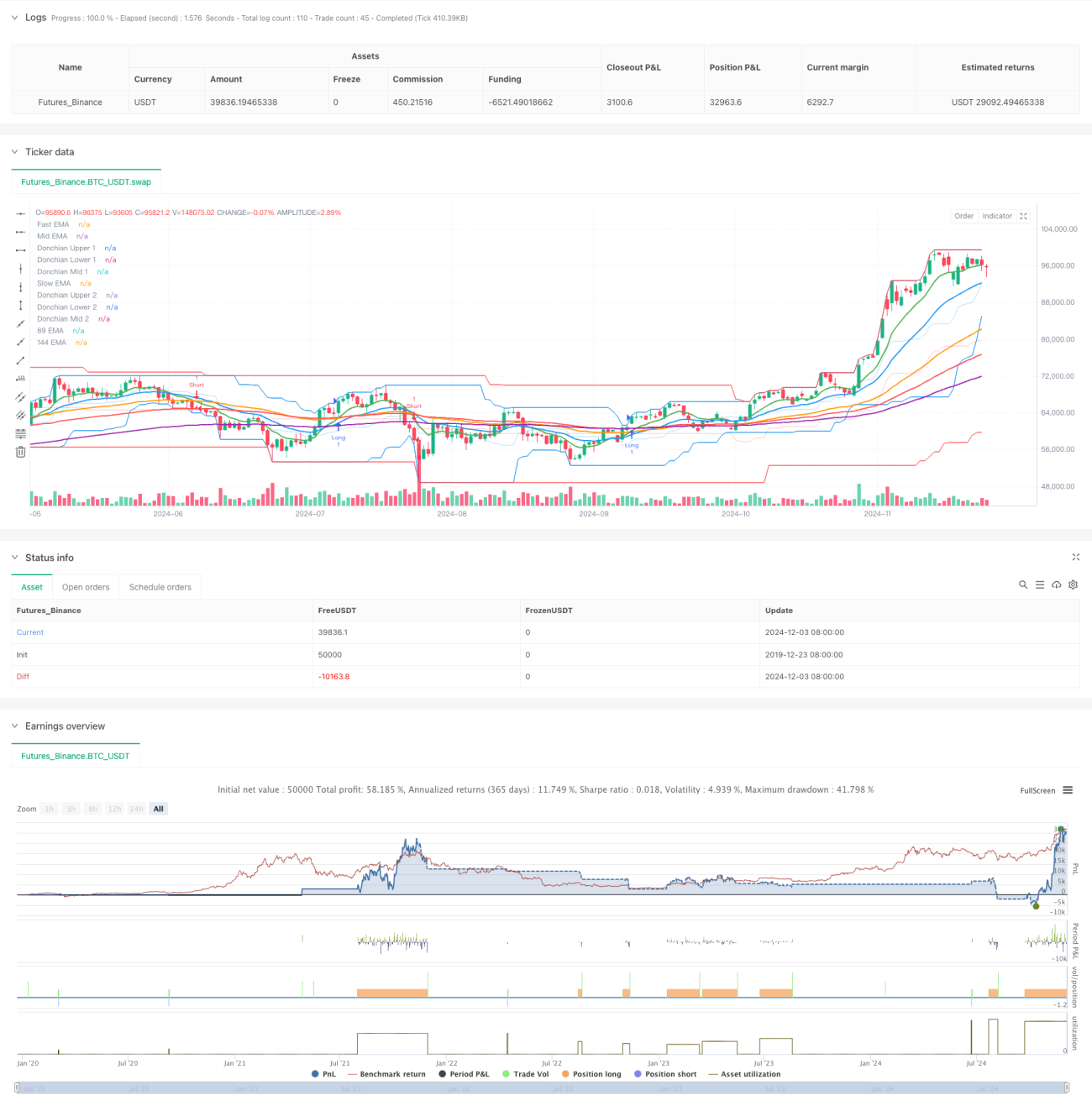
This strategy is a trend-following system that combines multiple technical indicators, primarily integrating five Exponential Moving Averages (EMAs) of different periods, the Relative Strength Index (RSI), and two Donchian Channels of different periods. The system captures market trends through the coordination of multiple indicators and manages risk and returns using dynamic stop-loss and profit targets.
Strategy Principles
The strategy employs multiple technical indicators for signal confirmation: First, it uses 5 EMAs (9, 21, 55, 89, 144 periods) to construct a trend framework, determining initial trend direction through crossovers between fast and slow EMAs. Second, it uses RSI (14 periods) as a trend filter, requiring RSI to be in the overbought zone (above 60) for long positions and oversold zone (below 40) for short positions, thus avoiding frequent trading in ranging markets. Finally, it uses 21-period and 74-period Donchian Channels to define price movement ranges, providing additional market structure reference for trading.
Strategy Advantages
- Multiple technical indicators cross-validation improves signal reliability
- Combination of trend-following and momentum indicators performs well in trending markets
- Uses dynamic stop-loss and multiple profit targets to protect capital while maximizing trend utilization
- RSI filtering reduces false signals in ranging markets
- High degree of system automation reduces emotional interference
Strategy Risks
- Multiple indicators may lead to signal lag, causing significant drawdowns in quick reversal markets
- RSI filtering might miss important trend beginnings
- Fixed percentage stop-loss and profit targets may not suit all market conditions
- Frequent stop-loss hits possible in highly volatile markets
- Too many technical indicators may lead to system over-optimization
Optimization Directions
- Introduce adaptive indicator parameters that adjust dynamically based on market volatility
- Add volume indicators as auxiliary confirmation
- Develop more flexible stop-loss strategies, such as trailing stops or ATR-based dynamic stops
- Implement market condition recognition mechanism for different parameter settings in different market conditions
- Consider adding time filters to avoid trading during unfavorable periods
Conclusion
The strategy constructs a relatively complete trading system through the combination of multiple technical indicators. While it has some lag, it can achieve stable returns in trending markets through strict signal filtering and risk management. Traders are advised to adjust parameters according to specific market characteristics and their risk tolerance in practical applications. Meanwhile, continuous monitoring of system performance and regular evaluation of optimization directions are necessary to ensure the strategy remains adaptable to market changes.
- 1