
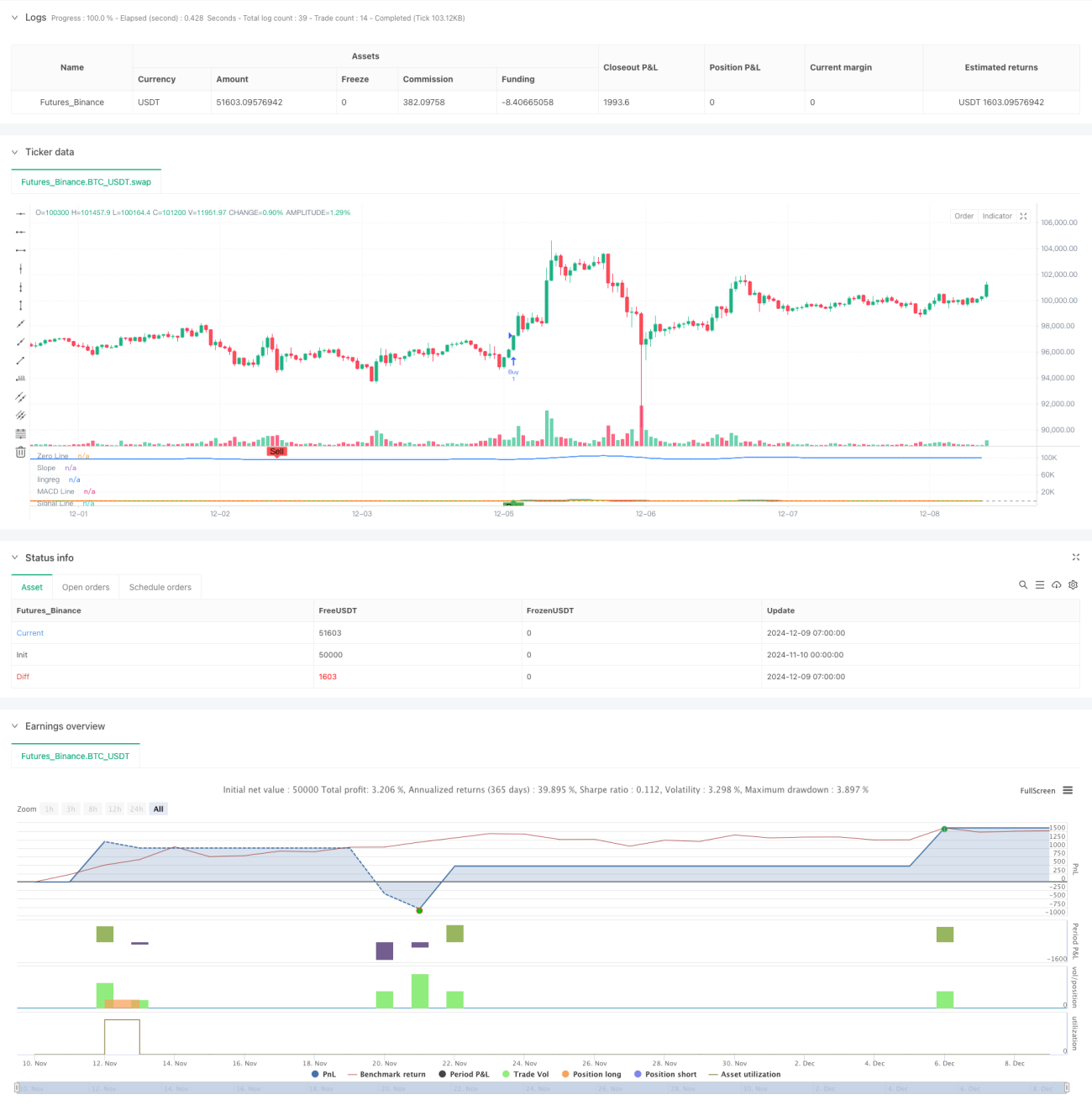
Overview
This strategy is an intelligent trading system that combines MACD (Moving Average Convergence Divergence) and Linear Regression Slope (LRS). It optimizes MACD calculation through multiple moving average methods and incorporates linear regression analysis to enhance signal reliability. The strategy allows traders to flexibly choose between single or dual indicator combinations for generating trading signals and includes stop-loss and take-profit mechanisms for risk control.
Strategy Principles
The strategy's core lies in capturing market trends through optimized MACD and linear regression indicators. The MACD component utilizes a combination of SMA, EMA, WMA, and TEMA calculations to enhance price trend sensitivity. The linear regression component evaluates trend direction and strength through regression line slope and position analysis. Buy signals can be generated based on MACD crossovers, linear regression uptrends, or a combination of both. Similarly, sell signals can be flexibly configured. The strategy includes percentage-based stop-loss and take-profit settings for effective risk-reward management.
Strategy Advantages
- Indicator combination flexibility: Ability to choose between single or dual indicators based on market conditions
- Enhanced MACD calculation: Improved trend identification through multiple moving average methods
- Objective trend confirmation: Statistically supported trend judgment through linear regression
- Comprehensive risk management: Integrated stop-loss and take-profit mechanisms
- Strong parameter adaptability: Key parameters can be optimized for different market characteristics
Strategy Risks
- Parameter sensitivity: Different market environments may require frequent parameter adjustments
- Signal delay: Moving average indicators have inherent lag
- Ineffective in ranging markets: May generate false signals in sideways markets
- Opportunity cost of dual confirmation: Strict dual-indicator confirmation may miss some good trading opportunities
Strategy Optimization Directions
- Add market environment recognition: Introduce volatility indicators to distinguish between trending and ranging markets
- Dynamic parameter adjustment: Automatically adjust MACD and linear regression parameters based on market conditions
- Optimize stop-loss and take-profit: Implement dynamic levels based on market volatility
- Incorporate volume analysis: Integrate volume indicators to improve signal reliability
- Include timeframe analysis: Consider multiple timeframe confirmation to enhance trading accuracy
Summary
This strategy creates a flexible and reliable trading system by combining improved versions of classic indicators with statistical methods. Its modular design allows traders to adjust strategy parameters and signal confirmation mechanisms according to different market environments. Through continuous optimization and improvement, the strategy shows promise for maintaining stable performance across various market conditions.
/*backtest
start: 2024-11-10 00:00:00
end: 2024-12-09 08:00:00
period: 1h
basePeriod: 1h
exchanges: [{"eid":"Futures_Binance","currency":"BTC_USDT"}]
*/

//@version=6
strategy('SIMPLIFIED MACD & LRS Backtest by NHBProd', overlay=false)

// Function to calculate TEMA (Triple Exponential Moving Average)- 1