
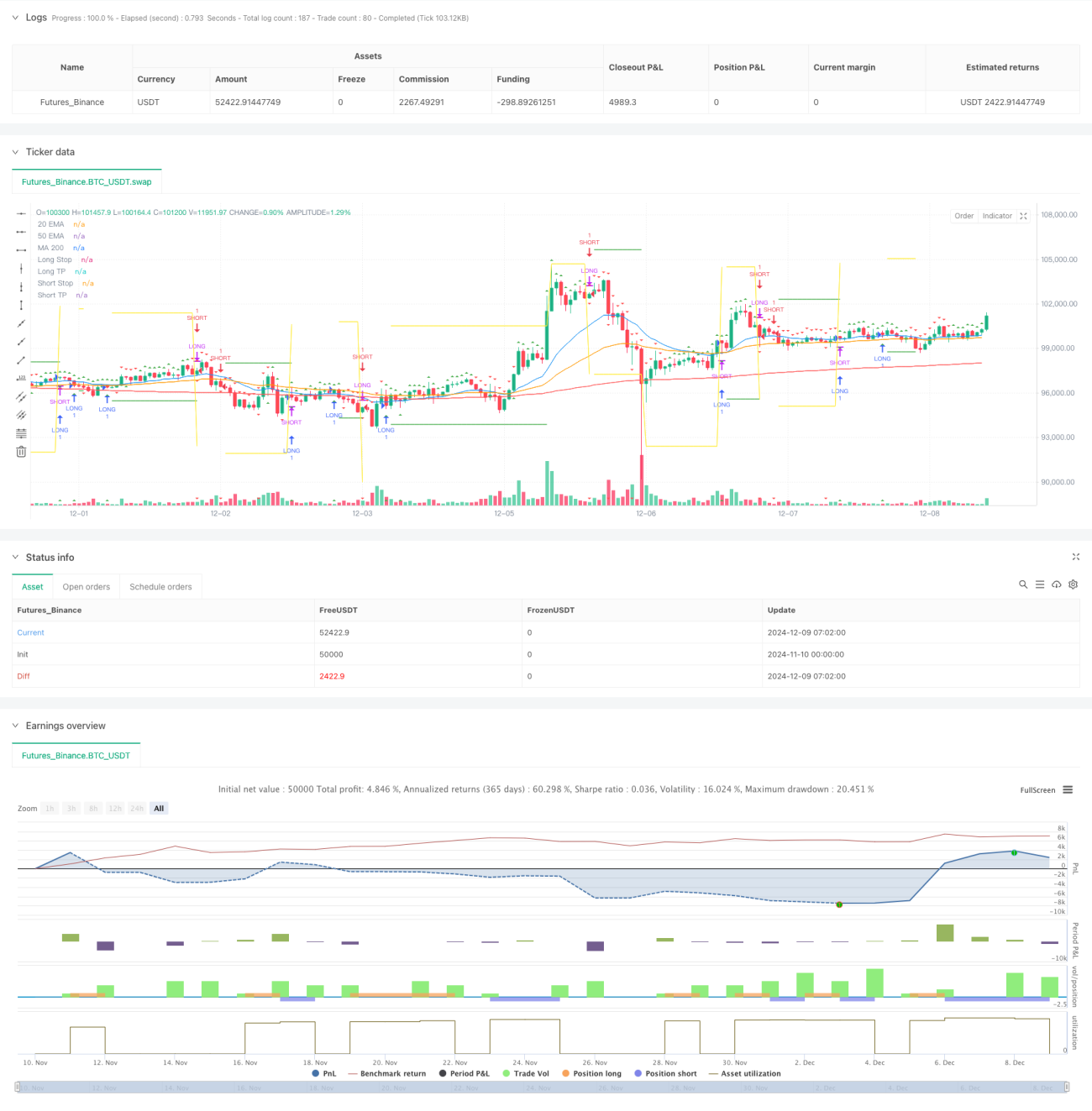
Overview
This strategy is a dynamic trading system based on multi-timeframe analysis, combining Exponential Moving Averages (EMA), Squeeze Momentum Indicator (SQM), and Money Flow Index (CMF) for signal generation. The core concept involves trend confirmation through multiple time frames and dynamic stop-loss optimization for risk management. The strategy employs an adaptive stop-loss and profit-taking scheme that automatically adjusts trading parameters based on market volatility.
Strategy Principles
The strategy utilizes three main technical indicators to identify trading opportunities. First, it uses 11-period and 34-period EMAs to determine market trend direction. Second, it employs a modified Squeeze Momentum indicator to detect market pressure and potential breakout opportunities, calculated through linear regression of price deviations. Finally, it confirms trade direction through a modified Money Flow indicator, ensuring sufficient capital supports price movements. The strategy sets dynamic stop-loss levels after signal confirmation, which automatically adjust as profits increase, protecting gains while allowing for price fluctuations.
Strategy Advantages
- Multi-dimensional signal confirmation: Significantly reduces false signals through the integration of multiple technical indicators and timeframes.
- Intelligent risk management: Dynamic stop-loss system automatically adjusts based on market volatility, protecting profits while avoiding premature exits.
- High adaptability: Strategy parameters can be adjusted for different market conditions.
- Complete trading cycle: Clear rules from entry to exit management reduce subjective judgment influence.
- Money flow confirmation: Validates price trends through money flow monitoring, improving trade reliability.
Strategy Risks
- Parameter sensitivity: Multiple technical indicator parameters require careful optimization.
- Market environment dependence: Signal quality may be affected in highly volatile or low-liquidity markets.
- Computational complexity: Multi-timeframe calculations may cause signal delays.
- Stop-loss adjustment risk: Dynamic stops may become too aggressive or conservative in certain market conditions.
- Capital management requirements: Strategy needs proper fund management to balance risk and reward.
Optimization Directions
- Introduce volatility adaptation: Dynamically adjust parameters based on ATR or other volatility indicators.
- Optimize signal filtering: Add volume weighting or time filtering to improve signal quality.
- Improve stop-loss mechanism: Optimize stop-loss placement using support and resistance levels.
- Enhanced market environment analysis: Introduce trend strength indicators for different market conditions.
- Refined capital management: Implement position sizing algorithms based on signal strength and market volatility.
Summary
This strategy offers traders a systematic trading approach through multi-dimensional technical analysis and intelligent risk management. Its core strength lies in combining trend following with dynamic risk management, capturing market opportunities while protecting profits. While there are aspects requiring optimization, the strategy can serve as an effective trading tool with proper parameter settings and risk control. Traders are advised to conduct thorough backtesting and parameter optimization before live implementation, gradually refining the trading system based on market experience.
- 1