
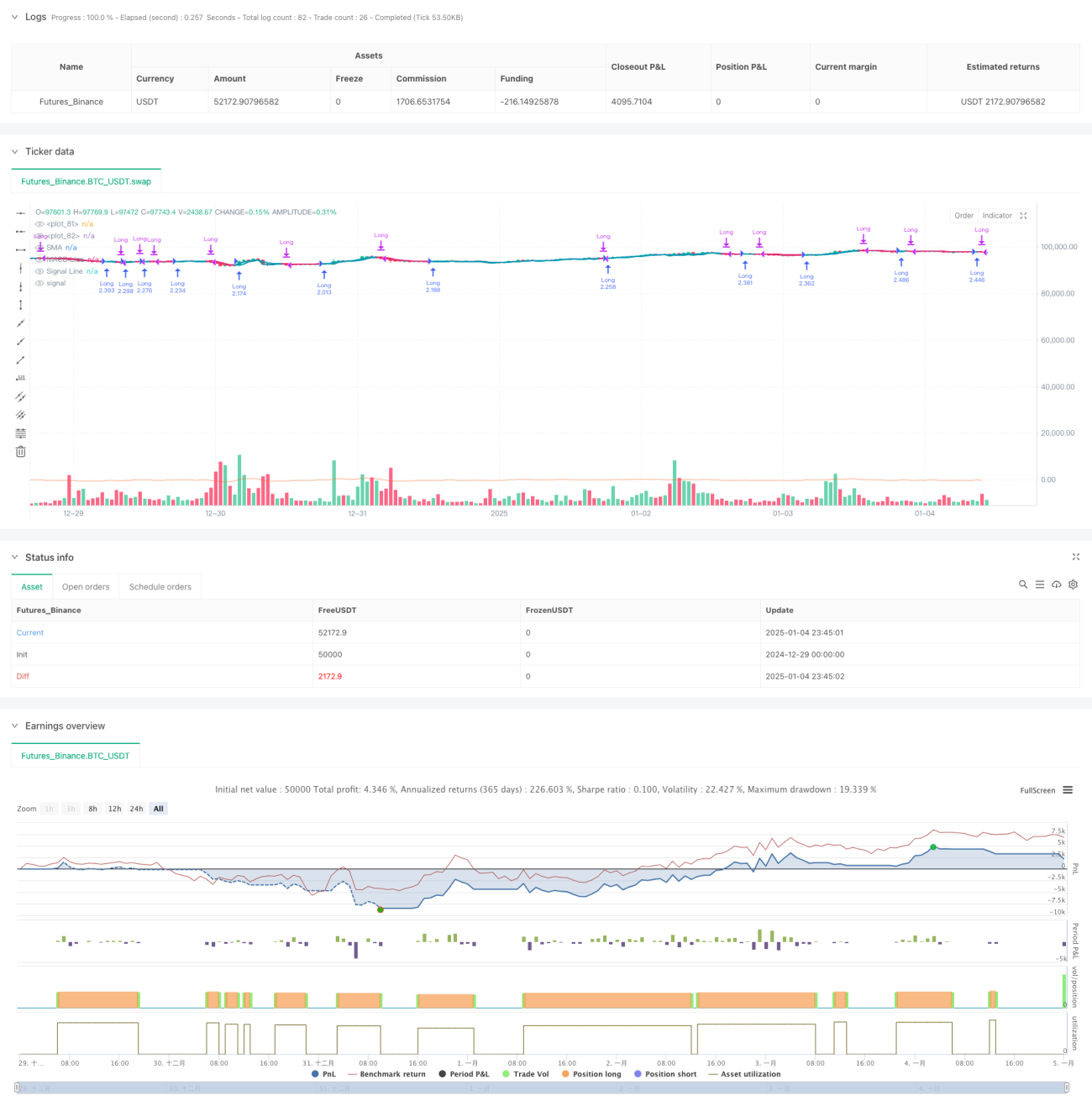
Overview
This strategy is an adaptive trend following system based on multiple technical indicator filters. It combines various technical indicators including Exponential Moving Average (EMA), Simple Moving Average (SMA), and Moving Average Convergence Divergence (MACD), dynamically adjusting parameters to adapt to different market environments for efficient trend capture and risk control. The strategy employs a layered filtering mechanism, significantly improving the reliability of trading signals through the synergistic combination of multiple technical indicators.
Strategy Principle
The core logic is based on a three-layer filtering mechanism:
- Adaptive Trend Recognition Layer: Uses a combination of fast and slow EMAs to calculate the trend baseline and dynamically adjusts upper and lower channel lines based on market volatility.
- SMA Filter Layer: Ensures price movement direction aligns with the overall trend using Simple Moving Average.
- MACD Confirmation Layer: Further validates trading signals using MACD indicator's trend confirmation functionality.
Trade signal generation requires all filter conditions to be met: trend transition, SMA direction confirmation, and MACD signal line support. The strategy also includes a dynamic position management system based on account equity, automatically adjusting position size through a leverage factor.
Strategy Advantages
- Strong Adaptability: Strategy can adapt to different market environments through dynamic parameter adjustment.
- Comprehensive Risk Control: Multiple filtering mechanisms significantly reduce the probability of false signals.
- High Customizability: Users can adjust various parameters according to personal trading style.
- High Automation Level: Supports JSON format alert messages for easy integration with automated trading systems.
- Good Visualization: Provides rich visual feedback including trend bands and signal markers.
Strategy Risks
- Trend Dependency: May generate frequent false signals in oscillating markets.
- Lag Risk: Multiple filtering mechanisms may lead to delayed entry timing.
- Parameter Sensitivity: Different parameter combinations may result in significant strategy performance variations.
- Leverage Risk: Excessive leverage may amplify losses.
Strategy Optimization Directions
- Volatility Adaptation: Add dynamic stop-loss mechanism based on ATR.
- Market Environment Recognition: Add market state classification system to use different parameter combinations in different market environments.
- Signal Quality Scoring: Establish signal strength scoring system to dynamically adjust positions based on signal strength.
- Capital Management Optimization: Introduce more sophisticated money management algorithms for more precise position control.
Summary
The strategy achieves relatively reliable trend following through multi-layer filtering mechanisms and dynamic parameter adjustment. Although there are certain risks of lag and parameter dependency, stable performance can still be achieved in actual trading through reasonable parameter optimization and risk control measures. Traders are recommended to thoroughly backtest and adjust parameter settings according to individual risk tolerance before live trading.
/*backtest
start: 2024-12-29 00:00:00
end: 2025-01-05 00:00:00
period: 45m
basePeriod: 45m
exchanges: [{"eid":"Futures_Binance","currency":"BTC_USDT"}]
*/

//@version=6
strategy("Adaptive Trend Flow Strategy with Filters for SPX", overlay=true, max_labels_count=500,
     initial_capital=1000, commission_type=strategy.commission.cash_per_order, commission_value=0.01, slippage=2,
margin_long=20, margin_short=20, default_qty_type=strategy.percent_of_equity, default_qty_value=100)- 1