
Overview
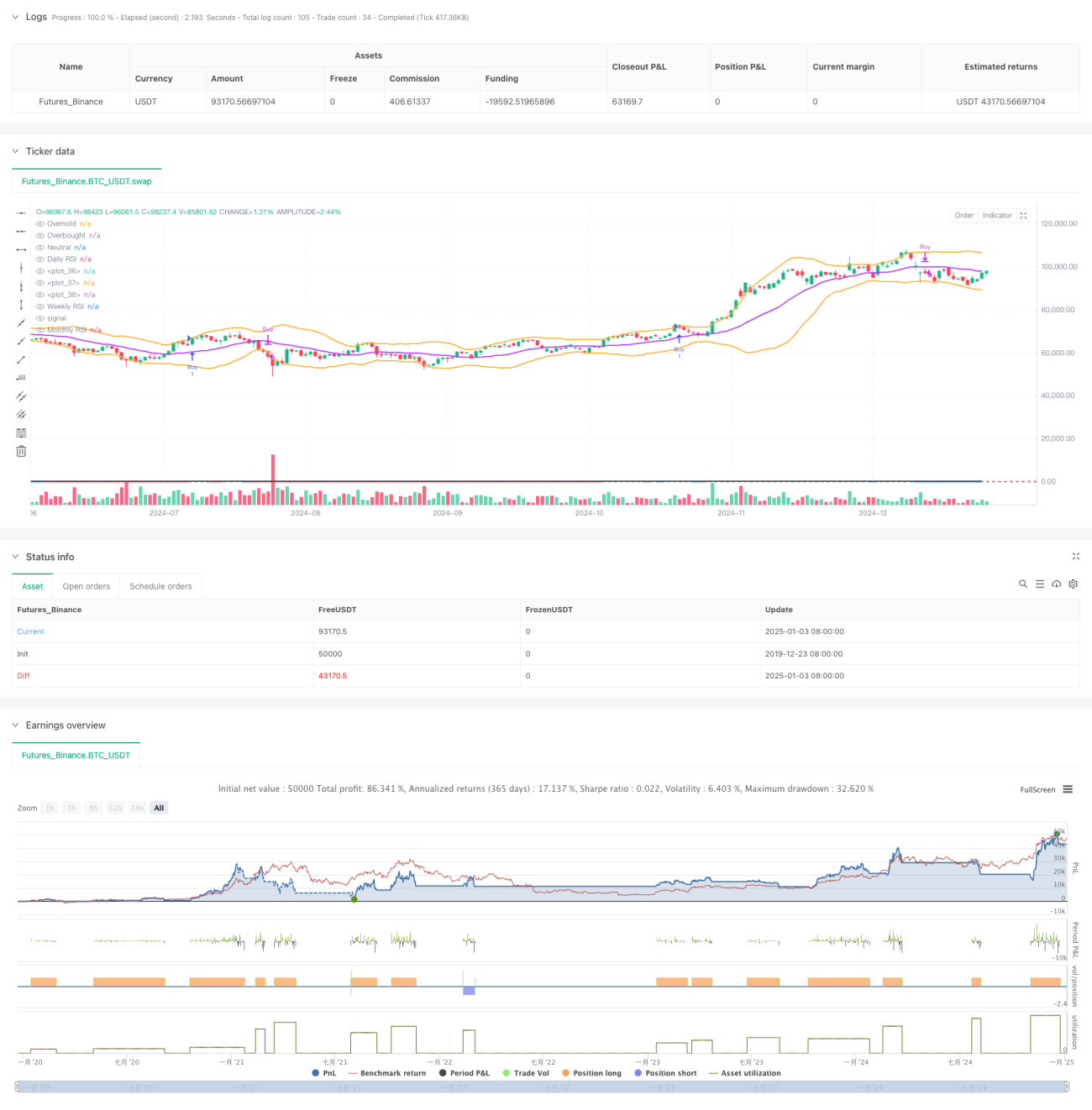
This strategy is a comprehensive trading system that combines multiple indicators, primarily based on Exponential Moving Averages (EMA), Supertrend indicator, Bollinger Bands (BB), and Relative Strength Index (RSI). The core logic builds trading signals around EMA and Supertrend, while incorporating BB and RSI for supplementary analysis of market volatility and momentum. The system employs multi-timeframe RSI analysis, including daily, weekly, and monthly periods, providing a more comprehensive market perspective for trading decisions.
Strategy Principles
The strategy utilizes a multi-layer technical indicator combination to capture market trends and volatility opportunities:
- Uses triple EMA (13,34,100) to establish a trend-following system, determining trend direction through crossovers and relative positions
- Integrates Supertrend indicator for trend confirmation and stop-loss reference
- Employs ADX indicator to filter strong trends, setting 25 as the trend strength threshold
- Utilizes Bollinger Bands (20,2) to monitor price volatility range
- Implements triple-timeframe RSI (14) to analyze market overbought/oversold conditions
Trading signal triggers:
- Long Entry: Supertrend turns bullish + EMA13 crosses above EMA34 + price above EMA100 + ADX>25
- Short Entry: Supertrend turns bullish + EMA13 crosses below EMA34 + price below EMA100 + ADX>25
- Exit Signals: Price crosses Supertrend for respective position exits
Strategy Advantages
- Integration of multiple technical indicators provides more reliable trading signals, effectively reducing false signals
- Triple EMA system captures trend characteristics across different timeframes
- ADX incorporation ensures trading only in strong trend markets
- Multi-timeframe RSI analysis offers comprehensive market momentum assessment
- Supertrend indicator provides objective stop-loss reference points
- Bollinger Bands integration aids in determining market volatility states and potential breakout opportunities
Strategy Risks
- Multiple indicator system may lead to lagging signals, affecting entry timing
- May generate frequent false breakout signals in ranging markets
- Fixed ADX threshold may perform inconsistently across different market environments
- Rapid market volatility may result in suboptimal stop-loss placement
Risk control suggestions:
- Dynamically adjust ADX threshold based on market characteristics
- Introduce volatility-adaptive stop-loss mechanism
- Add volume analysis for signal confirmation
Strategy Optimization Directions
- Indicator Parameter Optimization
- Consider introducing adaptive EMA periods
- Dynamically adjust Supertrend multiplier based on volatility
- Optimize Bollinger Bands parameters for different market phases
- Signal System Enhancement
- Integrate volume factors for trade signal verification
- Add market structure analysis
- Implement volatility filters
- Risk Management Improvement
- Design dynamic stop-loss mechanism
- Establish position sizing system
- Add trading time filters
Summary
This strategy constructs a relatively complete trading system through the organic combination of multiple technical indicators. EMA and Supertrend cooperation provides primary trading signals, ADX filtering ensures trading occurs in strong trend environments, while Bollinger Bands and RSI auxiliary analysis provides additional market perspectives. The strategy's main advantages lie in signal reliability and system completeness, but it also faces challenges in signal lag and parameter optimization. Through the proposed optimization directions, the strategy has the potential to enhance profitability while maintaining stability.
- 1