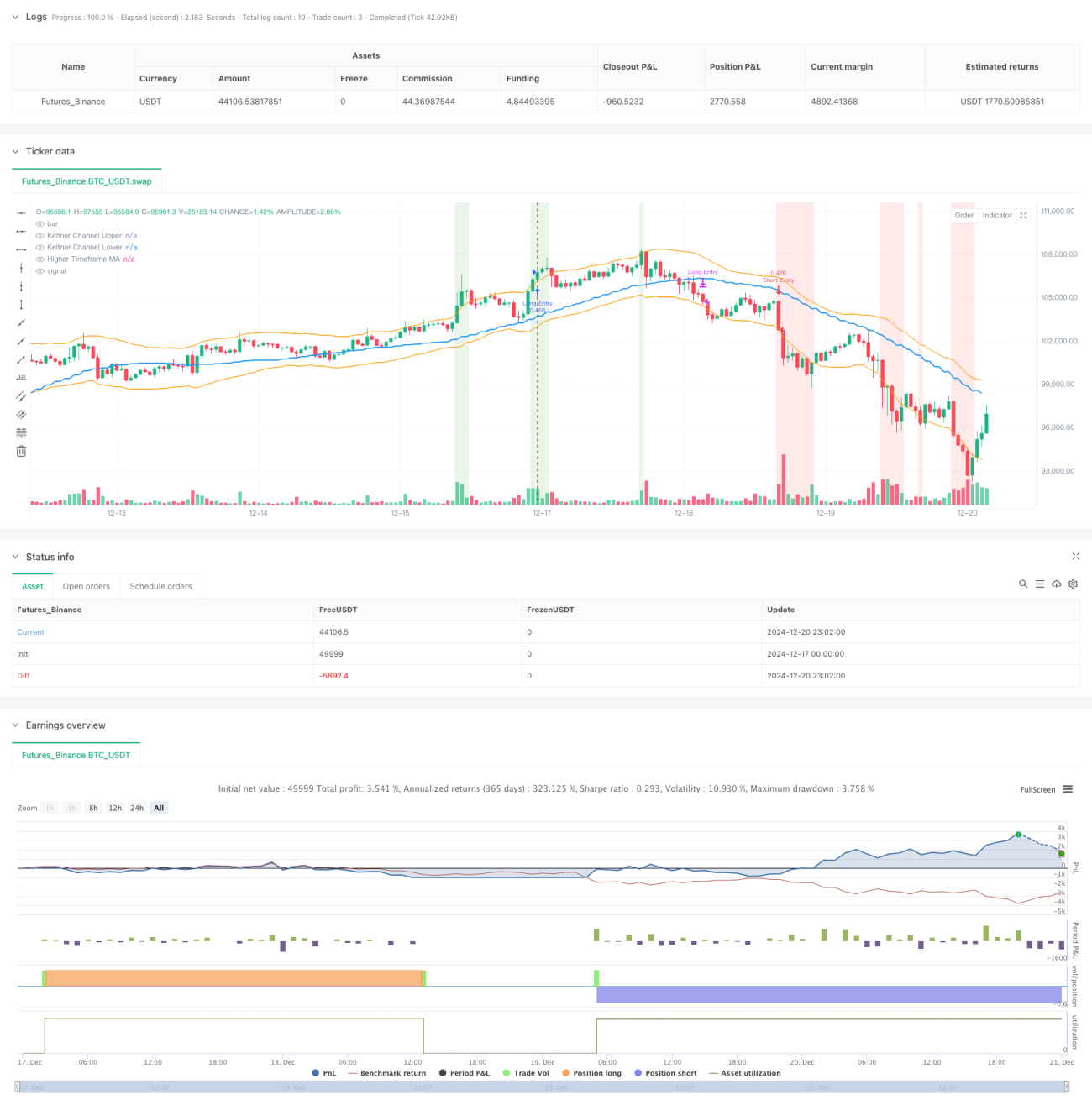
This strategy is a comprehensive trading system based on Keltner Channels and dynamic support/resistance levels. It analyzes multiple timeframes, combining moving averages and volatility indicators to form a complete trading decision framework. The core approach is to identify price breakout opportunities while considering market trends and volatility to capture high-probability trading opportunities.
The strategy employs a multi-layer technical indicator system: 1. Uses 21-period Keltner Channels as the primary trend identification tool, with channel width determined by ATR 2. Calculates key support/resistance levels using 21 left-side and 8 right-side bars 3. Incorporates higher timeframe moving averages as trend filters 4. Combines short-term (5-period) and long-term (30-period) moving averages for entry timing 5. Uses ATR for dynamic stop-loss adjustment
This is a well-structured and logically rigorous quantitative trading strategy. Through the coordinated use of multiple technical indicators, it ensures both reliable trading signals and effective risk control. The strategy’s strong extensibility allows for continuous optimization and improvement, potentially maintaining stable performance across different market environments.
/*backtest
start: 2024-12-17 00:00:00
end: 2024-12-21 00:00:00
period: 1h
basePeriod: 1h
exchanges: [{"eid":"Futures_Binance","currency":"BTC_USDT","balance":49999}]
*/
// This Pine Script™ code is subject to the terms of the Mozilla Public License 2.0 at https://mozilla.org/MPL/2.0/
// © sathcm
//@version=5
strategy("KMS", overlay=true, initial_capital=100000, default_qty_type=strategy.percent_of_equity, default_qty_value=100, commission_type=strategy.commission.percent, commission_value=0.05, slippage=3)
// Inputs for Keltner Channels
kcLength = input.int(21, title="Keltner Channel Length", minval=1) // Length for Keltner Channel calculation
kcMultiplier = input.float(2.0, title="Keltner Channel Multiplier", minval=0.1) // Multiplier for Keltner Channel width
// Calculate Keltner Channels using best practices
kcBasis = ta.ema(close, kcLength) // Use EMA for a smoother basis line
atrValue = ta.atr(kcLength) // Use ATR for channel width calculation
kcUpper = kcBasis + kcMultiplier * atrValue // Upper Keltner Channel
kcLower = kcBasis - kcMultiplier * atrValue // Lower Keltner Channel
// Inputs for Pivot Point Calculation
leftBars = input.int(21, title="Left Bars", minval=1) // Number of bars to the left for pivot calculation
rightBars = input.int(8, title="Right Bars", minval=1, tooltip="Number of bars to the right for pivot calculation") // Number of bars to the right for pivot calculation
// Calculate Smoothed Pivot Highs and Lows using Weighted Moving Average
pivotHigh = ta.pivothigh(high, leftBars, rightBars) // Apply WMA for smoothing
pivotLow = ta.pivotlow(low, leftBars, rightBars) // Apply WMA for smoothing
// Convert Pivot Highs and Lows to Boolean Conditions
isPivotHigh = not na(pivotHigh) // True when a pivot high exists
isPivotLow = not na(pivotLow) // True when a pivot low exists
// Get Recent Support and Resistance Levels
recentResistance = ta.valuewhen(isPivotHigh, high, 0) // Most recent resistance level
recentSupport = ta.valuewhen(isPivotLow, low, 0) // Most recent support level
// Plot Smoothed Support and Resistance Levels
//plot(recentResistance, color=color.red, title="Recent Resistance", linewidth=2, style=plot.style_line)
//plot(recentSupport, color=color.green, title="Recent Support", linewidth=2, style=plot.style_line)
// Store Entry Price into a Variable
var float entryPrice = na // Declare a variable to store the entry price
// Input for Higher Timeframe
higherTimeframeInput = input.timeframe('W', title="Higher Timeframe for MA Calculation")
if (timeframe.period == "240") or (timeframe.period == "120")
higherTimeframeInput := "D"
if (timeframe.period == "60") or (timeframe.period == "30") or (timeframe.period == "15")
higherTimeframeInput := "120"
if (timeframe.period == "10") or (timeframe.period == "5")
higherTimeframeInput := "30"
if (timeframe.period == "1")
higherTimeframeInput := "10"
prd = input.int(defval=10, title='Pivot Period', minval=4, maxval=30, group='Settings 🔨', tooltip='Used while calculating Pivot Points, checks left&right bars')
ppsrc = input.string(defval='High/Low', title='Source', options=['High/Low', 'Close/Open'], group='Settings 🔨', tooltip='Source for Pivot Points')
ChannelW = input.int(defval=5, title='Maximum Channel Width %', minval=1, maxval=8, group='Settings 🔨', tooltip='Calculated using Highest/Lowest levels in 300 bars')
minstrength = input.int(defval=1, title='Minimum Strength', minval=1, group='Settings 🔨', tooltip='Channel must contain at least 2 Pivot Points')
maxnumsr = input.int(defval=4, title='Maximum Number of S/R', minval=1, maxval=10, group='Settings 🔨', tooltip='Maximum number of Support/Resistance Channels to Show') - 1
loopback = input.int(defval=150, title='Loopback Period', minval=100, maxval=400, group='Settings 🔨', tooltip='While calculating S/R levels it checks Pivots in Loopback Period')
res_col = input.color(defval=color.new(color.red, 75), title='Resistance Color', group='Colors 🟡🟢🟣')
sup_col = input.color(defval=color.new(color.lime, 75), title='Support Color', group='Colors 🟡🟢🟣')
inch_col = input.color(defval=color.new(color.gray, 75), title='Color When Price in Channel', group='Colors 🟡🟢🟣')
// Get Pivot High/Low
src1 = ppsrc == 'High/Low' ? high : math.max(close, open)
src2 = ppsrc == 'High/Low' ? low : math.min(close, open)
ph = ta.pivothigh(src1, prd, prd)
pl = ta.pivotlow(src2, prd, prd)
// Calculate maximum S/R channel width
prdhighest = ta.highest(300)
prdlowest = ta.lowest(300)
cwidth = (prdhighest - prdlowest) * ChannelW / 100
// Get/keep Pivot levels
var pivotvals = array.new_float(0)
var pivotlocs = array.new_float(0)
if ph or pl
array.unshift(pivotvals, ph ? ph : pl)
array.unshift(pivotlocs, bar_index)
for x = array.size(pivotvals) - 1 to 0 by 1
if bar_index - array.get(pivotlocs, x) > loopback // remove old pivot points
array.pop(pivotvals)
array.pop(pivotlocs)
continue
break
// Find/create SR channel of a pivot point
get_sr_vals(ind) =>
float lo = array.get(pivotvals, ind)
float hi = lo
int numpp = 0
for y = 0 to array.size(pivotvals) - 1 by 1
float cpp = array.get(pivotvals, y)
float wdth = cpp <= hi ? hi - cpp : cpp - lo
if wdth <= cwidth // fits the max channel width?
if cpp <= hi
lo := math.min(lo, cpp)
else
hi := math.max(hi, cpp)
numpp += 20 // each pivot point added as 20
[hi, lo, numpp]
// Keep old SR channels and calculate/sort new channels if we met new pivot point
var suportresistance = array.new_float(20, 0) // min/max levels
changeit(x, y) =>
tmp = array.get(suportresistance, y * 2)
array.set(suportresistance, y * 2, array.get(suportresistance, x * 2))
array.set(suportresistance, x * 2, tmp)
tmp := array.get(suportresistance, y * 2 + 1)
array.set(suportresistance, y * 2 + 1, array.get(suportresistance, x * 2 + 1))
array.set(suportresistance, x * 2 + 1, tmp)
if ph or pl
supres = array.new_float(0) // number of pivot, strength, min/max levels
stren = array.new_float(10, 0)
// Get levels and strengths
for x = 0 to array.size(pivotvals) - 1 by 1
[hi, lo, strength] = get_sr_vals(x)
array.push(supres, strength)
array.push(supres, hi)
array.push(supres, lo)
// Add each HL to strength
for x = 0 to array.size(pivotvals) - 1 by 1
h = array.get(supres, x * 3 + 1)
l = array.get(supres, x * 3 + 2)
s = 0
for y = 0 to loopback by 1
if high[y] <= h and high[y] >= l or low[y] <= h and low[y] >= l
s += 1
array.set(supres, x * 3, array.get(supres, x * 3) + s)
// Reset SR levels
array.fill(suportresistance, 0)
// Get strongest SRs
src = 0
for x = 0 to array.size(pivotvals) - 1 by 1
stv = -1. // value
stl = -1 // location
for y = 0 to array.size(pivotvals) - 1 by 1
if array.get(supres, y * 3) > stv and array.get(supres, y * 3) >= minstrength * 20
stv := array.get(supres, y * 3)
stl := y
if stl >= 0
// Get SR level
hh = array.get(supres, stl * 3 + 1)
ll = array.get(supres, stl * 3 + 2)
array.set(suportresistance, src * 2, hh)
array.set(suportresistance, src * 2 + 1, ll)
array.set(stren, src, array.get(supres, stl * 3))
// Make included pivot points' strength zero
for y = 0 to array.size(pivotvals) - 1 by 1
if array.get(supres, y * 3 + 1) <= hh and array.get(supres, y * 3 + 1) >= ll or array.get(supres, y * 3 + 2) <= hh and array.get(supres, y * 3 + 2) >= ll
array.set(supres, y * 3, -1)
src += 1
if src >= 10
break
for x = 0 to 8 by 1
for y = x + 1 to 9 by 1
if array.get(stren, y) > array.get(stren, x)
tmp = array.get(stren, y)
array.set(stren, y, array.get(stren, x))
changeit(x, y)
get_level(ind) =>
float ret = na
if ind < array.size(suportresistance)
if array.get(suportresistance, ind) != 0
ret := array.get(suportresistance, ind)
ret
get_color(ind) =>
color ret = na
if ind < array.size(suportresistance)
if array.get(suportresistance, ind) != 0
ret := array.get(suportresistance, ind) > close and array.get(suportresistance, ind + 1) > close ? res_col : array.get(suportresistance, ind) < close and array.get(suportresistance, ind + 1) < close ? sup_col : inch_col
ret
// var srchannels = array.new_box(10)
// for x = 0 to math.min(9, maxnumsr) by 1
// box.delete(array.get(srchannels, x))
// srcol = get_color(x * 2)
// if not na(srcol)
// array.set(srchannels, x, box.new(left=bar_index, top=get_level(x * 2), right=bar_index + 1, bottom=get_level(x * 2 + 1), border_color=srcol, border_width=1, extend=extend.both, bgcolor=srcol))
// Improved dynamic support detection
float recentSupport1 = na
float previousSupport = na
float currentsupport = na
if na(previousSupport) or currentsupport != previousSupport
if array.size(suportresistance) > 1
for i = 0 to math.floor(array.size(suportresistance) / 2) - 1 // Iterate through support levels
currentsupport := array.get(suportresistance, i * 2 + 1) // Support is stored at odd indices
if currentsupport < close and (na(recentSupport1) or math.abs(close - currentsupport) < math.abs(close - recentSupport1))
previousSupport := currentsupport // Store the newly detected support
// Set the most recent support to the new support
recentSupport1 := na(recentSupport1) ? ta.lowest(low, 10) : currentsupport
// Moving averages for entry and exit
maShort = ta.sma(close, 5)
maLong = ta.sma(close, 30) + ta.atr(14)
// Track entry price
entryPrice1 = strategy.position_avg_price // Get the price of the currently open position
currentTimeFrame = timeframe.period
exitPrice = entryPrice1 * 0.99
if currentTimeFrame == "1H" or currentTimeFrame == "30" or currentTimeFrame == "15" or currentTimeFrame == "5"
exitPrice := entryPrice1 * 0.99 // Set the exit price at 99% of the entry price
if currentTimeFrame == "120" or currentTimeFrame == "180" or currentTimeFrame == "240" or currentTimeFrame == "D"
exitPrice := entryPrice1 * 0.98 // Set the exit price at 95% of the entry price
// Calculate Moving Average based on higher timeframe for length of 20 bars
higherTimeframeMA = request.security(syminfo.tickerid, higherTimeframeInput, ta.sma(close, 20), barmerge.gaps_off, barmerge.lookahead_on) // Calculate MA with adjusted timeframe
// Entry and Exit Conditions for Long
entryLong = (close > kcUpper) and (close > recentResistance) and (close > higherTimeframeMA) // Long entry when price breaks above KC upper, recent resistance, and higher timeframe MA
exitLong = (close < recentResistance - 1.5*atrValue) // Long exit when price falls below recent resistance with cushion of one ATR
// Entry and Exit Conditions for Short
entryShort = (close < kcLower) and (close < recentSupport) and (close < higherTimeframeMA+atrValue) // Add RSI filter to reduce false signals by confirming momentum // Short entry when price breaks below KC lower, recent support, and higher timeframe MA
exitShort = (close > recentSupport + atrValue) // Short exit when price rises above recent support with cushion of one ATR(close > recentSupport + atrValue) // Short exit when price rises above recent support with cushion of one ATR(close > recentSupport + atrValue) // Short exit when price rises above recent support with cushion of one ATR
// Strategy Execution for Long
if not na(recentSupport1) and (close <= recentSupport1 +(close*0.01) or close >= recentSupport1 - (close*0.0075)) and (maShort > maLong) and entryLong
strategy.entry("Long Entry", strategy.long)
//entryPrice := strategy.position_avg_price // Store the entry price when a position is opened
if ((maShort < maLong + 3*ta.atr(14)) or close < exitPrice) and exitLong
strategy.close("Long Entry")
// Strategy Execution for Short
if entryShort
strategy.entry("Short Entry", strategy.short)
entryPrice := strategy.position_avg_price // Store the entry price when a position is opened
if exitShort
strategy.close("Short Entry")
// Plot Keltner Channels
plot(kcUpper, color=color.orange, title="Keltner Channel Upper", linewidth=1)
plot(kcLower, color=color.orange, title="Keltner Channel Lower", linewidth=1)
// Plot Moving Averages
plot(higherTimeframeMA, color=color.blue, title="Higher Timeframe MA", linewidth=2)
//plot(recentSupport1, color=#04313f, title="Recent Support1")
//plot(recentResistance, color=color.purple, title="Recent Resistance")
//plot(entryPrice1, color=color.lime, title="Entry Price 1")
//plot(exitPrice, color=color.maroon, title="Exit Price")
//plot(maShort, color=color.green, title="MA Short")
//plot(maLong, color=color.blue, title="MA Long Plus ATR")
// Highlight Entry Zones
bgcolor(entryLong ? color.new(color.green, 85) : na, title="Long Entry Zone")
bgcolor(entryShort ? color.new(color.red, 85) : na, title="Short Entry Zone")
// Alerts
alertcondition(entryLong, title="Long Entry", message="Price broke above the Keltner Channel and recent resistance for Long Entry")
alertcondition(exitLong, title="Long Exit", message="Price fell below recent resistance with cushion of one ATR - Long Exit")
alertcondition(entryShort, title="Short Entry", message="Price broke below the Keltner Channel and recent support for Short Entry")
alertcondition(exitShort, title="Short Exit", message="Price rose above recent support with cushion of one ATR - Short Exit")