Dual EMA and Stochastic RSI Trend Following Strategy

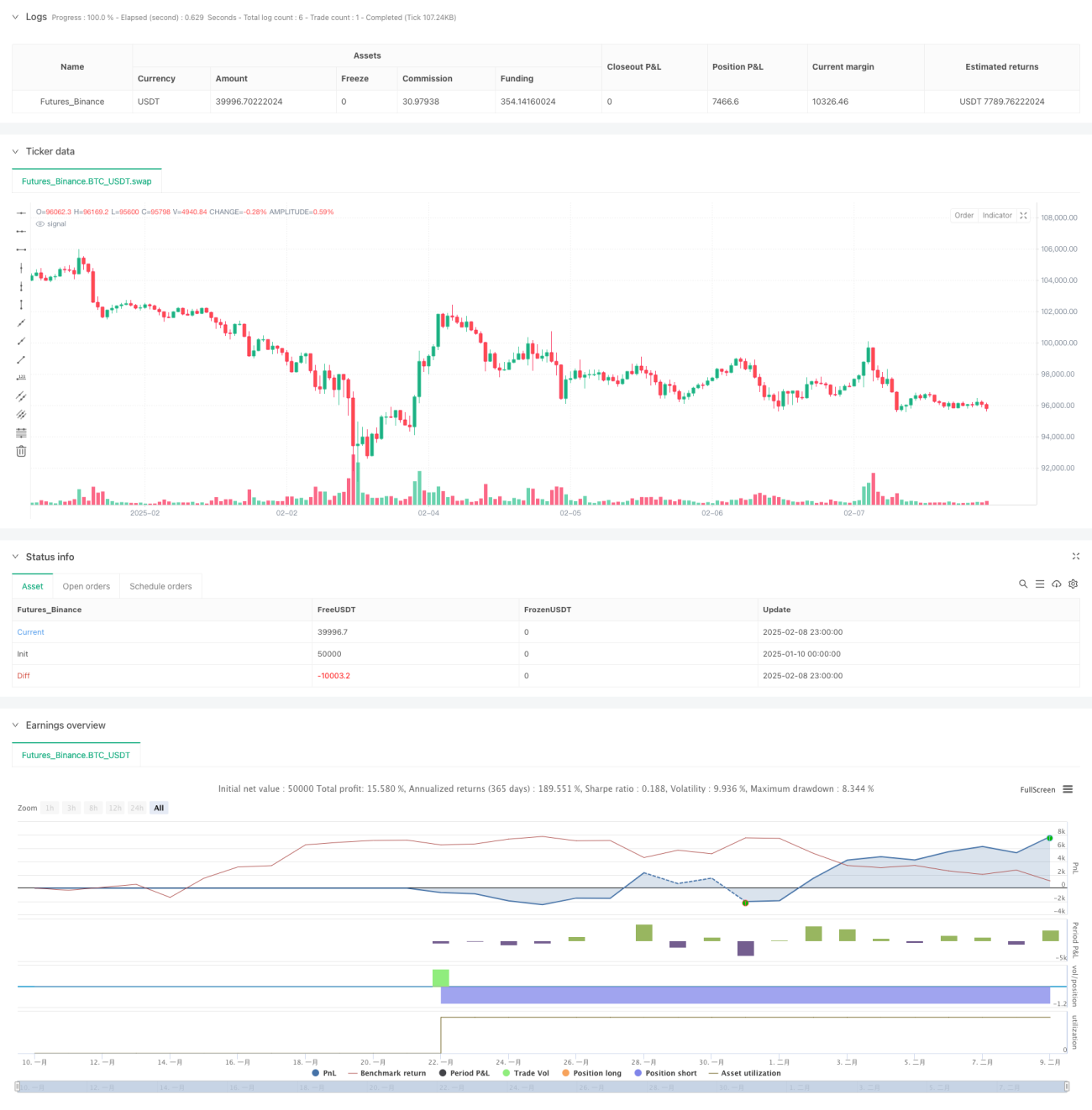
Overview
This is a trend-following strategy that combines Exponential Moving Averages (EMA) with Stochastic Relative Strength Index (Stochastic RSI). The strategy identifies high-probability trading opportunities by analyzing price trends and overbought/oversold conditions. It utilizes EMA 9 and EMA 21 crossovers to determine trend direction while using Stochastic RSI for market state confirmation to enhance signal quality.
Strategy Principles
The core logic is based on the combination of two main technical indicators:
- Dual EMA System: Uses 9-period and 21-period Exponential Moving Averages to identify trends. Long signals are generated when the fast EMA(9) crosses above the slow EMA(21), and vice versa for short signals.
- Stochastic RSI: Identifies overbought and oversold areas by calculating the stochastic oscillator of RSI values. It first calculates a 14-period RSI, converts it to stochastic form, and then smooths it with a 3-period Simple Moving Average (SMA).
Trading signal conditions:
- Long Entry: EMA 9 crosses above EMA 21 and Stochastic RSI is below the oversold threshold (20)
- Short Entry: EMA 9 crosses below EMA 21 and Stochastic RSI is above the overbought threshold (80)
- Exit: When opposite trading signals occur
Strategy Advantages
- Signal Confirmation: Reduces false breakout risks by combining trend and momentum indicators
- Flexible Parameters: Allows traders to adjust EMA periods and Stochastic RSI parameters for different market conditions
- Clear Visualization: Displays EMAs directly on the price chart and Stochastic RSI in a separate panel for easy analysis
- Risk Management: Includes basic stop-loss and profit-taking mechanisms
- Dual Filtering: Uses trend and overbought/oversold indicators as double filters to improve trade quality
Strategy Risks
- Trend Reversal Risk: False EMA crossover signals may occur in highly volatile markets
- Lag Issues: Moving averages are inherently lagging indicators, potentially leading to delayed entries
- Sideways Market Risk: May generate frequent false signals in markets without clear trends
- Parameter Sensitivity: Different parameter settings can lead to significantly different results
- Market Environment Dependency: Strategy performs well in trending markets but may underperform in ranging markets
Strategy Optimization
- Volatility Filter: Add ATR indicator to filter trades in low volatility environments
- Stop Loss Enhancement: Implement trailing stops for better profit protection
- Time Filter: Add trading time windows to avoid low liquidity periods
- Volume Confirmation: Consider volume factors when generating trading signals
- Adaptive Parameters: Implement dynamic parameter adjustment based on market conditions
Summary
This is a well-structured trend-following strategy with rigorous logic. By combining EMA and Stochastic RSI, the strategy achieves a good balance in identifying trends and market conditions. While there are inherent risks, the strategy can maintain stable performance across various market environments through proper parameter optimization and risk management. Traders are advised to conduct thorough backtesting and adjust parameters according to specific market characteristics before live trading.
- 1