Trend Momentum Strategy - Multi-Period Dynamic ZigZag Wave Timing System

SL TP PH PL
Created on: 2025-02-18 13:29:06 Modified on: 2025-02-18 13:29:06
Copy: 1 Number of hits: 343
avatar of ChaoZhang ChaoZhang
1
Follow
1617
Followers

 Trend Momentum Strategy - Multi-Period Dynamic ZigZag Wave Timing System

Overview

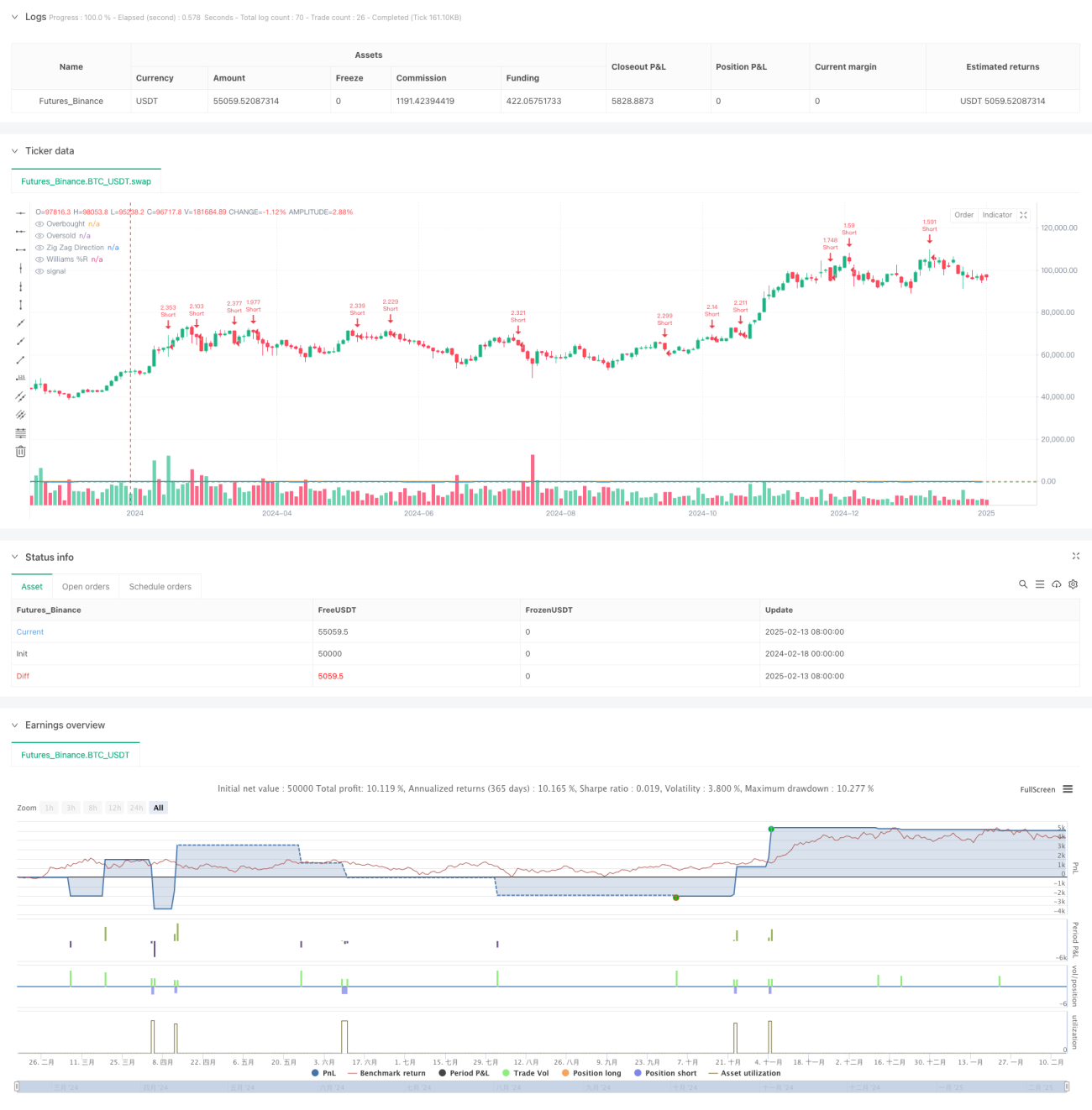
This strategy is a multi-dimensional trading system that combines the ZigZag indicator with the Williams %R indicator. It identifies significant swing highs and lows using the ZigZag indicator while confirming entry points with the Williams %R when the market reaches overbought or oversold conditions. This combination captures major market trend reversals while using momentum confirmation to improve trading accuracy.

Strategy Principles

The core logic is based on two main components: 1. The ZigZag indicator identifies significant swing points using depth and deviation parameters to filter market noise and determine trend direction. A new swing low indicates the start of an uptrend, while a new swing high indicates the start of a downtrend. 2. The Williams %R indicator calculates market momentum by comparing current price to the highest price within a specific period. Values crossing above -80 indicate oversold conditions (potential buy), while crossing below -20 indicate overbought conditions (potential sell).

Trading rules are as follows: - Long Entry: ZigZag identifies a new swing low and Williams %R crosses up from oversold zone - Short Entry: ZigZag identifies a new swing high and Williams %R crosses down from overbought zone - Stop Loss is set at 1% and Take Profit at 2%

Strategy Advantages

  1. Multi-dimensional confirmation: Improved signal reliability through trend and momentum verification
  2. Strong adaptability: ZigZag deviation parameters can be dynamically adjusted based on market volatility
  3. Comprehensive risk control: Fixed percentage stop-loss and take-profit strategy controls risk per trade
  4. Excellent visualization: Clear display of trading signals through labels and graphics for analysis and optimization

Strategy Risks

  1. Choppy market risk: May generate frequent false breakout signals in sideways markets
  2. Slippage risk: Potentially significant slippage in fast-moving markets
  3. Parameter sensitivity: Strategy performance heavily depends on indicator parameter selection
  4. Signal lag: May miss some quick moves due to the need for new swing point confirmation

Optimization Directions

  1. Add market environment filtering: Incorporate volatility indicators to identify market conditions and use different parameters accordingly
  2. Dynamic stop-loss optimization: Adjust stop-loss positions based on ATR or volatility
  3. Volume confirmation integration: Add volume verification when generating signals
  4. Time filtering: Add trading time period filters to avoid highly volatile sessions

Summary

This is a complete trading system combining trend following and momentum trading. Through the synergy of multiple technical indicators, it maintains a high win rate while effectively controlling risk. Although there is some lag, stable trading results can be achieved through proper parameter optimization and risk management. The strategy is particularly suitable for medium to long-term trend markets and performs better when there are clear directional opportunities.

Strategy source code
/*backtest
start: 2024-02-18 00:00:00
end: 2025-02-15 08:00:00
period: 2d
basePeriod: 2d
exchanges: [{"eid":"Futures_Binance","currency":"BTC_USDT"}]
*/

//@version=6
strategy("Zig Zag + Williams %R Strategy", overlay=true, default_qty_type=strategy.percent_of_equity, default_qty_value=300)

// ====================
// === Parameters
// ====================

// Zig Zag parameters
zigzag_depth = input.int(5, title="Zig Zag Depth", minval=1)
zigzag_deviation = input.float(1.0, title="Zig Zag Deviation (%)", minval=0.1, step=0.1)

// Williams %R parameters
williams_length = input.int(14, title="Williams %R Length", minval=1)
williams_overbought = input.int(-20, title="Williams %R Overbought", minval=-100, maxval=0)
williams_oversold = input.int(-80, title="Williams %R Oversold", minval=-100, maxval=0)

// ====================
// === Zig Zag Calculation
// ====================

// Initialize variables
var float last_pivot_high = na
var float last_pivot_low = na
var int zz_dir = 0  // 1 for uptrend, -1 for downtrend

// Calculate pivots
pivot_high = ta.pivothigh(high, zigzag_depth, zigzag_depth)
pivot_low = ta.pivotlow(low, zigzag_depth, zigzag_depth)

// Update Zig Zag direction and last pivots with deviation
if (not na(pivot_high))
    if (zz_dir != -1)  // Only change to downtrend if not already in downtrend
        if (na(last_pivot_high) or (high[zigzag_depth] > last_pivot_high * (1 + zigzag_deviation / 100)))
            last_pivot_high := high[zigzag_depth]
            zz_dir := -1
            label.new(bar_index[zigzag_depth], high[zigzag_depth], text="PH", color=color.red, style=label.style_label_down)

if (not na(pivot_low))
    if (zz_dir != 1)  // Only change to uptrend if not already in uptrend
        if (na(last_pivot_low) or (low[zigzag_depth] < last_pivot_low * (1 - zigzag_deviation / 100)))
            last_pivot_low := low[zigzag_depth]
            zz_dir := 1
            label.new(bar_index[zigzag_depth], low[zigzag_depth], text="PL", color=color.green, style=label.style_label_up)

// ====================
// === Williams %R Calculation
// ====================

// Calculate Williams %R manually
highest_high = ta.highest(high, williams_length)
lowest_low = ta.lowest(low, williams_length)
williams_r = (highest_high - close) / (highest_high - lowest_low) * -100

// ====================
// === Trade Conditions
// ====================

// Assign crossover and crossunder results to variables
crossover_williams = ta.crossover(williams_r, williams_oversold)
crossunder_williams = ta.crossunder(williams_r, williams_overbought)

// Define trade conditions
longCondition = (zz_dir == 1) and crossover_williams
shortCondition = (zz_dir == -1) and crossunder_williams

// ====================
// === Trading
// ====================

// Enter Long
if (longCondition)
    strategy.entry("Long", strategy.long)
    label.new(bar_index, low, text="BUY", color=color.green, style=label.style_label_up)

// Enter Short
if (shortCondition)
    strategy.entry("Short", strategy.short)
    label.new(bar_index, high, text="SELL", color=color.red, style=label.style_label_down)

// ====================
// === Visualization
// ====================

// Plot Zig Zag pivot shapes
plotshape(series=(not na(pivot_high) and high[zigzag_depth] == last_pivot_high), title="Swing High", location=location.abovebar, color=color.red, style=shape.triangledown, size=size.small, text="ZZ High")
plotshape(series=(not na(pivot_low) and low[zigzag_depth] == last_pivot_low), title="Swing Low", location=location.belowbar, color=color.green, style=shape.triangleup, size=size.small, text="ZZ Low")

// Plot Williams %R
hline(williams_overbought, "Overbought", color=color.red, linestyle=hline.style_dashed)
hline(williams_oversold, "Oversold", color=color.green, linestyle=hline.style_dashed)
plot(williams_r, title="Williams %R", color=color.blue)

// Debug plot for Zig Zag direction
plot(zz_dir, title="Zig Zag Direction", color=color.orange, linewidth=2)

// ====================
// === Risk Management
// ====================

// Risk parameters
stop_loss_perc = input.float(1.0, title="Stop Loss (%)") / 100
take_profit_perc = input.float(2.0, title="Take Profit (%)") / 100

// Stop Loss and Take Profit for Long
if (longCondition)
    strategy.exit("Long Exit", from_entry="Long", stop=close * (1 - stop_loss_perc), limit=close * (1 + take_profit_perc))

// Stop Loss and Take Profit for Short
if (shortCondition)
    strategy.exit("Short Exit", from_entry="Short", stop=close * (1 + stop_loss_perc), limit=close * (1 - take_profit_perc))