Trend Breakout Trading Strategy Based on Dual Moving Averages and Volume

Overview
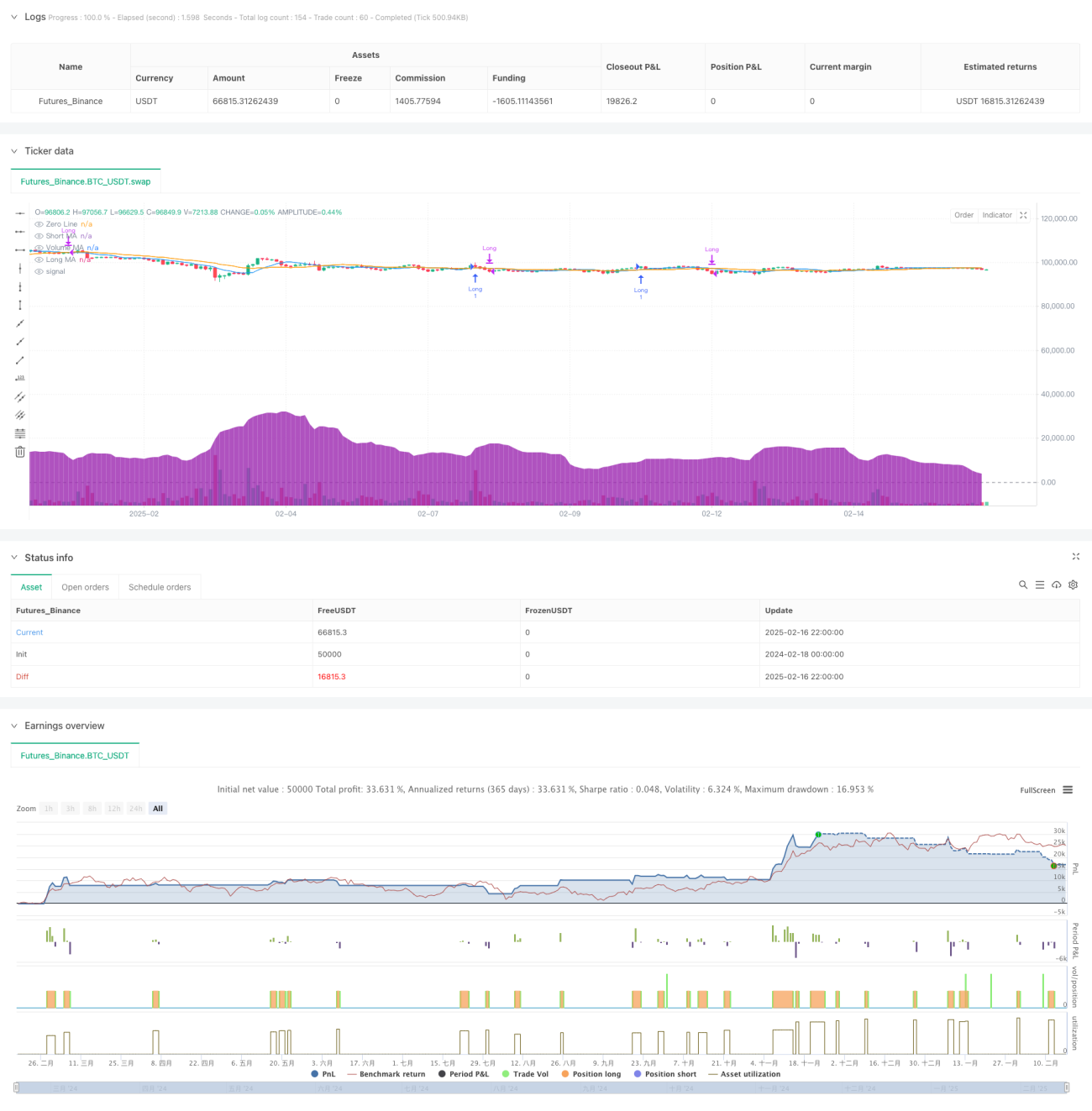
This is a long-only trend trading strategy that combines dual moving average crossover with volume analysis. The strategy makes trading decisions by comparing short-term and long-term moving average crossover signals while incorporating volume indicators. A long signal is generated when the short-term moving average crosses above the long-term moving average with significant volume expansion. The strategy also includes a stop-loss mechanism for risk control.
Strategy Principles
The core logic of the strategy is based on the following key elements:
- Dual Moving Average System: Uses 9-day and 21-day Simple Moving Averages (SMA) as signal indicators. The short-term MA represents recent price trends, while the long-term MA represents medium-term price trends.
- Volume Analysis: Uses a 20-day volume moving average to measure normal trading volume levels, requiring entry volume to be at least 1.5 times the average level and increasing compared to the previous period.
- Stop-Loss Mechanism: Sets a 2% stop-loss level from the entry price to control maximum loss per trade.
- Exit Mechanism: Automatically closes positions when the short-term MA crosses below the long-term MA.
Strategy Advantages
- Multiple Confirmation Mechanism: Improves signal reliability through dual confirmation of price trends and volume.
- Comprehensive Risk Control: Fixed percentage stop-loss effectively controls risk exposure per trade.
- Trend-Following Characteristics: Captures trend changes using MA crossovers, enabling early trend entry.
- Objective Quantitative Indicators: All trading signals are based on objective technical indicators, avoiding subjective judgment interference.
- High Adaptability: Parameters can be adjusted according to different market characteristics.
Strategy Risks
-
Choppy Market Risk: Frequent MA crossovers in sideways markets may lead to multiple false breakouts.
Solution: Add trend confirmation indicators such as ADX or trend strength indicators. -
Slippage Risk: May face significant slippage losses during volume surges.
Solution: Set reasonable slippage tolerance and use limit orders for entries. -
Stop-Loss Trigger Risk: Fixed percentage stops may be too sensitive in high volatility markets.
Solution: Consider using ATR-based dynamic stops or volatility-adjusted stop-loss methods.
Strategy Optimization Directions
- Dynamic Parameter Optimization
- Dynamically adjust MA periods based on market volatility
- Implement adaptive volume thresholds
- Introduce volatility factors for stop-loss adjustment
- Signal Optimization
- Add trend strength filters
- Incorporate price pattern confirmation
- Include volume pattern analysis
- Risk Management Optimization
- Implement dynamic position sizing
- Add profit target management
- Optimize stop-loss methods
Summary
This strategy builds a relatively complete trading system by combining price trends and volume changes. Its strengths lie in multiple confirmation mechanisms and comprehensive risk control, though it may face false breakout risks in choppy markets. There is significant room for improvement through dynamic parameter optimization and signal enhancement. Overall, it's a fundamentally sound trend-following strategy with clear logic, suitable for application in trending markets.
- 1