Neural Moving Average Crossover Trend Following Strategy with EMA Filtering System

Overview
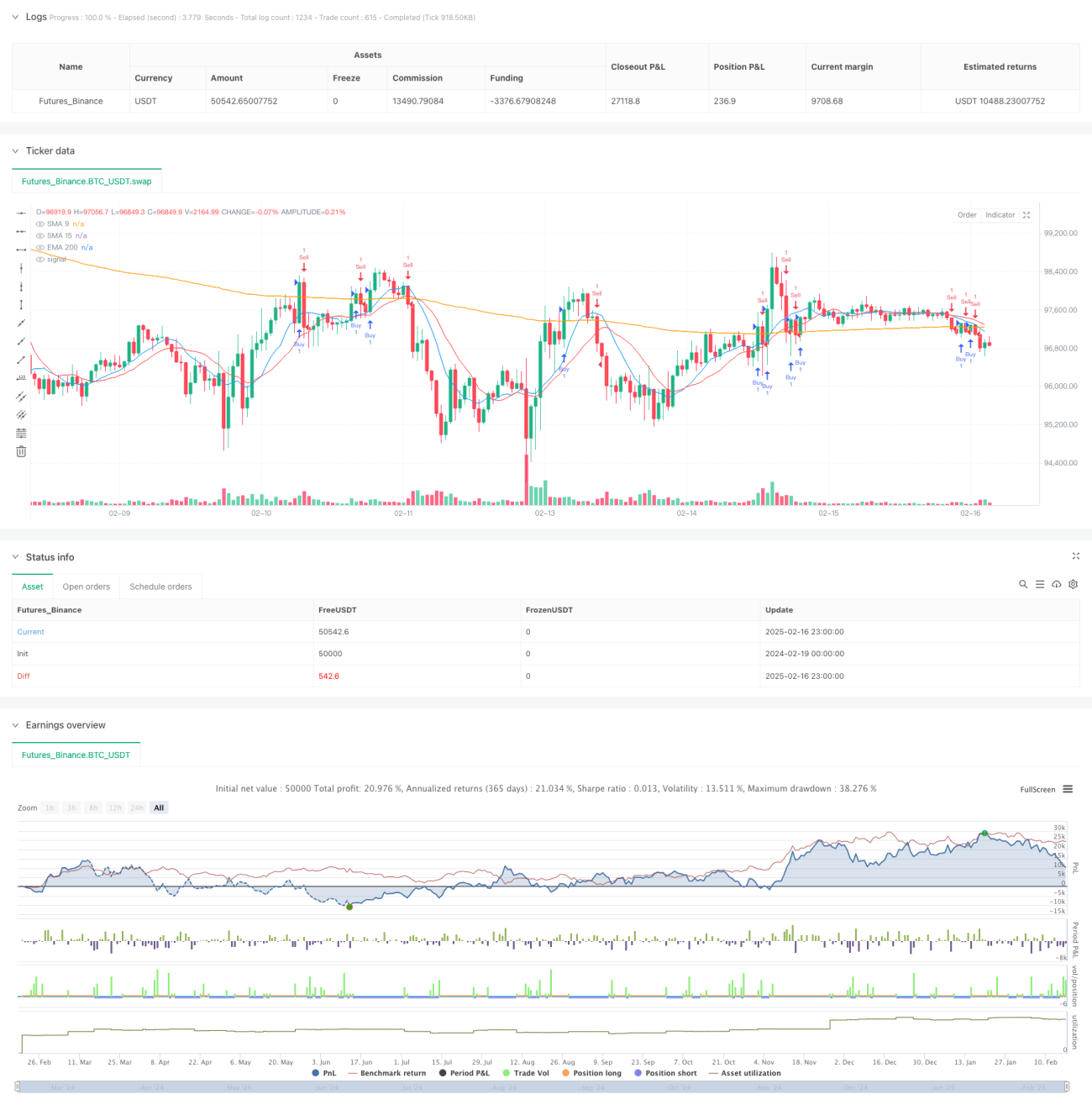
This strategy is a trading system based on moving average crossover signals and trend filtering. It combines short-term SMA crossover signals (9-period and 15-period) with a long-term EMA (200-period) as a trend filter to capture market trends across different timeframes. The system also includes a re-entry mechanism that allows for position rebuilding during trend continuation.
Strategy Principles
The strategy employs a triple moving average system for trading decisions:
- Uses 9-period and 15-period Simple Moving Averages (SMA) for generating trading signals
- Employs 200-period Exponential Moving Average (EMA) as a trend filter
- Generates long signals when the short-term SMA (9-period) crosses above the 15-period SMA and price is above the 200-period EMA
- Generates short signals when the short-term SMA (9-period) crosses below the 15-period SMA and price is below the 200-period EMA
- Includes re-entry logic allowing new positions after initial crossover signals as long as price maintains position relative to the 200 EMA
Strategy Advantages
- Multiple timeframe analysis: Combines short-term and long-term moving averages for a comprehensive market perspective
- Trend filtering: Uses 200 EMA to filter false signals and improve trade quality
- Re-entry mechanism: Allows multiple entries during strong trends to maximize profit potential
- Clear entry/exit rules: Based on objective technical indicators, reducing subjective judgment
- Bi-directional trading: Profits from both bullish and bearish markets
- Integrated risk management: Automatic risk control through the moving average system
Strategy Risks
- Choppy market risk: May generate frequent false signals in sideways markets
- Lag risk: Moving averages are inherently lagging indicators, potentially missing optimal entry points
- Trend reversal risk: May suffer significant losses during sharp market reversals
- Re-entry risk: Excessive position building may lead to overexposure
Mitigation measures:
- Add additional volatility filters
- Set maximum position limits
- Implement dynamic stop-loss mechanisms
- Deploy position sizing system
Strategy Optimization Directions
- Dynamic Period Optimization:
- Automatically adjust moving average periods based on market volatility
- Introduce Adaptive Moving Averages (AMA) to replace fixed-period ones
- Entry Optimization:
- Add volume confirmation
- Include momentum indicator validation
- Implement price pattern confirmation
- Risk Management Optimization:
- Implement dynamic position sizing
- Add trailing stops
- Develop volatility-based stop-loss settings
- Re-entry Logic Optimization:
- Add trend strength confirmation
- Design graduated position building system
- Incorporate market environment recognition
Summary
This strategy builds a comprehensive trend-following trading system by combining multiple moving average systems with trend filters. Its main advantage lies in capturing significant profits in trending markets while improving stability through moving average filtering and re-entry mechanisms. Although inherent risks exist, implementing the optimization directions can further enhance strategy performance. The strategy is suitable for tracking medium to long-term market trends and serves as a reliable trading tool for patient traders.
- 1