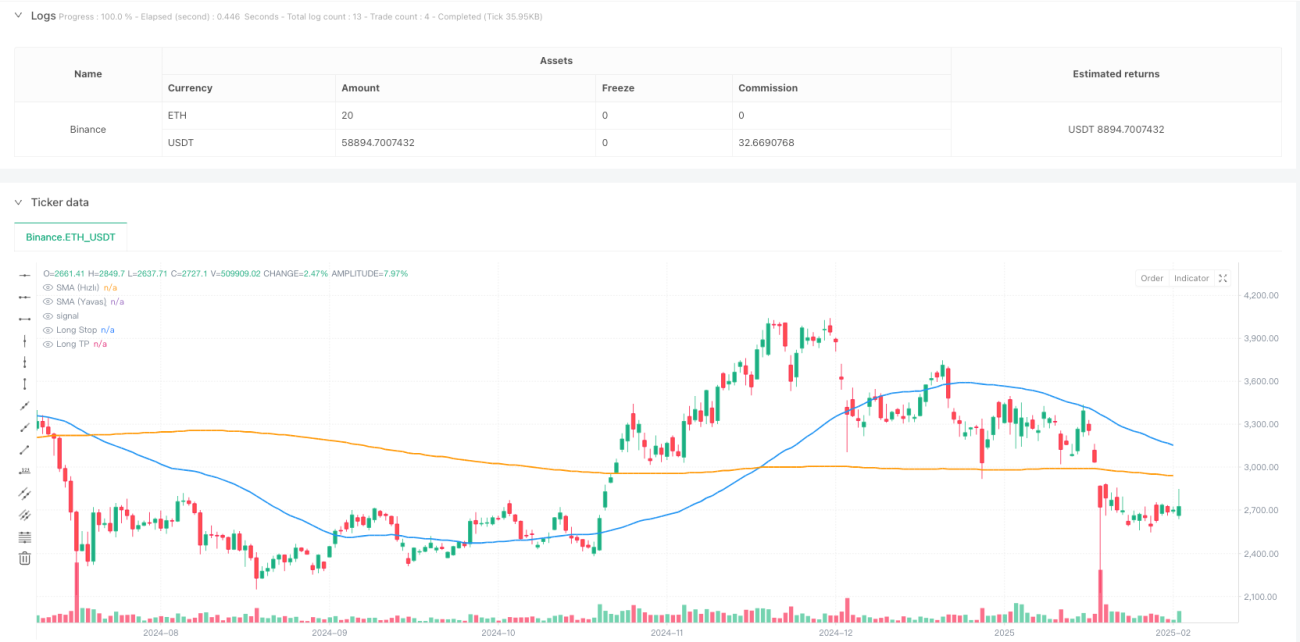
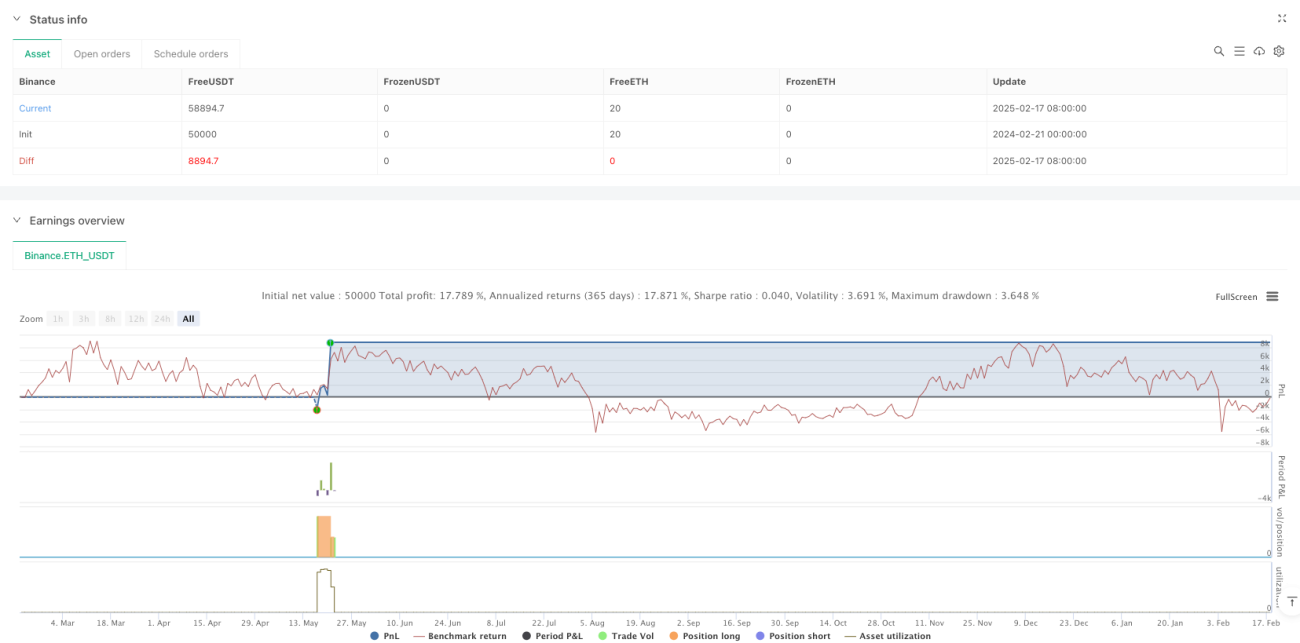
This strategy is a trend following system that combines multiple technical indicators. It primarily uses cross signals from RSI, MACD and SMA to determine trading direction, while using the ATR indicator to dynamically adjust stop-loss and take-profit levels. The strategy also incorporates a volume filter to ensure trading under sufficient market liquidity and employs partial profit-taking mechanisms to optimize money management.
The strategy employs a triple verification mechanism to confirm trading signals: 1. Determines main trend direction through the relationship between 50 and 200-day moving averages 2. Uses RSI crosses in overbought/oversold zones to find entry points 3. Confirms trend momentum with MACD indicator 4. Uses volume filter to ensure adequate market liquidity 5. Employs ATR-based dynamic stop-loss and profit targets
The multiple verifications aim to reduce false signals and improve trading accuracy. The strategy opens positions when long conditions are met (uptrend + RSI crosses above 40 + MACD up + volume confirmation) and uses 2x ATR for stop-loss and 4x ATR for take-profit.
This is a comprehensive trend following strategy that establishes a robust trading system through the coordinated use of multiple technical indicators. The strategy’s main feature is its ability to adapt to market changes through dynamic stop-loss and profit mechanisms while maintaining safety. Although there are areas for optimization, the overall framework is sound and suitable for further refinement and live testing.
/*backtest
start: 2024-02-21 00:00:00
end: 2025-02-18 08:00:00
period: 1d
basePeriod: 1d
exchanges: [{"eid":"Binance","currency":"ETH_USDT"}]
*/
//@version=5
strategy( title="AI Trade Strategy v2 (Extended) - Fixed", shorttitle="AI_Trade_v2", overlay=true, format=format.price, initial_capital=100000, default_qty_type=strategy.percent_of_equity, default_qty_value=100, pyramiding=0)
//============================================================================
//=== 1) Basic Indicators (SMA, RSI, MACD) ==================================
//============================================================================
// Time Filter (optional, you can update)
inDateRange = (time >= timestamp("2018-01-01T00:00:00")) and (time <= timestamp("2069-01-01T00:00:00"))
// RSI Parameters
rsiLength = input.int(14, "RSI Period")
rsiOB = input.int(60, "RSI Overbought Level")
rsiOS = input.int(40, "RSI Oversold Level")
rsiSignal = ta.rsi(close, rsiLength)
// SMA Parameters
smaFastLen = input.int(50, "SMA Fast Period")
smaSlowLen = input.int(200, "SMA Slow Period")
smaFast = ta.sma(close, smaFastLen)
smaSlow = ta.sma(close, smaSlowLen)
// MACD Parameters
fastLength = input.int(12, "MACD Fast Period")
slowLength = input.int(26, "MACD Slow Period")
signalLength = input.int(9, "MACD Signal Period")
[macdLine, signalLine, histLine] = ta.macd(close, fastLength, slowLength, signalLength)
//============================================================================
//=== 2) Additional Filter (Volume) ========================================
//============================================================================
useVolumeFilter = input.bool(true, "Use Volume Filter?")
volumeMaPeriod = input.int(20, "Volume MA Period")
volumeMa = ta.sma(volume, volumeMaPeriod)
// If volume filter is enabled, current bar volume should be greater than x times the average volume
volMultiplier = input.float(1.0, "Volume Multiplier (Volume > x * MA)")
volumeFilter = not useVolumeFilter or (volume > volumeMa * volMultiplier)
//============================================================================
//=== 3) Trend Conditions (SMA) ============================================
//============================================================================
isBullTrend = smaFast > smaSlow
isBearTrend = smaFast < smaSlow
//============================================================================
//=== 4) Entry Conditions (RSI + MACD + Trend + Volume) ====================
//============================================================================
// RSI crossing above 30 + Bullish Trend + Positive MACD + Volume Filter
longCondition = isBullTrend and ta.crossover(rsiSignal, rsiOS) and (macdLine > signalLine) and volumeFilter
shortCondition = isBearTrend and ta.crossunder(rsiSignal, rsiOB) and (macdLine < signalLine) and volumeFilter
//============================================================================
//=== 5) ATR-based Stop + Trailing Stop ===================================
//============================================================================
atrPeriod = input.int(14, "ATR Period")
atrMultiplierSL = input.float(2.0, "Stop Loss ATR Multiplier")
atrMultiplierTP = input.float(4.0, "Take Profit ATR Multiplier")
atrValue = ta.atr(atrPeriod)
//============================================================================
//=== 6) Trade (Position) Management ======================================
//============================================================================
if inDateRange
//--- Long Entry ---
if longCondition
strategy.entry(id="Long", direction=strategy.long, comment="Long Entry")
//--- Short Entry ---
if shortCondition
strategy.entry(id="Short", direction=strategy.short, comment="Short Entry")
//--- Stop & TP for Long Position ---
if strategy.position_size > 0
// ATR-based fixed Stop & TP calculation
longStopPrice = strategy.position_avg_price - atrValue * atrMultiplierSL
longTakeProfit = strategy.position_avg_price + atrValue * atrMultiplierTP
// PARTIAL EXIT: (Example) take 50% of the position at early TP
partialTP = strategy.position_avg_price + (atrValue * 2.5)
strategy.exit( id = "Partial TP Long", stop = na, limit = partialTP, qty_percent= 50, from_entry = "Long" )
// Trailing Stop + Final ATR Stop
// WARNING: trail_offset=... is the offset in price units.
// For example, in BTCUSDT, a value like 300 means a 300 USDT trailing distance.
float trailingDist = atrValue * 1.5
strategy.exit( id = "Long Exit (Trail)", stop = longStopPrice, limit = longTakeProfit, from_entry = "Long", trail_offset= trailingDist )
//--- Stop & TP for Short Position ---
if strategy.position_size < 0
// ATR-based fixed Stop & TP calculation for Short
shortStopPrice = strategy.position_avg_price + atrValue * atrMultiplierSL
shortTakeProfit = strategy.position_avg_price - atrValue * atrMultiplierTP
// PARTIAL EXIT: (Example) take 50% of the position at early TP
partialTPShort = strategy.position_avg_price - (atrValue * 2.5)
strategy.exit( id = "Partial TP Short", stop = na, limit = partialTPShort, qty_percent= 50, from_entry = "Short" )
// Trailing Stop + Final ATR Stop for Short
float trailingDistShort = atrValue * 1.5
strategy.exit( id = "Short Exit (Trail)", stop = shortStopPrice, limit = shortTakeProfit, from_entry = "Short", trail_offset= trailingDistShort )
//============================================================================
//=== 7) Plot on Chart (SMA, etc.) =========================================
//============================================================================
plot(smaFast, color=color.blue, linewidth=2, title="SMA (Fast)")
plot(smaSlow, color=color.orange, linewidth=2, title="SMA (Slow)")
// (Optional) Plot Stop & TP levels dynamically:
longStopForPlot = strategy.position_size > 0 ? strategy.position_avg_price - atrValue * atrMultiplierSL : na
longTPForPlot = strategy.position_size > 0 ? strategy.position_avg_price + atrValue * atrMultiplierTP : na
shortStopForPlot = strategy.position_size < 0 ? strategy.position_avg_price + atrValue * atrMultiplierSL : na
shortTPForPlot = strategy.position_size < 0 ? strategy.position_avg_price - atrValue * atrMultiplierTP : na
plot(longStopForPlot, color=color.red, style=plot.style_linebr, title="Long Stop")
plot(longTPForPlot, color=color.green, style=plot.style_linebr, title="Long TP")
plot(shortStopForPlot, color=color.red, style=plot.style_linebr, title="Short Stop")
plot(shortTPForPlot, color=color.green, style=plot.style_linebr, title="Short TP")