Dynamic Trend Following with Volatility Filtering: ADX and CI Dual-Confirmed Moving Average Crossover System

ADX CI SMA DM TR ATR DI
Created on: 2025-02-21 09:33:38 Modified on: 2025-02-21 09:33:38
Copy: 0 Number of hits: 406
avatar of ianzeng123 ianzeng123
2
Follow
319
Followers

 Dynamic Trend Following with Volatility Filtering: ADX and CI Dual-Confirmed Moving Average Crossover System  Dynamic Trend Following with Volatility Filtering: ADX and CI Dual-Confirmed Moving Average Crossover System

Overview

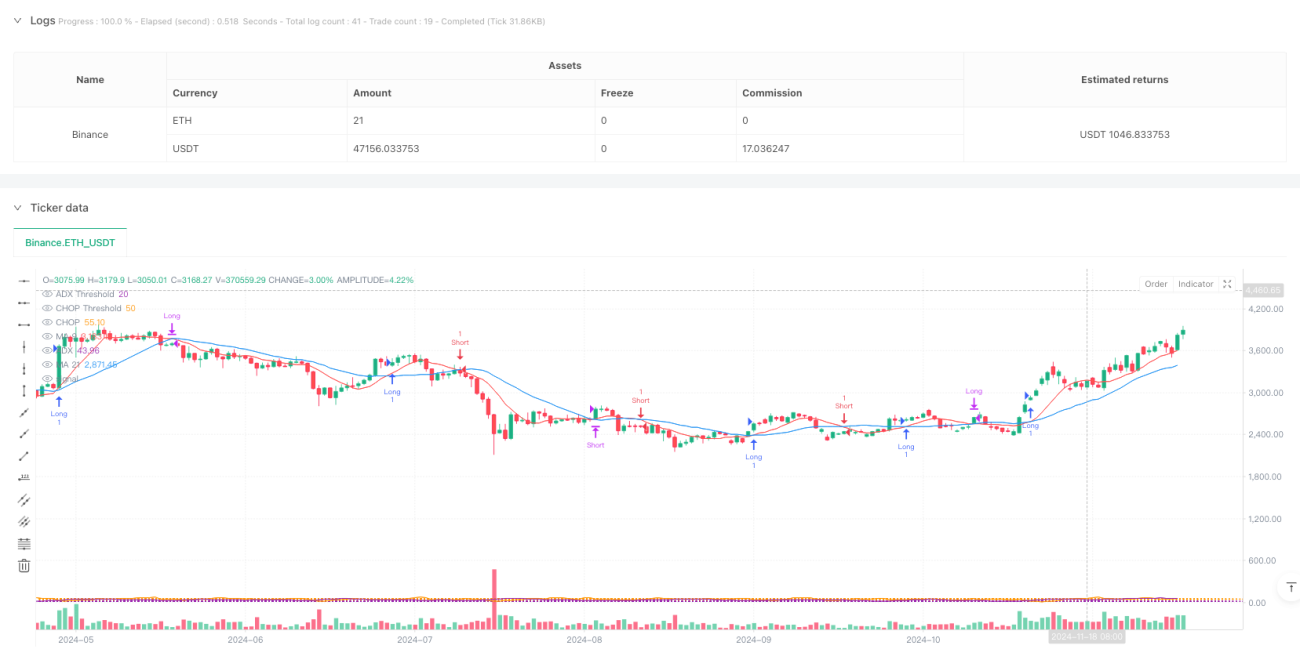
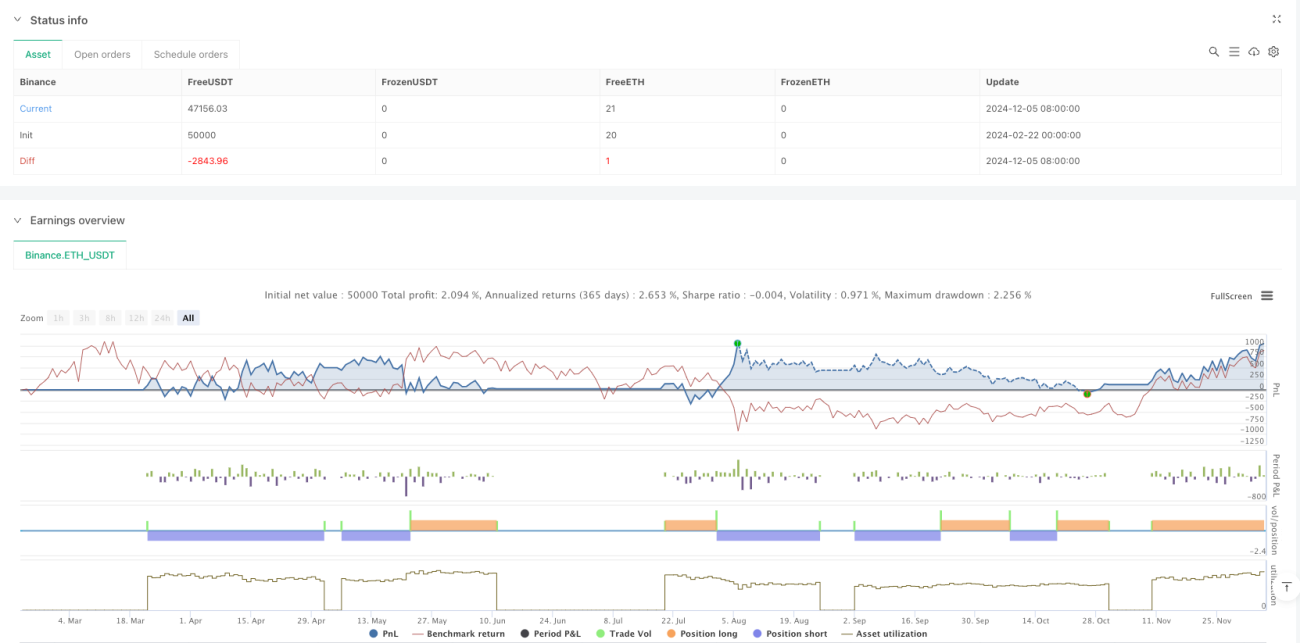
This strategy combines moving average crossover signals with market state filtering. It captures market trends through the intersection of 9-period and 21-period Simple Moving Averages (SMA) while utilizing the Average Directional Index (ADX) and Choppiness Index (CI) to filter market conditions, ensuring trades are only executed in clear trending markets with favorable volatility characteristics. This approach effectively combines traditional trend-following strategies with modern technical indicators to provide a more robust trading framework.

Strategy Principles

The core logic consists of three key components: 1. Trend Signal Generation: Uses 9-period and 21-period SMA crossovers to determine trend direction and generate basic trading signals. 2. Trend Strength Confirmation: Validates trend strength through the ADX indicator (threshold set at 20) to ensure trading only in clear trending market conditions. 3. Market Volatility Filtering: Incorporates the Choppiness Index (threshold at 50) to identify market volatility characteristics and avoid trading in highly choppy markets.

The strategy employs optimized technical indicator calculations, including custom sum functions, highest and lowest value calculations, and standardized True Range (TR) calculations, ensuring signal accuracy and computational efficiency.

Strategy Advantages

  1. Multiple Confirmation Mechanism: Combines MA crossover, ADX, and CI triple filtering to significantly improve trading signal reliability.
  2. High Adaptability: Strategy parameters can be adjusted for different market environments, providing good adaptability.
  3. Comprehensive Risk Control: Effectively reduces false breakout risks by filtering out high volatility periods using the CI index.
  4. High Computational Efficiency: Employs optimized calculation methods, particularly excelling in historical data processing.

Strategy Risks

  1. Parameter Sensitivity: Strategy effectiveness highly depends on ADX and CI threshold settings, different market environments may require different parameter configurations.
  2. Lag Issues: Multiple moving average indicators may result in delayed signals.
  3. Sideways Market Performance: May miss some short-term trading opportunities in range-bound markets.
  4. Computational Complexity: Multiple indicator calculations increase strategy complexity, potentially affecting real-time trading execution efficiency.

Strategy Optimization Directions

  1. Dynamic Parameter Adjustment: Introduce adaptive parameter adjustment mechanisms to dynamically modify ADX and CI thresholds based on market conditions.
  2. Stop Loss Optimization: Add dynamic stop-loss mechanisms, potentially designing more flexible stop-loss strategies based on ATR or Volatility Bands.
  3. Signal Confirmation Enhancement: Consider adding volume confirmation mechanisms to further improve signal reliability.
  4. Computational Efficiency Improvement: Optimize indicator calculation methods, especially performance in handling long-period data.

Summary

This strategy constructs a complete trading system by combining classical moving average crossover strategy with modern technical indicators. It focuses not only on trend capture but also pays special attention to market environment suitability, enhancing trading stability through multiple filtering mechanisms. While there are some parameter sensitivity and lag issues, there is significant room for improvement through the proposed optimization directions. Overall, this is a logically complete and highly practical trading strategy.

Strategy source code
/*backtest
start: 2024-02-22 00:00:00
end: 2024-12-06 00:00:00
period: 1d
basePeriod: 1d
exchanges: [{"eid":"Binance","currency":"ETH_USDT"}]
*/

//@version=6
strategy("MA9/MA21 Cross with ADX & CHOP Filter", overlay=true, initial_capital=10000, currency=currency.USD)

// ─── CUSTOM FUNCTIONS ──────────────────────────────────────────────────────
// Custom function to compute the sum over the last 'len' bars.
f_sum(src, len) =>
    s = 0.0
    for i = 0 to len - 1
        s += src[i]
    s

// Custom function to compute the highest value over the last 'len' bars.
f_highest(src, len) =>
    h = src[0]
    for i = 1 to len - 1
        h := math.max(h, src[i])
    h

// Custom function to compute the lowest value over the last 'len' bars.
f_lowest(src, len) =>
    l = src[0]
    for i = 1 to len - 1
        l := math.min(l, src[i])
    l

// ─── INPUTS ──────────────────────────────────────────────────────────────
ma9Period   = input.int(9, title="MA 9 Period", minval=1)
ma21Period  = input.int(21, title="MA 21 Period", minval=1)
adxLength   = input.int(7, title="ADX Smoothing / DI Length", minval=1)
adxThresh   = input.float(20.0, title="ADX Threshold", step=0.1)
chopLen     = input.int(7, title="CHOP Length", minval=1)
chopOff     = input.int(0, title="CHOP Offset", minval=0)  // Not applied in calculation
chopThresh  = input.float(50.0, title="CHOP Maximum (do not trade if above)", step=0.1)

// ─── CALCULATE INDICATORS ────────────────────────────────────────────────────
// Moving Averages
ma9  = ta.sma(close, ma9Period)
ma21 = ta.sma(close, ma21Period)

// --- True Range Calculation ---
// Manual implementation of true range (tr)
tr = math.max(math.max(high - low, math.abs(high - nz(close[1]))), math.abs(low - nz(close[1])))

// --- ADX Calculation (Manual Implementation) ---
// Calculate directional movements
upMove   = high - nz(high[1])
downMove = nz(low[1]) - low
plusDM   = (upMove > downMove and upMove > 0) ? upMove : 0.0
minusDM  = (downMove > upMove and downMove > 0) ? downMove : 0.0

// Smooth the values using the built-in rma function
atr      = ta.rma(tr, adxLength)
plusDI   = 100 * ta.rma(plusDM, adxLength) / atr
minusDI  = 100 * ta.rma(minusDM, adxLength) / atr
dx       = 100 * math.abs(plusDI - minusDI) / (plusDI + minusDI)
adxValue = ta.rma(dx, adxLength)

// --- Choppiness Index Calculation ---
// Compute the sum of true range over chopLen periods
atrSum      = f_sum(tr, chopLen)
// Compute highest high and lowest low over chopLen periods using custom functions
highestHigh = f_highest(high, chopLen)
lowestLow   = f_lowest(low, chopLen)
priceRange  = highestHigh - lowestLow
chop        = priceRange != 0 ? 100 * math.log(atrSum / priceRange) / math.log(chopLen) : 0

// ─── STRATEGY CONDITIONS ─────────────────────────────────────────────────────
// MA Crossover Signals
longCond  = ta.crossover(ma9, ma21)
shortCond = ta.crossunder(ma9, ma21)

// Filter: Only trade if ADX > threshold and CHOP ≤ threshold.
filterCond = (adxValue > adxThresh) and (chop <= chopThresh)

// Entries and Exits
if longCond and filterCond
    strategy.entry("Long", strategy.long)
if shortCond and filterCond
    strategy.entry("Short", strategy.short)
if shortCond
    strategy.close("Long")
if longCond
    strategy.close("Short")

// ─── PLOTTING ──────────────────────────────────────────────────────────────
plot(ma9, color=color.red, title="MA 9")
plot(ma21, color=color.blue, title="MA 21")
plot(adxValue, title="ADX", color=color.purple)
hline(adxThresh, title="ADX Threshold", color=color.purple, linestyle=hline.style_dotted)
plot(chop, title="CHOP", color=color.orange)
hline(chopThresh, title="CHOP Threshold", color=color.orange, linestyle=hline.style_dotted)