
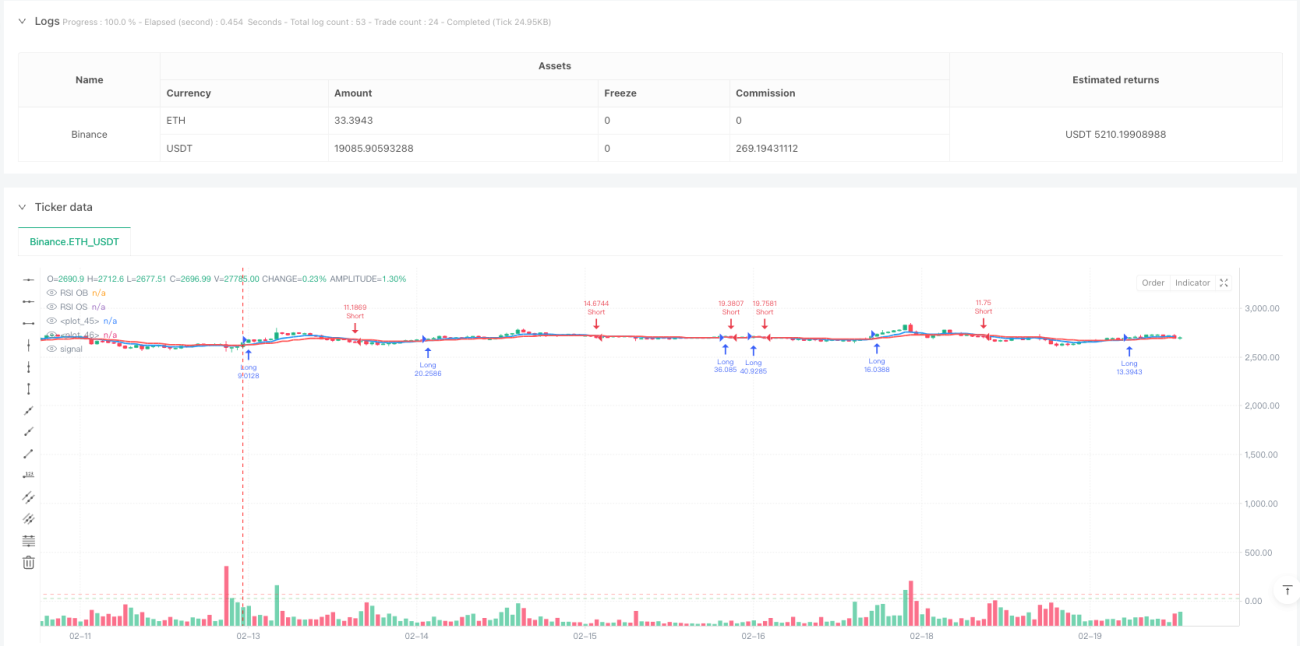
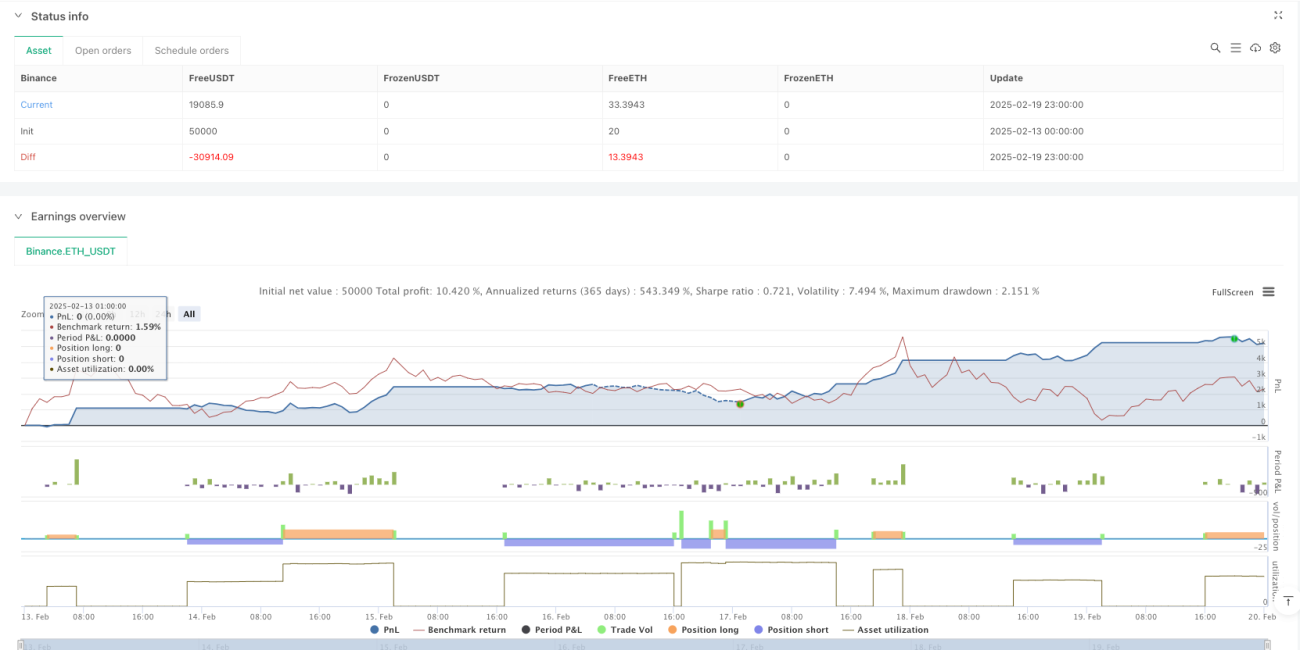
Overview
This strategy is a multi-level confirmation trading system that combines EMA crossover, RSI momentum indicator, and ATR volatility indicator. The strategy uses 9-period and 21-period exponential moving averages (EMA) as the primary trend determination basis, combined with RSI for momentum confirmation and ATR for dynamic position sizing and stop-loss/take-profit placement. Through the coordination of multiple technical indicators, the strategy effectively filters false signals and improves trading reliability.
Strategy Principle
The core logic of the strategy is based on the following levels:
- Trend Determination Layer: Uses the crossover of fast EMA (9-period) and slow EMA (21-period) to determine market trend direction. Long signals are generated when the fast line crosses above the slow line, and short signals when the fast line crosses below.
- Momentum Confirmation Layer: Uses 14-period RSI to filter trend signals. Executes longs only when RSI is below 70 and shorts only when RSI is above 30, avoiding positions in overbought or oversold areas.
- Risk Management Layer: Uses 14-period ATR for dynamic stop-loss and take-profit placement. Stop-loss is set at 1.5x ATR and take-profit at 3x ATR, ensuring a good risk-reward ratio. ATR is also used to calculate appropriate position size based on 1% account equity risk.
Strategy Advantages
- Multi-level Confirmation Mechanism: Forms a complete trading confirmation system by combining moving averages, momentum, and volatility indicators, significantly reducing false signals.
- Dynamic Risk Management: Uses ATR to dynamically adjust stop-loss and take-profit levels, allowing better adaptation to market volatility changes.
- Intelligent Position Management: Automatically adjusts position size based on current market volatility and account equity, effectively controlling risk.
- Systematic Operation: Strategy is fully systematic, eliminating emotional influences from subjective judgment.
Strategy Risks
- Ranging Market Risk: In range-bound markets, EMA crossovers may generate frequent false signals leading to consecutive stops.
- Slippage Risk: During intense market volatility, actual execution prices may significantly deviate from signal prices.
- Trend Reversal Risk: Fixed ATR multiplier stops may not adequately protect capital during sudden market reversals.
Strategy Optimization Directions
- Add Market Environment Filter: Can add trend strength indicators like ADX, executing trades only in strong trend markets.
- Optimize Parameter Adaptation: Can dynamically adjust EMA and RSI period parameters based on different market volatility cycles.
- Improve Stop-Loss Mechanism: Can consider adding trailing stops to protect more profits in trending markets.
- Add Trading Time Filter: Can incorporate trading time windows to avoid highly volatile periods.
Summary
The strategy builds a robust trading system through the coordination of EMA crossover, RSI momentum, and ATR volatility in three dimensions. Its strengths lie in its complete multi-level confirmation mechanism and dynamic risk management system, though it may face higher risks in ranging markets. Performance can be improved through additions like market environment filtering and parameter adaptation optimization. Overall, this is a logically clear and practical trading strategy.
- 1