
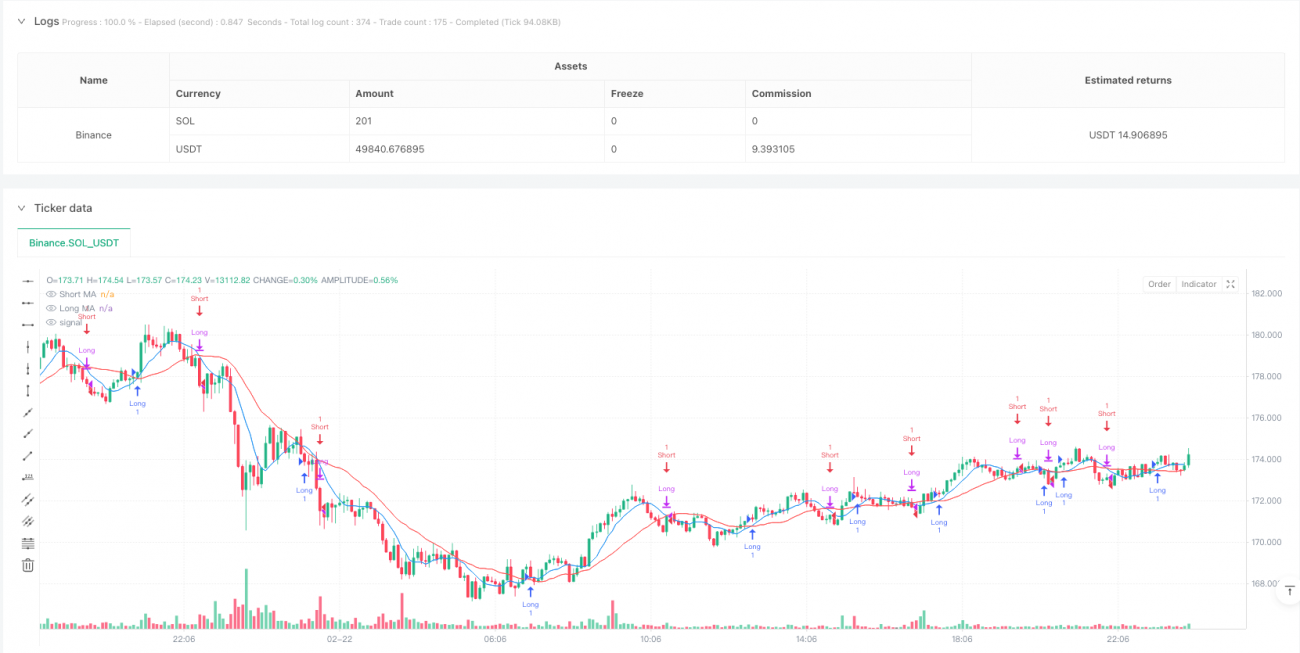
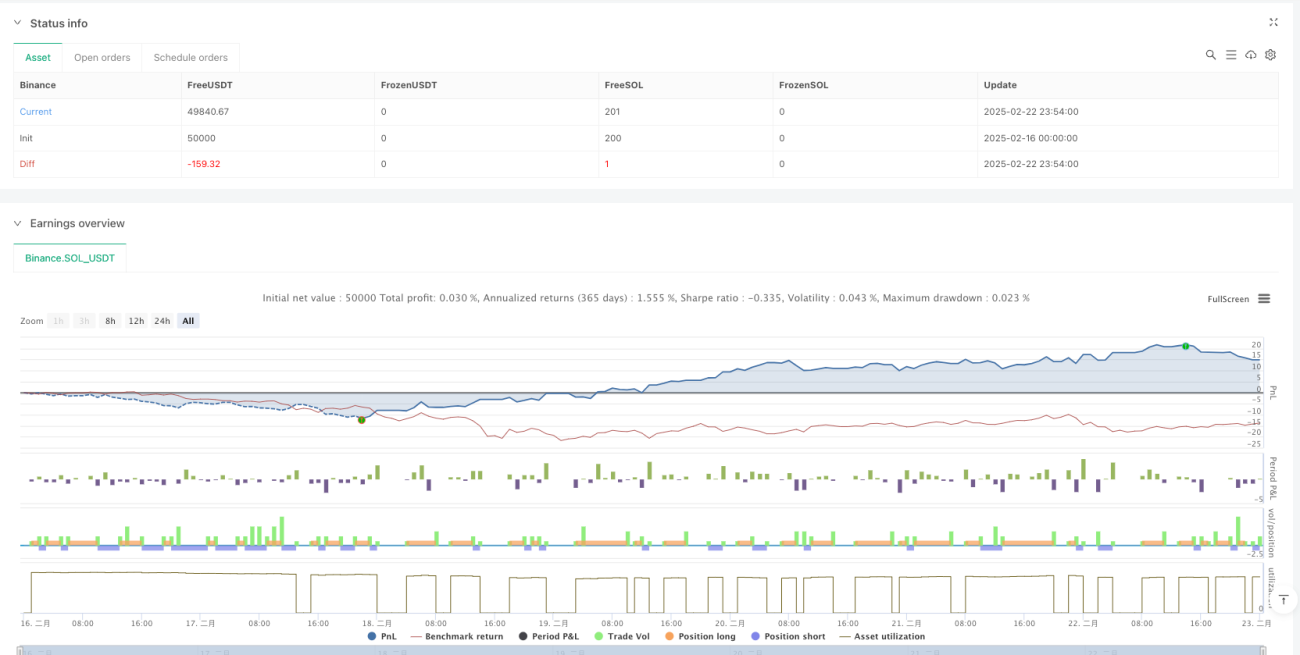
Overview
This strategy is a trend-following trading system that combines Simple Moving Averages (SMA) with the Relative Strength Index (RSI). It identifies trend directions through crossovers of short-term and long-term moving averages, uses RSI for momentum confirmation, and seeks high-probability trading opportunities in the market. The strategy includes a comprehensive risk management module for effective control of trading risks.
Strategy Principles
The core logic is based on the combination of two technical indicators:
- Dual MA System: Uses 8-period and 21-period simple moving averages to identify trend changes. Buy signals are generated when the short-term MA crosses above the long-term MA, and sell signals when it crosses below.
- RSI Filter: Employs a 14-period RSI for momentum confirmation. Long positions are only executed when RSI is below 70, and short positions when RSI is above 30, avoiding trades in overextended areas.
- Risk Control: Each trade includes a 1% stop loss and 2% take profit level to protect capital and secure profits.
Strategy Advantages
- Indicator Synergy: Combines trend-following and momentum indicators for more accurate identification of market turning points.
- Robust Risk Management: Built-in stop loss and take profit mechanisms effectively control risk.
- Flexible Parameters: All key parameters can be optimized for different market conditions.
- Wide Applicability: Can be applied across multiple markets and timeframes.
- Clear Logic: Strategy rules are explicit, easy to understand and execute.
Strategy Risks
- Choppy Market Risk: May generate frequent false signals in sideways markets.
- Lag Risk: Moving averages have inherent lag, potentially missing some profit opportunities.
- Parameter Sensitivity: May require parameter adjustments in different market environments.
- Trend Dependency: Strategy performs best in strong trending markets but may underperform in other conditions.
Optimization Directions
- Introduce market environment recognition mechanism for different parameter combinations.
- Add volume indicators as confirmatory signals.
- Optimize stop loss and take profit mechanisms, consider implementing dynamic stop loss.
- Add trend strength filters to trade only in strong trending markets.
- Develop adaptive parameter adjustment mechanisms to improve strategy adaptability.
Summary
This is a comprehensively structured trend-following strategy with clear logic. By combining SMA and RSI, it captures trends while avoiding trades in overextended areas. The built-in risk management ensures strategy stability. While there are some inherent limitations, the suggested optimization directions can further enhance strategy performance. This strategy is particularly suitable for traders seeking stable returns.
- 1