Multi-Step Non-Repainting Renko Emulation Trend Reversal Quantitative Trading Strategy

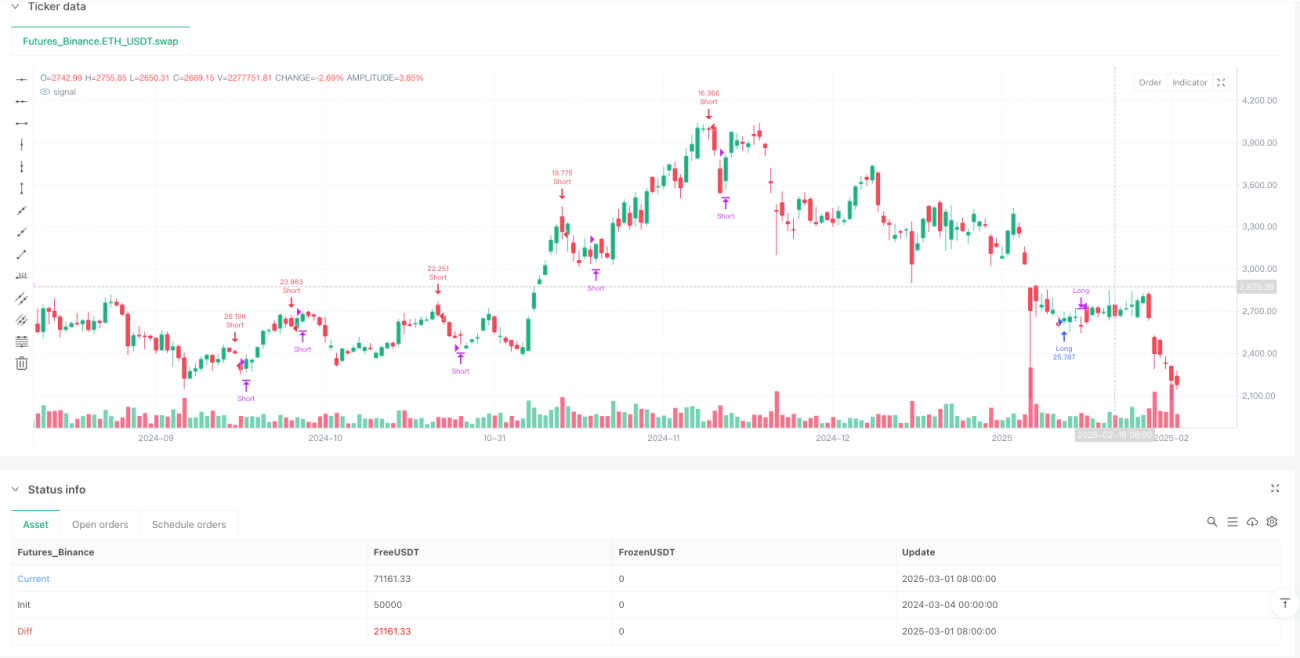
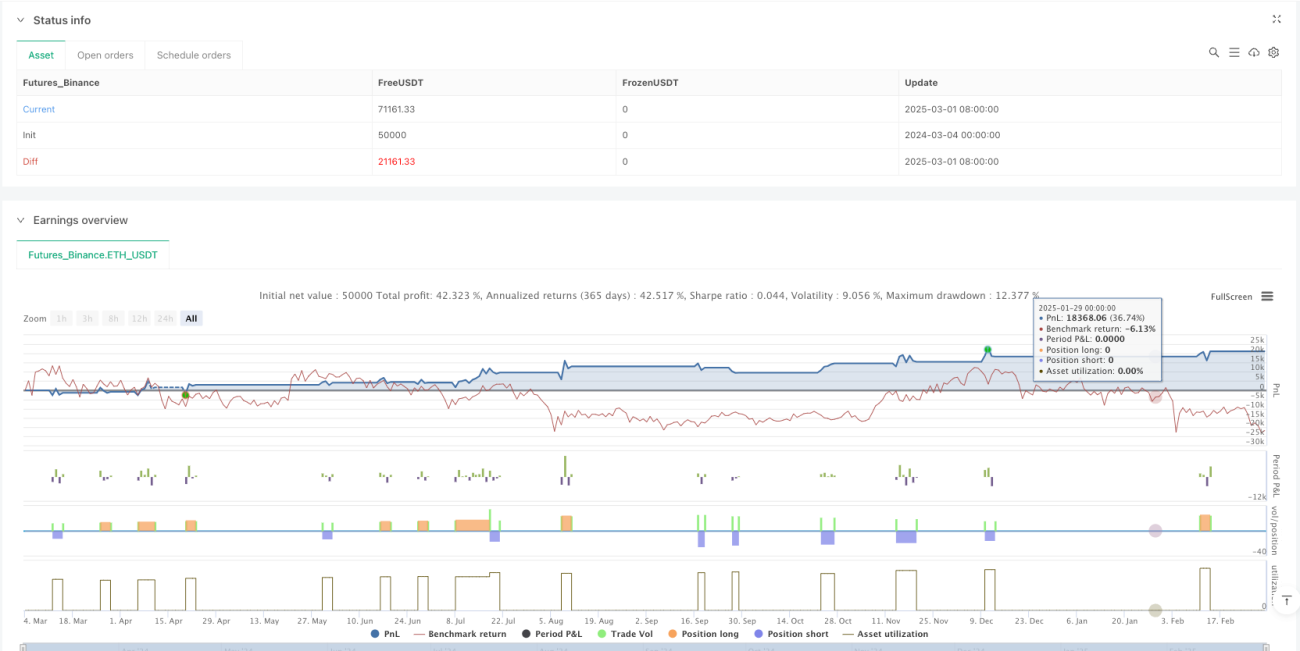
Strategy Overview
This strategy is a non-repainting quantitative trading system based on Renko chart emulation that solves the repainting problem found in traditional Renko strategies by simulating Renko brick behavior on standard time-based charts. The strategy uses fixed-size price bricks to filter market noise, focusing only on meaningful price movements while ensuring historical signals remain unchanged. This strategy is particularly suitable for trend following and trend reversal trading, making trading decisions by comparing brick direction changes through multiple steps.
Key features:
- Implements non-repainting Renko effects on time-based charts
- Identifies trend reversals using brick direction changes
- Multi-step verification mechanism to improve signal quality
- Graphical display of brick formation process
- Stable backtesting results consistent with real-time trading performance
Strategy Principles
The core principle of this strategy is to implement Renko brick functionality on a standard time-based chart while solving the repainting problem found in traditional Renko charts. The specific working principles are as follows:
-
Parameter Configuration & Initialization:
brickSize: Defines the brick size, determining how much price must move to form a new brickrenkoPrice: Stores the closing price of the last completed Renko brickprevRenkoPrice: Stores the price level of the previous Renko brickbrickDir: Tracks the direction of bricks (1=up, -1=down)newBrick: A boolean flag indicating whether a new brick has been formedbrickStart: Stores the bar index at which the current brick started
-
Non-Repainting Renko Brick Identification:
- The system performs calculations only on confirmed bars, ensuring historical data is not recalculated
- Calculates the difference between the current price and the last Renko brick level
- When the price difference reaches or exceeds the brick size, a new Renko brick is formed
- Updates the brick price level based on the number of bricks that would fit within the price movement
- Updates the direction (brickDir) and sets a flag (newBrick) indicating a new brick has been formed
-
Renko Visualization on Time-Based Charts:
- Uses graphical elements to draw Renko-style bricks on a standard chart
- Green boxes represent bullish bricks
- Red boxes represent bearish bricks
- Once formed, bricks never change or disappear
-
Multi-Step Trend Reversal Detection:
- The strategy checks not only the current brick direction but also compares multiple historical bricks
- Confirms genuine trend reversals by verifying direction changes across consecutive bricks
Strategy Advantages
After in-depth code analysis, this strategy demonstrates the following significant advantages:
-
Solves the Repainting Problem:
- Traditional Renko strategies perform well in backtesting but often fail in live trading, primarily due to the repainting issue
- This strategy ensures that once a brick is formed, it will not change by emulating Renko behavior on standard time-based charts
- This makes backtesting results more reliable and closer to live trading performance
-
Noise Filtering and Clear Trend Identification:
- Renko charts inherently filter small fluctuations, forming new bricks only when price moves by a preset amount
- This helps identify clear price trends and reduces false signals
- Suitable for finding meaningful price movements in highly volatile markets
-
Multi-Step Signal Verification:
- The strategy checks not just single direction changes but verifies multiple consecutive bricks' directions
- By comparing
brickDir[brickSize]with the currentbrickDirand historical price level relationships - Multi-step verification mechanism significantly reduces false signals
-
Visual Trading Foundation:
- Draws colored bricks on charts, visually displaying price structure
- Green and red boxes clearly identify market direction
- Visual aids help traders better understand market behavior
-
Flexibility and Customizability:
- Brick size can be adjusted by users, allowing strategy optimization for different markets and timeframes
- Smaller brick sizes generate more frequent trading signals, suitable for short-term trading
- Larger brick sizes filter more noise, suitable for medium to long-term trend following
Strategy Risks
Despite solving the repainting problem, the following risk factors still exist:
-
Signal Delay Risk:
- Since the strategy executes calculations only on confirmed bars, trade execution may be slightly later than traditional Renko charts
- In fast-moving markets, entry points may miss optimal prices
- Solution: Consider combining with other confirmation indicators or adjusting brick size to balance timeliness and accuracy
-
Brick Size Selection Risk:
- Too small bricks generate excessive trading signals, increasing trading costs and potentially leading to overtrading
- Too large bricks may miss important market turning points
- Solution: Optimize brick size based on the volatility of the target asset and trading timeframe
-
Trend Reversal False Signal Risk:
- Despite using multi-step verification, false breakouts may still occur in violently volatile markets
- Price may cross brick boundaries multiple times before a real trend forms
- Solution: Consider adding additional filters such as volume confirmation or momentum indicators
-
Drawdown Risk:
- Trend reversal strategies may lead to consecutive losses in strongly trending markets
- Reversal signals may trigger too early, resulting in counter-trend trading
- Solution: Implement appropriate stop-loss mechanisms and position management strategies
-
Computational Resource Risk:
- Drawing numerous bricks may consume significant resources, especially on long timeframes and large datasets
- The code limits the maximum number of boxes to 500, which may be insufficient in some cases
- Solution: Optimize code efficiency or consider displaying only the most recent N bricks
Strategy Optimization Directions
Based on code analysis, here are several key optimization directions for this strategy:
-
Dynamic Brick Size Optimization:
- The current strategy uses fixed brick size, which can be improved to dynamic brick size based on market volatility
- Use smaller bricks during low volatility periods and larger bricks during high volatility periods
- This will improve the strategy's adaptability to different market conditions
- Implementation method: Use ATR (Average True Range) to dynamically adjust brick size
-
Add Trading Filters:
- Combine volume or other momentum indicators to confirm trend reversal signals
- Avoid trading under low liquidity or extreme volatility conditions
- Implementation method: Add additional confirmation conditions based on RSI, volume breakouts, or MACD
-
Improve Stop Loss and Profit Taking Mechanisms:
- The current strategy only closes positions when direction reverses; intelligent stop loss and target profit levels can be added
- Set dynamic stop loss levels based on multiples of brick size
- Implementation method: Add
strategy.exit()commands, setting stop loss points based on ATR or brick size
-
Optimize Multi-Step Verification Mechanism:
- The current strategy uses fixed
brickSizemultiples to compare historical bricks - Research the optimal number of historical comparison steps
- Backtest different markets and timeframes to find the best parameter combinations
- Implementation method: Parameterize the number of steps, allowing users to customize verification depth
- The current strategy uses fixed
-
Improve Visualization and Alert Systems:
- Add trend lines and key level markers
- Add alert functionality for brick formation and trading signals
- Display current trend strength and duration
- Implementation method: Use
label.new()andalert()functions to enhance user experience
Conclusion
The Multi-Step Non-Repainting Renko Emulation Trend Reversal Quantitative Trading Strategy successfully addresses the repainting problem in traditional Renko strategies, enabling traders to apply Renko logic on standard time-based charts while maintaining the stability of historical signals. The strategy identifies trend reversals through a multi-step verification mechanism, improving signal quality, and visually displays market structure through graphical representation.
The main advantages of the strategy include solving the repainting problem, filtering market noise, multi-level signal verification, and intuitive graphical representation. However, risks still exist, including signal delays, brick size selection, and false signals. Future optimizations can be achieved by implementing dynamic brick sizes, adding trading filters, improving stop loss mechanisms, optimizing verification steps, and enhancing visualization systems.
This approach, which combines the advantages of Renko charts while avoiding their drawbacks, is particularly suitable for trend following and trend reversal trading strategies, providing traders with a reliable technical analysis tool that can deliver stable live performance while maintaining backtesting accuracy.
//@version=5
strategy("Non-Repainting Renko Emulation Strategy [PineIndicators]", overlay=true, calc_on_every_tick=false, max_boxes_count = 500, max_labels_count = 500, max_lines_count = 500, initial_capital = 10000, default_qty_value = 100, default_qty_type = strategy.percent_of_equity, commission_value = 0.01, slippage = 2)

// Parameter: Brick-Größe (z.B. 10 Punkte)
brickSize = input.float(3.0, "Brick Size", step=0.1)

// Persistente Variablen
var float renkoPrice     = na    // Aktueller Renko-Level (Schlusswert des letzten Bricks)
var float prevRenkoPrice = na    // Vorheriger Renko-Level (für Box-Berechnung)
var int   brickDir       = 0     // 1 = Aufwärts, -1 = Abwärts
var bool  newBrick       = false // Signalisiert, dass ein neuer Brick abgeschlossen wurde
var int brickStart = bar_index // Beginn des aktuellen Bricks (x-Achse)- 1