
Overview
The Enhanced Dynamic Channel Breakout Trend Following Trading System is a comprehensive quantitative trading strategy based on the classic Turtle Trading system, modernized with multiple technical indicators. This system primarily utilizes Donchian Channels to identify price breakouts, while combining Simple Moving Average (SMA) to determine market trend direction, Relative Strength Index (RSI) to filter entry signals, and Average True Range (ATR) to manage risk and position sizing. The system features a scientific multi-unit entry mechanism that allows for increasing positions during favorable trends, and employs an ATR-based dynamic stop-loss system to protect capital. The core philosophy of this strategy is to follow confirmed trends while strictly controlling risk, making it suitable for medium to long-term trend trading.
Strategy Principles
The principles of this strategy revolve around several key technical indicators:
-
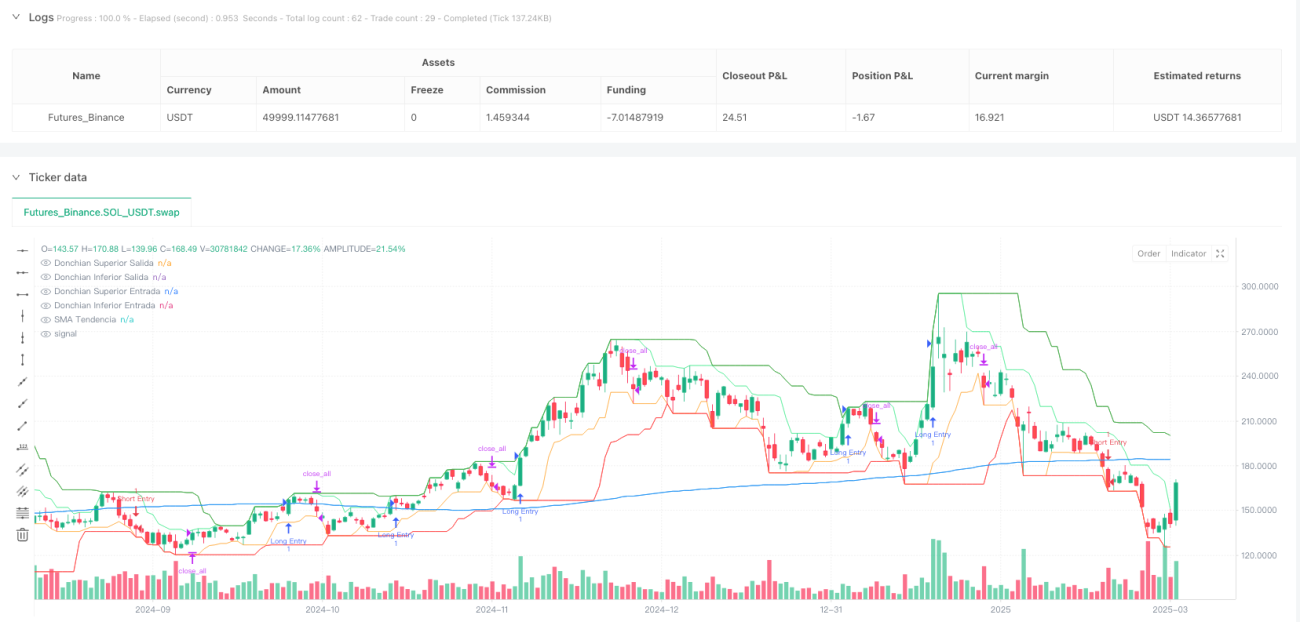
Donchian Channels: Two different period Donchian Channels are used - a longer period (default 15) to identify price breakouts and trigger entry signals, and a shorter period (default 5) to determine exit points.
-
Trend Confirmation Mechanism: A 200-period Simple Moving Average (SMA) serves as a trend filter, only considering long positions when price is above the SMA, and short positions when price is below the SMA.
-
RSI Filter: The Relative Strength Index (RSI) is used as a secondary filter to prevent entering trades in overbought or oversold areas, thereby reducing counter-trend trading risk.
-
Dynamic Position Sizing: ATR is used to calculate position size for each trade, ensuring consistent risk exposure across different volatility environments. The specific calculation method divides risk capital (2% of account equity) by (ATR multiplied by price).
-
Multi-Unit Entry Mechanism: When price moves 0.5 times ATR in a favorable direction, additional position units can be added, up to a maximum of 4 units, forming a pyramid-style position building structure.
-
Dynamic Stop-Loss System: ATR-based stop-loss is set at 2 times ATR distance from the entry price, with a trailing stop mechanism that adjusts the stop-loss as price moves in a favorable direction.
Specific entry conditions are as follows:
- Long: When the price high breaks above the highest point of the past 15 periods, the price is above the 200 SMA, and RSI is below 70.
- Short: When the price low breaks below the lowest point of the past 15 periods, the price is below the 200 SMA, and RSI is above 30.
Exit conditions:
- Long exit: When the price low breaks below the lowest point of the past 5 periods.
- Short exit: When the price high breaks above the highest point of the past 5 periods.
Strategy Advantages
-
Multi-layered Trend Confirmation: By combining Donchian Channels, Moving Average, and RSI indicators, a multi-layered filtering system is created, significantly improving the quality of entry signals and reducing losses from false breakouts.
-
Adaptive Position Management: The ATR-based position sizing method allows the strategy to dynamically adjust position size according to market volatility - smaller positions in high volatility environments and larger positions in low volatility environments, achieving consistent risk control.
-
Progressive Position Building: The pyramid-style position building allows for increasing positions after trend confirmation, enhancing profit potential while effectively controlling risk with smaller initial positions.
-
Dynamic Stop-Loss Protection: ATR-based trailing stops adjust the stop-loss position according to actual market volatility, effectively preventing premature stop-outs while promptly protecting profits when trends reverse.
-
Flexible Parameter Settings: The strategy provides multiple adjustable parameters, including Donchian Channel periods, ATR period, RSI thresholds, etc., allowing traders to adjust according to different market environments and personal risk preferences.
-
Clear Trading Rules: The strategy rules are clear and explicit, fully systematized, reducing subjective judgment and emotional influence, conducive to maintaining trading discipline.
Strategy Risks
-
Poor Performance in Ranging Markets: As a trend-following system, this strategy may generate frequent false signals and small losses in ranging markets without clear trends, forming so-called "whipsaw losses." The solution is to add additional market environment filters or temporarily stop trading when a ranging market is confirmed.
-
Slippage and Liquidity Risk: In fast-moving markets, especially when adding additional units, increased slippage and insufficient liquidity may be experienced. This can be mitigated by setting maximum slippage limits and avoiding trading during low-liquidity periods.
-
Parameter Overfitting: Excessive parameter optimization may lead to a strategy that performs well on historical data but poorly in live trading. Forward validation and robustness testing are recommended to evaluate strategy performance under different parameter settings.
-
Single Market Dependency: Applying the strategy to a single market may expose it to specific market risks. Consider applying the strategy across multiple uncorrelated markets to form a multi-market portfolio, diversifying risk.
-
Event Risk: Market surprises may cause significant price gaps beyond stop-loss settings, resulting in larger-than-expected losses. This impact can be mitigated by setting maximum risk limits and using other risk management tools such as options protection.
Strategy Optimization Directions
-
Market State Adaptation: Introduce market state identification mechanisms to enable the strategy to distinguish between trending and ranging markets, and automatically adjust parameters or trading behavior according to different market states. Consider adding ADX (Average Directional Index) to measure trend strength or using volatility indicators such as Bollinger Band width to determine market state.
-
Multi-timeframe Analysis: Integrate signals from longer timeframes as additional filters, for example, only entering trades when the daily trend direction aligns with the hourly trend direction, improving signal quality.
-
Improved Stop-Loss Strategy: Experiment with stop-loss strategies based on support/resistance levels, volatility percentages, or time decay factors to make stop-losses more flexible and effective. Particularly, consider setting different stop-loss levels for different position units to better protect profits.
-
Optimized Position Building: The current position adding mechanism is based on fixed ATR multipliers. Consider dynamically adjusting position adding conditions based on trend strength, more aggressively adding positions in strong trends and more conservatively in weak trends.
-
Machine Learning Integration: Introduce machine learning algorithms to predict optimal entry timing or optimize parameter selection, such as using random forests or support vector machines to classify various technical indicators and identify high-probability trading opportunities.
-
Enhanced Volatility Adjustment: Automatically adjust strategy parameters when market volatility changes significantly, enabling the strategy to adapt to different market environments. For example, increase Donchian Channel periods and ATR multipliers in high-volatility environments to reduce misleading signals.
Summary
The Enhanced Dynamic Channel Breakout Trend Following Trading System is a comprehensive quantitative trading strategy that combines classic trend-following principles with modern technical indicators. By utilizing Donchian Channels to identify breakouts, combining SMA and RSI to filter signals, and employing ATR-based position management and dynamic stop-losses, this strategy significantly improves adaptability and risk control while maintaining the simplicity of the original Turtle Trading system.
This strategy is particularly suitable for markets with evident medium to long-term trends, effectively capturing major trends and managing risk through multi-layered signal filtering and progressive position building. While performance may be suboptimal in ranging markets, through the proposed optimization directions, especially market state adaptation and multi-timeframe analysis, the strategy's robustness and adaptability can be further enhanced.
For quantitative traders, this strategy provides a balanced framework that contains both a clear rule system for systematic implementation and sufficient parameter adjustment space to adapt to personal risk preferences and specific market characteristics. Through continuous monitoring and optimization, this strategy has the potential to become an effective long-term trend-following tool.
- 1