
Overview
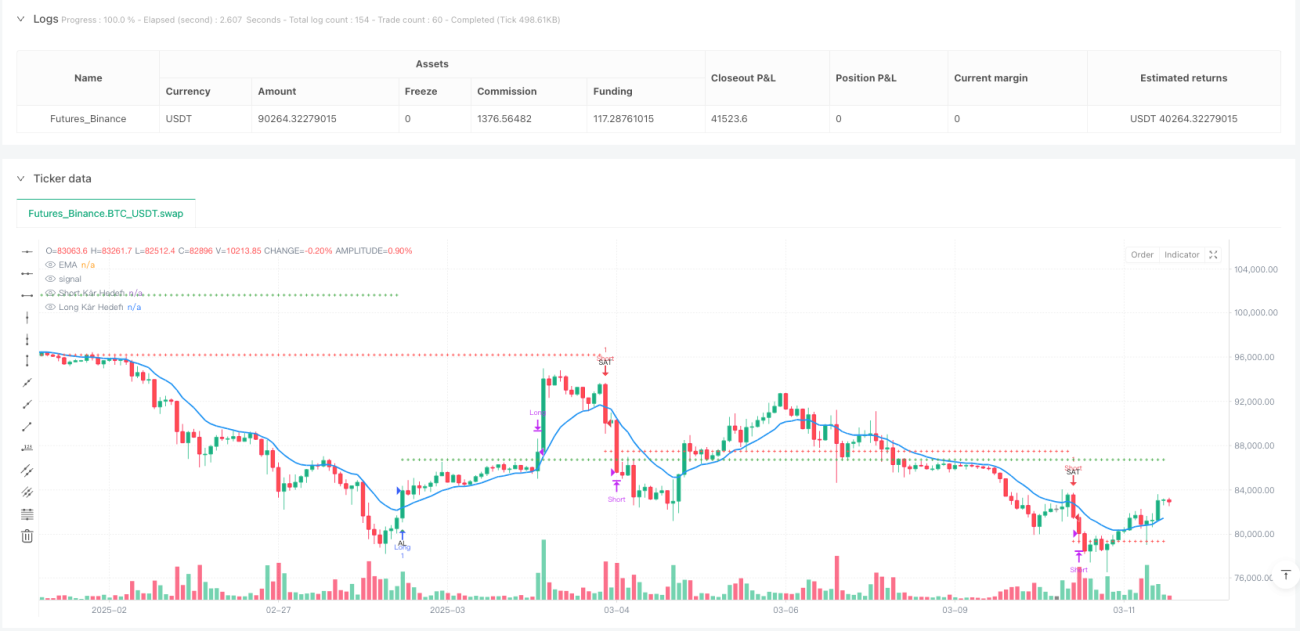
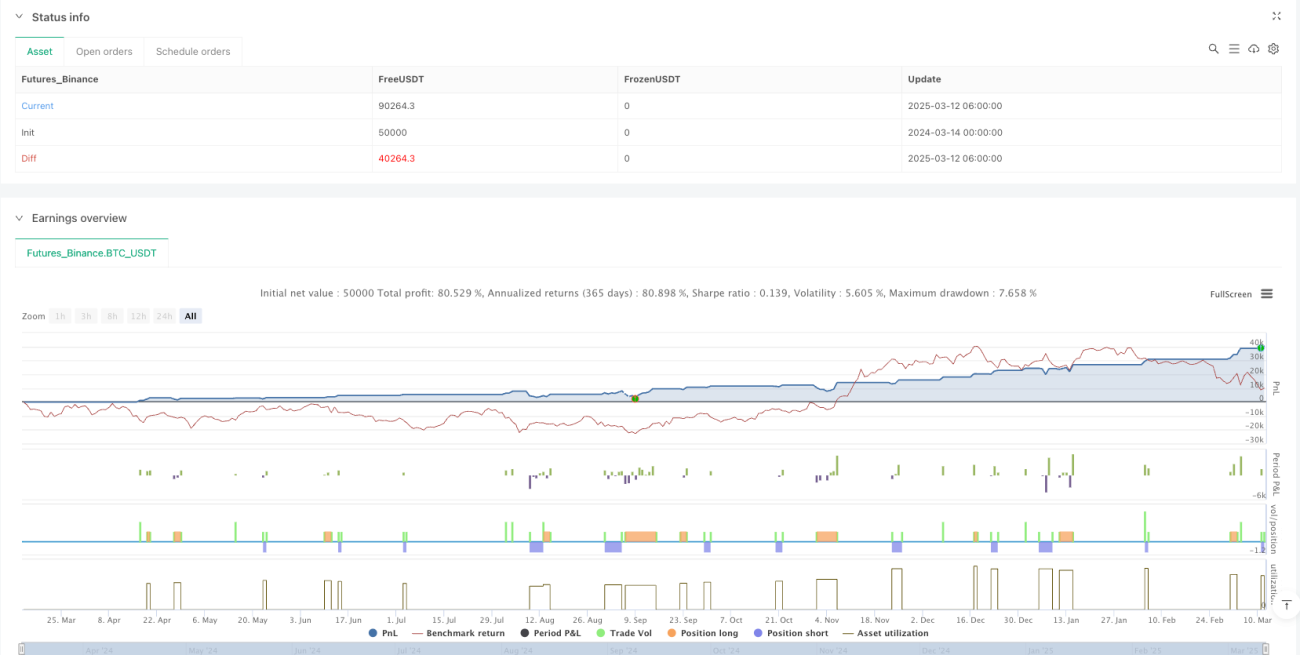
The Advanced EMA Crossover Momentum Trend Capture Strategy is a stop-loss-free trading system specifically designed for cryptocurrency scalping on 1-minute and 5-minute timeframes. This strategy integrates Exponential Moving Average (EMA) crossover signals, Average Directional Index (ADX) trend strength confirmation, volume breakout filtering, and Average True Range (ATR) based profit targets to form a comprehensive trading system. The core design philosophy focuses on providing a moderate frequency of trading signals while reducing false signals through multiple filtering mechanisms, and employing straightforward entry and exit logic to prevent trader confusion in the decision-making process.
Strategy Principle
The operation of this strategy is based on a combination of several key technical indicators and conditions:
-
EMA Crossover Signals: Uses a 13-period Exponential Moving Average as the main trend reference. Buy signals are generated when price crosses above the EMA, and sell signals when price crosses below.
-
Candlestick Confirmation: To enhance signal reliability, the candle after the crossover must close with the corresponding color (green candle close for buy signals, red candle close for sell signals).
-
ADX Trend Strength Filter: The strategy only executes trades when the ADX value is greater than 30, ensuring entry only during strong trends.
-
Volume Confirmation: Requires current volume to exceed 1.5 times the 5-period volume moving average, verifying that price movements are supported by sufficient market participation.
-
Position Control: The strategy does not allow simultaneous long and short positions, ensuring consistency in trading direction.
-
ATR-Based Profit Target: After entry, profit targets are set at entry price plus or minus (ATR × 1.5), using addition for long positions and subtraction for short positions.
-
No Stop-Loss Design: The strategy does not set stop-losses, keeping positions open until profit targets are reached. This design aims to avoid premature exits from potentially profitable trades due to short-term price fluctuations.
Strategy Advantages
-
Multiple Filtering Mechanisms: Through EMA crossovers, candlestick confirmation, ADX trend strength, and volume breakout conditions, the strategy significantly reduces the probability of false signals, improving trading accuracy.
-
Moderate Signal Frequency: The strategy design balances the number of signals, neither missing trading opportunities due to too few signals nor causing overtrading due to too many signals, particularly suitable for scalpers' needs.
-
Clear Entry and Exit Rules: The strategy provides explicit entry and exit conditions, reducing subjective judgment in the trading process and helping traders maintain trading discipline.
-
Volatility-Based Profit Targets: Using ATR as the calculation basis for profit targets allows dynamic adaptation to changes in market volatility, maintaining appropriate expected returns in different market environments.
-
Focus on High-Probability Trends: Through ADX filtering, the strategy only trades in strong trends, avoiding ranging and weak trend markets, increasing the success rate of trades.
Strategy Risks
-
No Stop-Loss Risk: The most significant risk of the strategy comes from not setting stop-losses. In cases of sudden market reversals, potentially profitable trades may turn into substantial losses, especially in highly volatile market environments.
-
Delayed Trend Reversal Response: Although the strategy uses ADX to filter weak trends, ADX itself is a lagging indicator and may not capture trend changes in a timely manner, causing positions to be maintained even after a trend has ended.
-
False Volume Breakouts: In some cases, volume breakouts may be caused by short-term market manipulation or liquidity events rather than genuine increases in market participation, potentially leading to false entry signals.
-
Consecutive Loss Risk: Despite multiple filtering mechanisms, consecutive losses may still occur under extreme market conditions, especially in highly volatile markets lacking clear direction.
-
Continuous Monitoring Required: Due to the absence of automatic stop-loss mechanisms, traders need to continuously monitor the market to manually exit in adverse conditions, increasing operational complexity and time costs.
Strategy Optimization Directions
-
Dynamic Stop-Loss Mechanism: Consider introducing volatility-based dynamic stop-loss mechanisms, such as ATR-based stop-loss placement, to limit maximum loss risk per trade while maintaining tolerance for short-term fluctuations.
-
Trend Strength Gradation: The ADX threshold can be graded to adjust position size according to different ADX values, increasing positions in stronger trends and reducing positions in weaker trends to optimize capital management.
-
Time-Based Exit Conditions: Introduce time-based exit conditions to automatically close positions if profit targets are not reached within a certain period, avoiding capital being tied up in inactive trades for extended periods.
-
Multi-Timeframe Confirmation: Combine higher timeframe trend directions as additional filtering conditions, only trading when higher timeframe trends align, increasing trade success rates.
-
Optimize Volume Indicators: Experiment with more sophisticated volume indicators, such as relative volume indicators or volume-weighted moving averages, to more accurately identify effective volume breakouts.
-
Backtest Period Optimization: Optimize parameter settings for EMA, ADX, and ATR for different market environments and trading instruments to find the most suitable parameter combinations for specific market conditions.
-
Add Profit Protection Mechanisms: Consider setting trailing stops after trades reach certain profit levels to secure partial profits, preventing profitable trades from turning into losses due to market reversals.
Summary
The Advanced EMA Crossover Momentum Trend Capture Strategy is a systematic trading method specifically designed for scalping, effectively improving trading signal quality through multiple technical indicator combinations. The core advantages of this strategy lie in its clear trading rules and moderate trading frequency, making it particularly suitable for scalpers' needs. However, the no stop-loss design also brings significant risks, requiring traders to remain vigilant when applying this strategy and consider implementing appropriate risk management measures. Through continuous optimization and parameter adjustments, traders can further improve the strategy's performance, making it better adapted to different market environments and personal trading styles. Ultimately, the key to successfully applying this strategy lies in understanding its principles and limitations, and flexibly applying it in conjunction with personal risk tolerance and market experience.
- 1