Vishal Adaptive Multi-Indicator Trading Strategy

MACD SAR ST EMA ATR TF
Created on: 2025-03-28 17:17:56 Modified on: 2025-03-28 17:17:56
Copy: 0 Number of hits: 407
avatar of ianzeng123 ianzeng123
2
Follow
319
Followers

 Vishal Adaptive Multi-Indicator Trading Strategy  Vishal Adaptive Multi-Indicator Trading Strategy

Overview

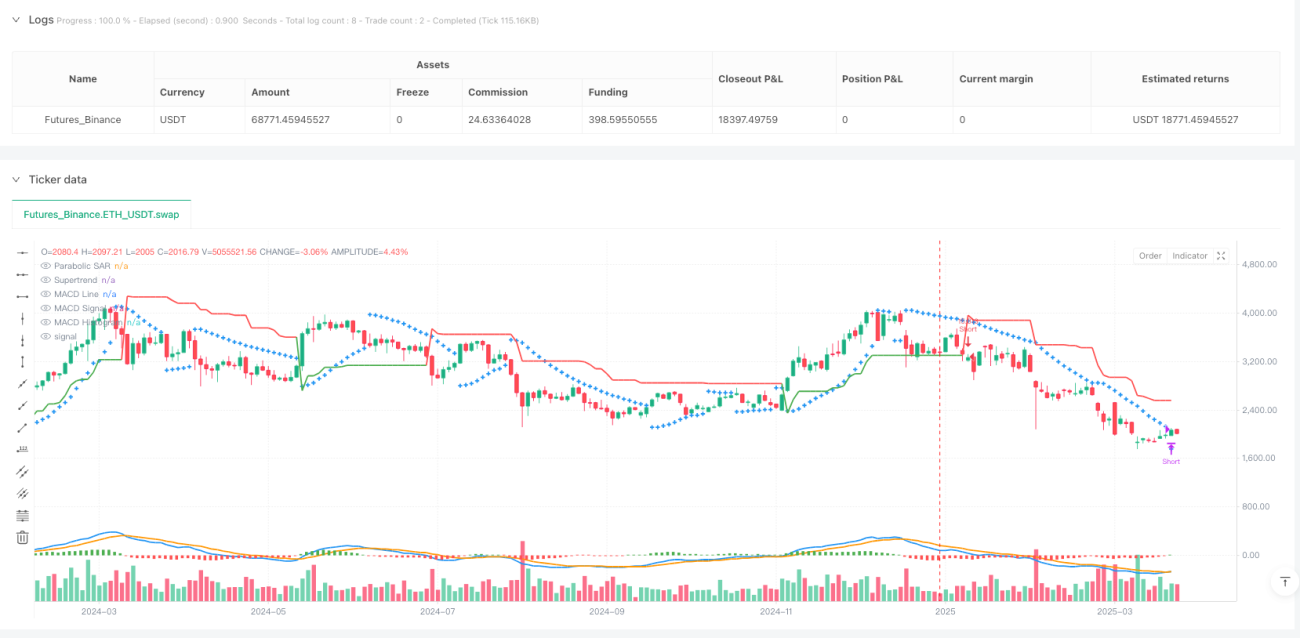
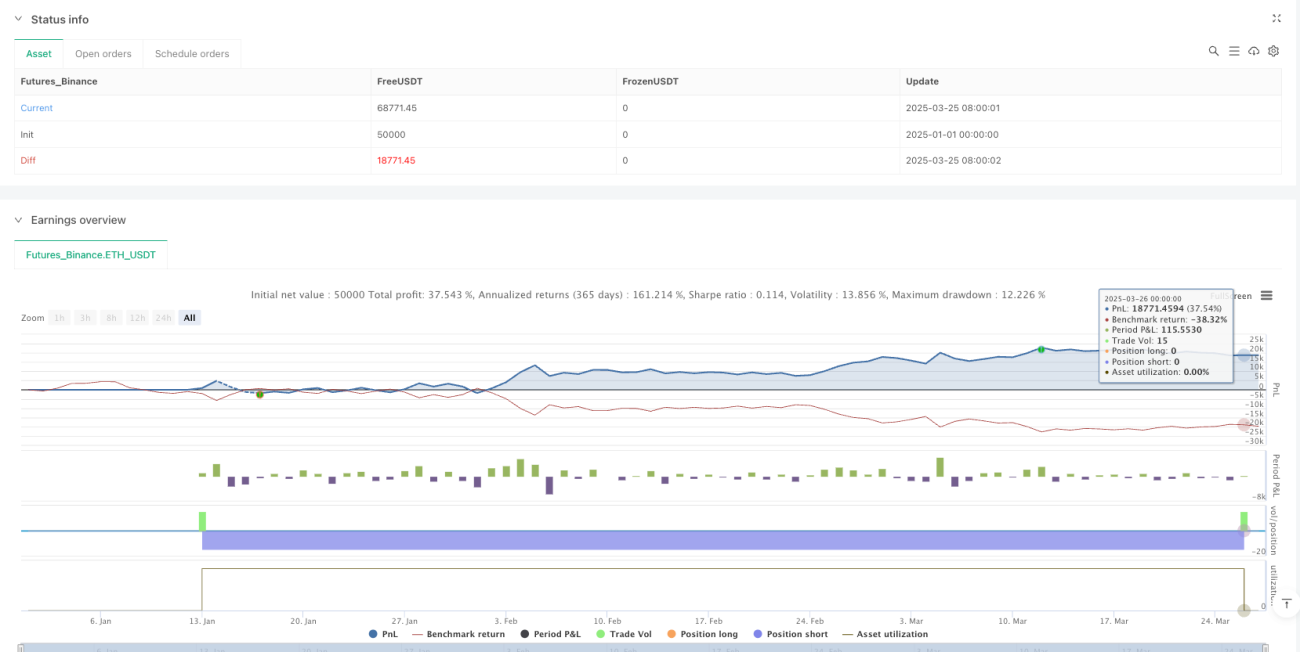
This strategy is a comprehensive quantitative trading method that integrates multiple technical indicators (MACD, Supertrend, and Parabolic SAR) to identify market trends and trading signals. The strategy aims to provide a flexible and rigorous decision-making framework adaptable to different market environments.

Strategy Principles

The strategy is based on the dynamic combination of three key technical indicators: 1. MACD Indicator: Evaluates price momentum and trend direction 2. Supertrend Indicator: Determines the dominant market trend (bullish or bearish) 3. Parabolic SAR: Provides precise entry and exit signals

The strategy makes trading decisions through the following logic: - Long Entry Conditions: - MACD line above signal line - Supertrend is green (bullish) - Closing price above Parabolic SAR - Short Entry Conditions: - MACD line below signal line - Supertrend is red (bearish) - Closing price below Parabolic SAR

Strategy Advantages

  1. Multi-indicator Verification: Reduces false signal risk
  2. Flexible Signal Triggering: No strict order requirement for indicators
  3. Full Position Trading Strategy: Maximizes potential earnings per trade
  4. Symmetric Trading Logic: Consistent performance in bullish and bearish markets
  5. Dynamic Exit Mechanism: Confirms exit through two consecutive candles

Strategy Risks

  1. Indicator Lag Risk: Technical indicators based on historical data may have delays
  2. Full Position Trading Risk: Lack of stop-loss can lead to significant capital fluctuations
  3. Severe Market Volatility Risk: Complex market environments may affect strategy performance
  4. Parameter Sensitivity: Indicator parameter selection directly impacts strategy effectiveness

Strategy Optimization Directions

  1. Introduce Dynamic Position Management: Adjust position size based on market volatility
  2. Add Stop-Loss Mechanism: Reduce maximum loss per trade
  3. Optimize Indicator Parameters: Find the best parameter combination through backtesting
  4. Introduce Additional Filter Conditions: Such as trading volume, volatility indicators
  5. Increase Multi-Timeframe Verification: Improve signal reliability

Summary

The Vishal Adaptive Multi-Indicator Trading Strategy is an innovative quantitative trading approach that provides a comprehensive and flexible trading decision framework through the synergistic action of MACD, Supertrend, and Parabolic SAR. Despite certain risks, its multi-indicator verification and symmetric trading logic offer investors a trading model worth in-depth research.

Strategy source code
/*backtest
start: 2025-01-01 00:00:00
end: 2025-03-27 00:00:00
period: 2d
basePeriod: 2d
exchanges: [{"eid":"Futures_Binance","currency":"ETH_USDT"}]
*/

//@version=6
strategy("Vishal Strategy", overlay=true, margin_long=100, margin_short=100, initial_capital=100000, default_qty_type=strategy.percent_of_equity, default_qty_value=100)

// **MACD Inputs & Calculation**
fast_length  = input.int(13, title="MACD Fast Length")
slow_length  = input.int(27, title="MACD Slow Length")
signal_length = input.int(9, title="MACD Signal Smoothing")

fast_ma  = ta.ema(close, fast_length)
slow_ma  = ta.ema(close, slow_length)
macd     = fast_ma - slow_ma
signal   = ta.ema(macd, signal_length)
hist     = macd - signal

// **Supertrend Inputs & Calculation**
atrPeriod = input.int(11,    "ATR Length", minval = 1)
factor    = input.float(3.0, "Factor",     minval = 0.01, step = 0.01)
[supertrend, direction] = ta.supertrend(factor, atrPeriod)
bullTrend  = direction < 0   // Uptrend Condition
bearTrend  = direction > 0   // Downtrend Condition

// **Parabolic SAR Inputs & Calculation**
sarStep = input.float(0.02, "Parabolic SAR Step")
sarMax  = input.float(0.2, "Parabolic SAR Max")
sar = ta.sar(sarStep, sarStep, sarMax)

// **Trade Entry Conditions**
macdBullish = macd > signal // MACD in Bullish Mode
macdBearish = macd < signal // MACD in Bearish Mode
priceAboveSAR = close > sar // Price above SAR (Bullish)
priceBelowSAR = close < sar // Price below SAR (Bearish)

// **Boolean Flags to Track Conditions Being Met**
var bool macdConditionMet = false
var bool sarConditionMet = false
var bool trendConditionMet = false

// **Track if Each Condition is Met in Any Order**
if (macdBullish)
    macdConditionMet := true
if (macdBearish)
    macdConditionMet := false

if (priceAboveSAR)
    sarConditionMet := true
if (priceBelowSAR)
    sarConditionMet := false

if (bullTrend)
    trendConditionMet := true
if (bearTrend)
    trendConditionMet := false

// **Final Long Entry Signal (Triggers When All Three Flags Are True)**
longSignal = macdConditionMet and sarConditionMet and trendConditionMet

// **Final Short Entry Signal (Triggers When All Three Flags Are False)**
shortSignal = not macdConditionMet and not sarConditionMet and not trendConditionMet

// **Execute Full Equity Trades**
if (longSignal)
    strategy.entry("Long", strategy.long)

if (shortSignal)
    strategy.entry("Short", strategy.short)

// **Exit Logic - Requires 2 Consecutive Candle Closes Below/Above SAR**
var int belowSARCount = 0
var int aboveSARCount = 0

if (strategy.position_size > 0)  // Long position is active
    belowSARCount := close < sar ? belowSARCount + 1 : 0
    if (belowSARCount >= 1)
        strategy.close("Long")

if (strategy.position_size < 0)  // Short position is active
    aboveSARCount := close > sar ? aboveSARCount + 1 : 0
    if (aboveSARCount >= 1)
        strategy.close("Short")

// **Plot Indicators**
plot(supertrend, title="Supertrend", color=bullTrend ? color.green : color.red, linewidth=2, style=plot.style_linebr)
plot(sar, title="Parabolic SAR", color=color.blue, style=plot.style_cross, linewidth=2)
plot(macd, title="MACD Line", color=color.blue, linewidth=2)
plot(signal, title="MACD Signal", color=color.orange, linewidth=2)
plot(hist, title="MACD Histogram", style=plot.style_columns, color=hist >= 0 ? color.green : color.red)