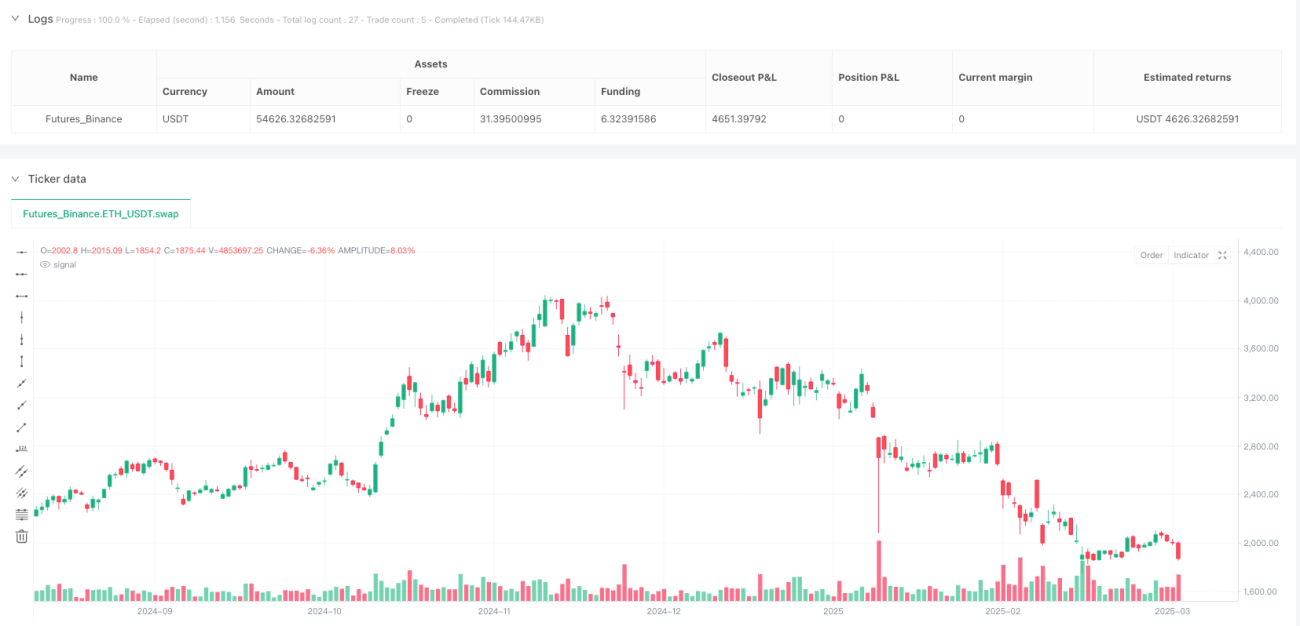
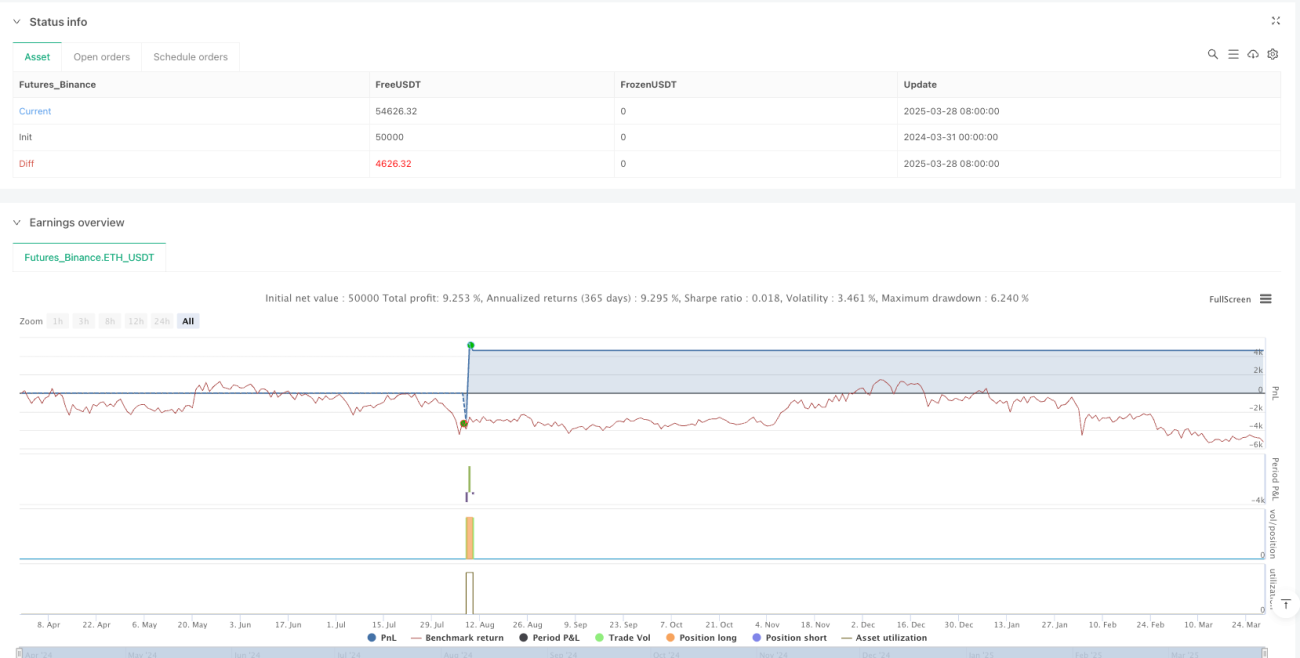
Dynamic Multi-Timeframe Pivot Trend Breakthrough Strategy

RSI PP R1 S1 EMA TF
Created on: 2025-03-31 17:27:39 Modified on: 2025-03-31 17:27:39
Copy: 4 Number of hits: 332
avatar of ianzeng123 ianzeng123
2
Follow
319
Followers

 Dynamic Multi-Timeframe Pivot Trend Breakthrough Strategy  Dynamic Multi-Timeframe Pivot Trend Breakthrough Strategy

Overview

This strategy is a dynamic trend breakthrough trading approach based on multi-timeframe pivots and the Relative Strength Index (RSI). By combining weekly-level price support and resistance levels with the RSI indicator, the strategy aims to capture trend opportunities in financial markets while providing refined position management and risk control mechanisms.

Strategy Principles

The core principles of the strategy include the following key steps:

  1. Multi-Timeframe Price Pivot Calculation:
  • Calculate key support and resistance levels using weekly-level previous candle’s close, high, and low prices
  • Compute typical support levels (S1, S2, S3) and resistance levels (R1, R2, R3)
  • Dynamically adjust support and resistance levels’ sensitivity through a factor
  1. RSI Indicator Dynamic Optimization:
  • Calculate RSI with a 21-period length
  • Introduce Exponential Moving Average (EMA) to smooth RSI
  • Construct a composite indicator combining raw RSI and EMA smoothed values
  1. Trading Signal Generation:
  • Long Entry: Composite indicator crosses above 0
  • Long Exit: Highest price breaks R3 resistance level
  • Short Entry: Lowest price breaks S3 support level
  • Short Exit: Composite indicator crosses below 0

Strategy Advantages

  1. Multi-Timeframe Perspective: Effectively filter short-term market noise by introducing weekly-level data
  2. Flexible Position Management: Staged take-profit mechanism reduces single-trade risk
  3. Dynamic Indicator Construction: Combine RSI and EMA to improve signal accuracy
  4. Symmetric Long and Short Trading Logic: Provide flexible strategies for different market environments
  5. Controllable Risk: Built-in stop-loss and staged take-profit mechanisms

Strategy Risks

  1. Indicator Lag: RSI and price pivots may have latency issues
  2. Parameter Sensitivity: Strategy performance highly depends on parameter selection
  3. Transaction Cost Impact: Frequent trading may lead to high commission fees
  4. Extreme Market Conditions: Trend reversal and violent fluctuations may cause strategy failure

Strategy Optimization Directions

  1. Introduce machine learning algorithms to optimize parameter selection
  2. Add volume and volatility filtering mechanisms
  3. Combine more technical indicators for signal verification
  4. Develop dynamic stop-loss and take-profit algorithms
  5. Introduce more complex position sizing management models

Summary

The strategy builds a relatively robust trend breakthrough trading method through multi-timeframe and multi-indicator comprehensive analysis. Its core advantage lies in dynamically capturing market trends and fine-grained risk management. Future optimization spaces include algorithmic intelligence and iterative risk control model development.

Strategy source code
/*backtest
start: 2024-03-31 00:00:00
end: 2025-03-29 08:00:00
period: 1d
basePeriod: 1d
exchanges: [{"eid":"Futures_Binance","currency":"ETH_USDT"}]
*/

// This Pine Script™ code is subject to the terms of the Mozilla Public License 2.0 at https://mozilla.org/MPL/2.0/
// © yuxishejiang

//@version=6
//@version=5
strategy(title="BTC中轴策略优化-V2", overlay=true, pyramiding=1, initial_capital=5000, default_qty_type=strategy.percent_of_equity, default_qty_value=100, calc_on_order_fills=false, slippage=0, commission_type=strategy.commission.percent, commission_value=0.075)

// 核心参数
strat_dir_input = input.string(title="Strategy Direction", defval="long", options=["long", "short"])
strat_dir_value = strat_dir_input == "long" ? strategy.direction.long : strat_dir_input == "short" ? strategy.direction.short : strategy.direction.all
strategy.risk.allow_entry_in(strat_dir_value)

// 指标计算
higherTF = input.timeframe("W", "Higher Timeframe")
pc = request.security(syminfo.tickerid, higherTF, close[1], barmerge.gaps_off, barmerge.lookahead_on)
ph = request.security(syminfo.tickerid, higherTF, high[1], barmerge.gaps_off, barmerge.lookahead_on)
pl = request.security(syminfo.tickerid, higherTF, low[1], barmerge.gaps_off, barmerge.lookahead_on)

PP = (ph + pl + pc) / 3
R1 = PP + (PP - pl)
S1 = PP - (ph - PP)
R2 = PP + (ph - pl)
S2 = PP - (ph - pl)
factor = input.int(2, "Factor")
R3 = ph + factor * (PP - pl)
S3 = pl - 2 * (ph - PP)

length = input.int(21, "RSI Length")
p = close
vrsi = ta.rsi(p, length)
pp_ema = ta.ema(vrsi, length)
d = (vrsi - pp_ema) * 5
cc = (vrsi + d + pp_ema) / 2

// 仓位管理变量
var float entry_qty = na

// 交易执行逻辑
longEntry = ta.crossover(cc, 0)
longExit = ta.crossover(high, R3)  // 使用实时最高价判断

shortEntry = ta.crossunder(low, S3)  // 改为使用S3支撑位
shortExit = ta.crossunder(cc, 0)     // 同步修改为下穿

if (longEntry)
    strategy.entry("Long", strategy.long)
    entry_qty := strategy.position_size

if (strategy.position_size > 0 and longExit)
    strategy.close("Long", comment="5M背离离场")

if (shortEntry)
    strategy.entry("Short", strategy.short)
    entry_qty := strategy.position_size

if (strategy.position_size < 0 and shortExit)
    strategy.close("Short", comment="空头离场")

// 止盈止损模块
per(pcnt) =>
    strategy.position_size != 0 ? math.round(math.abs(pcnt/100 * strategy.position_avg_price / syminfo.mintick)) : na

stoploss = input.float(15, "Stop Loss (%)", minval=0.01)
tp1 = input.float(3, "Take Profit 1 (%)", minval=0.01)
tp2 = input.float(5, "Take Profit 2 (%)", minval=0.01)
tp3 = input.float(7, "Take Profit 3 (%)", minval=0.01)
tp4 = input.float(10, "Take Profit 4 (%)", minval=0.01)

// 分阶段平仓逻辑
if strategy.position_size != 0
    qty_total = math.abs(entry_qty)
    qty1 = math.floor(qty_total * 0.25)
    qty2 = math.floor(qty_total * 0.25)
    qty3 = math.floor(qty_total * 0.25)
    qty4 = qty_total - (qty1 + qty2 + qty3)
    
    if strategy.position_size > 0
        strategy.exit("x1", qty=qty1, profit=per(tp1), loss=per(stoploss))
        strategy.exit("x2", qty=qty2, profit=per(tp2), loss=per(stoploss))
        strategy.exit("x3", qty=qty3, profit=per(tp3), loss=per(stoploss))
        strategy.exit("x4", qty=qty4, profit=per(tp4), loss=per(stoploss))
    else
        strategy.exit("x1", qty=qty1, profit=per(tp1), loss=per(stoploss))
        strategy.exit("x2", qty=qty2, profit=per(tp2), loss=per(stoploss))
        strategy.exit("x3", qty=qty3, profit=per(tp3), loss=per(stoploss))
        strategy.exit("x4", qty=qty4, profit=per(tp4), loss=per(stoploss))

// 可视化部分保持不变
// 多头入场可视化
if (longEntry)
    label.new(bar_index, low, "多头入场", color=color.green, textcolor=color.white, style=label.style_label_up, size=size.small)

// 多头离场可视化
if (strategy.position_size > 0 and longExit)
    label.new(bar_index, high, "多头离场", color=color.red, textcolor=color.white, style=label.style_label_down, size=size.small)

// 空头入场可视化
if (shortEntry)
    label.new(bar_index, high, "空头入场", color=color.red, textcolor=color.white, style=label.style_label_down, size=size.small)

// 空头离场可视化
if (strategy.position_size < 0 and shortExit)
    label.new(bar_index, low, "空头离场", color=color.green, textcolor=color.white, style=label.style_label_up, size=size.small)