
Overview
The Multi-Timeframe EMA Cloud Trend-Following Short Strategy is a quantitative trading system focused on capturing downward trends. The core of this strategy lies in utilizing Exponential Moving Averages (EMAs) across different timeframes to construct a dynamic cloud, providing clear short signals to traders. When the short-term EMA crosses below the long-term EMA, forming a bearish cloud, the system triggers a short entry signal. This strategy is particularly suitable for trend-following traders, especially those focusing on bearish market opportunities. The strategy incorporates a flexible multi-timeframe analysis framework, allowing traders to confirm trend direction across different time horizons, while providing comprehensive risk management through percentage-based stop loss and take profit settings.
Strategy Principles
The core principle of this strategy is based on the relative positioning of two Exponential Moving Averages (EMAs) of different periods:
-
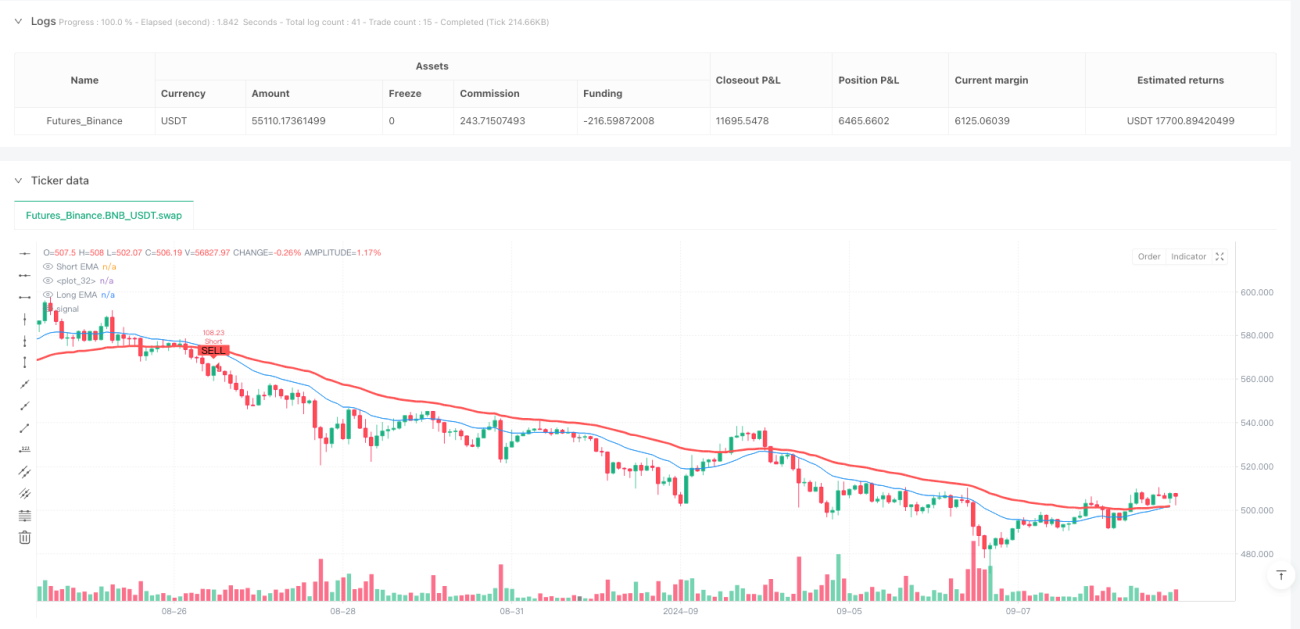
Dual EMA Cloud Construction: The strategy uses a short-period EMA (default 21 periods) and a long-period EMA (default 50 periods) to create a dynamic cloud. When the short-term EMA is below the long-term EMA, the cloud indicates a bearish state; when the short-term EMA is above the long-term EMA, the cloud indicates a bullish state.
-
Multi-Timeframe Analysis: Through the
request.securityfunction, cross-timeframe analysis is implemented, allowing traders to calculate the EMA cloud on either the current chart timeframe or another selected timeframe. This provides a more comprehensive trend perspective, helping to filter out short-term fluctuations. -
Short Signal Generation: When the short-term EMA crosses below the long-term EMA (detected via the
ta.crossunderfunction), the system identifies a potential trend change and triggers a short entry signal. -
Risk Management Mechanism: The strategy integrates percentage-based stop loss and take profit calculations:
- Short stop loss price = Entry price * (1 + Stop loss percentage)
- Short take profit price = Entry price * (1 - Take profit percentage)
-
Visual Assistance: The strategy plots the EMA cloud on the chart and marks short signals with red labels, providing traders with intuitive visual references.
-
Alert Functionality: Short signals are set up with alerts through the
alertconditionfunction, ensuring traders don't miss trading opportunities.
The strategy execution flow is clear: first calculating EMAs across different timeframes, then constructing the dynamic cloud, detecting cloud state changes to generate short signals, and finally executing trades with corresponding stop loss and take profit levels.
Strategy Advantages
-
Trend-Following Efficiency: The strategy focuses on capturing downward trends, providing clear trend reversal signals through EMA crossovers, avoiding frequent trading in ranging markets, and improving capital utilization efficiency.
-
Multi-Timeframe Analysis Benefits: The strategy allows for EMA cloud calculation across different timeframes. This cross-period analysis helps confirm trend strength and persistence, reducing false signal risk.
-
Visual Intuitiveness: The EMA cloud and short signal markers provide clear visual references, enabling traders to quickly identify market conditions and potential entry points, simplifying the decision-making process.
-
Comprehensive Risk Management: Built-in percentage-based stop loss and take profit mechanisms ensure consistency in risk per trade, unaffected by market volatility or instrument differences, aiding long-term capital management.
-
Flexible Parameters: The strategy offers multiple adjustable parameters (EMA lengths, timeframes, stop loss/take profit percentages, etc.), allowing traders to optimize strategy performance based on personal risk preferences and market conditions.
-
Automated Alert System: The built-in alert functionality ensures traders are promptly notified of potential trading opportunities without constant market monitoring, improving trading efficiency.
-
Intelligent Capital Management: The strategy uses a percentage of equity for position sizing (default_qty_type=strategy.percent_of_equity), ensuring automatic adjustment of position size as account equity changes, enabling compound growth.
Strategy Risks
-
Trend Reversal Risk: As a trend-following strategy, it may face significant drawdowns in rapidly reversing markets. Solution: Introduce momentum indicators or volatility filters to reduce or avoid trading when trends are unclear.
-
Lag Issues: EMAs are inherently lagging indicators, potentially leading to suboptimal entry points, especially in rapidly changing markets. Solution: Try reducing EMA period lengths or combining with other leading indicators to optimize entry timing.
-
False Signal Risk: Short-term market noise can lead to false EMA crossover signals. Solution: Add confirmation mechanisms, such as requiring price confirmation below the EMA or adding volume conditions.
-
Narrow Stop Loss Risk: Fixed percentage stops may not adapt to all market conditions and can be easily triggered in high-volatility environments. Solution: Consider ATR (Average True Range) based dynamic stops to adapt to varying market volatility.
-
Single Market Dependency: Focusing exclusively on short strategies limits profit opportunities in bullish markets. Solution: Consider developing paired strategies or balancing long and short strategies in a portfolio.
-
Parameter Optimization Trap: Excessive parameter optimization may lead to curve-fitting, reducing strategy performance in future markets. Solution: Use sufficiently long backtesting periods, conduct robustness tests, and implement walk-forward optimization.
-
Execution Risk: Slippage and commissions in actual trading can significantly impact strategy performance. Solution: Include realistic slippage and commission assumptions in backtesting to ensure strategy viability under actual trading conditions.
Strategy Optimization Directions
-
Multi-Indicator Fusion: Combine the EMA cloud with other technical indicators such as RSI (Relative Strength Index) or MACD (Moving Average Convergence Divergence) to build a more comprehensive entry confirmation system. This can reduce false signals and improve strategy precision, as multi-indicator convergence typically represents stronger market signals.
-
Dynamic Stop Loss Mechanism: Replace fixed percentage stops with ATR (Average True Range) based stops, allowing the stop level to automatically adjust according to market volatility. This approach better adapts to different market conditions, avoiding premature stops during high volatility periods.
-
Time Filters: Introduce trading time filters to avoid high volatility periods such as major economic data releases or market opening/closing times. This can reduce false signals caused by temporary market abnormalities.
-
Trend Strength Assessment: Add trend strength indicators (such as ADX - Average Directional Index), executing trades only when the trend is sufficiently strong. This helps avoid ineffective trades in ranging markets, improving the strategy's win rate.
-
Partial Profit Locking: Implement stepped take profits, locking in partial profits when price reaches certain target levels. This approach can reduce drawdown risk while maintaining the potential to capture major trends.
-
Position Sizing Optimization: Implement volatility-based position sizing, reducing exposure when volatility increases. This approach helps maintain risk consistency, avoiding excessive risk during high volatility periods.
-
Backtesting Robustness: Conduct cross-market, cross-period strategy testing to ensure strategy maintains stable performance under different conditions. This is crucial for verifying strategy adaptability and reducing overfitting risk.
Conclusion
The Multi-Timeframe EMA Cloud Trend-Following Short Strategy provides traders with a systematic approach to identifying and capturing downward trends. By utilizing the EMA cloud as a visual guide, combined with multi-timeframe analysis and strict risk management, the strategy can effectively filter market noise and identify meaningful trend reversals.
The strategy's main advantages lie in its simplicity and adaptability, providing clear short signals while maintaining sufficient flexibility to adapt to different market environments. The built-in risk management mechanisms ensure each trade has predefined risk parameters, contributing to long-term capital preservation.
However, it's also important to be aware of the inherent limitations of such trend-following strategies. By implementing the suggested optimizations such as multi-indicator confirmation, dynamic stops, and trend strength filters, traders can further enhance the strategy's robustness and performance.
Ultimately, successful application of this strategy requires patience and discipline, understanding the importance of market context, and adjusting parameters to suit different market conditions. For traders focused on capturing bearish market opportunities, this strategy provides a systematic and repeatable trading approach.
/*backtest
start: 2024-04-03 00:00:00
end: 2024-09-10 00:00:00
period: 2h
basePeriod: 2h
exchanges: [{"eid":"Futures_Binance","currency":"BNB_USDT"}]
*/

//@version=6
strategy(title="Short-Only MTF EMA Cloud Strategy", overlay=true, default_qty_type=strategy.percent_of_equity, default_qty_value=100, currency=currency.USD)

// Inputs for EMA Cloud- 1