
Overview
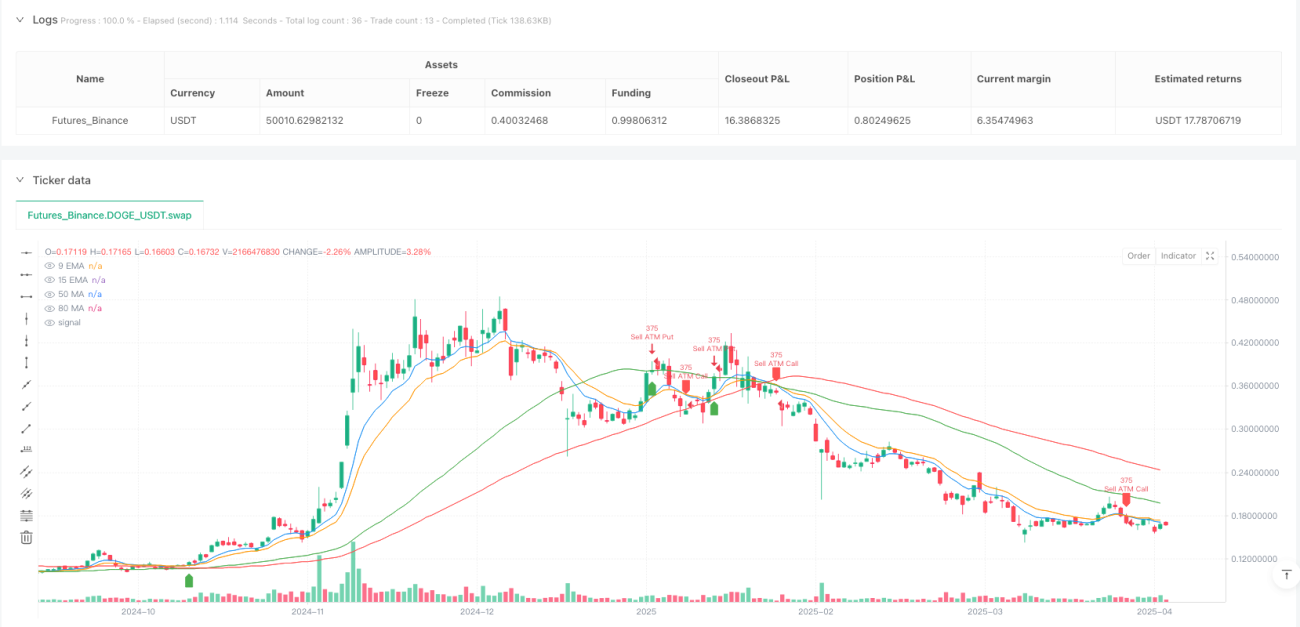
The Dynamic Trend-Filtered ATM Option Selling Strategy is an intraday trading approach that combines short-term and medium-term moving averages with momentum indicators to identify optimal option selling opportunities. This strategy utilizes the 9/15 Exponential Moving Average (EMA) crossover signals as the primary entry trigger, while incorporating 50/80 Moving Average (MA) as an overall market trend filter, and the Relative Strength Index (RSI) for momentum confirmation. To eliminate overnight risk, the strategy ensures all trades are automatically closed before market close (15:24 IST), making it particularly suitable for intraday traders who prefer not to carry overnight positions.
Strategy Principles
The core principle of this strategy is to sell At-The-Money (ATM) options in clearly defined trend environments, using a multi-layered technical indicator filtering system to enhance trade accuracy:
-
Trend Identification Layer: The 50-day and 80-day Moving Averages (MA) are used to determine the medium-term market trend direction. When price is below both MAs, the market is considered in a downtrend, suitable for selling Call options (CE); when price is above both MAs, the market is in an uptrend, suitable for selling Put options (PE).
-
Short-term Signal Layer: The 9-day and 15-day Exponential Moving Averages (EMA) crossovers are used to capture short-term trend shifts. When the 9 EMA crosses below the 15 EMA, it indicates a bearish short-term trend shift, which combined with a downtrend background allows for Call option selling; when the 9 EMA crosses above the 15 EMA, it indicates a bullish short-term trend shift, suitable for Put option selling in an uptrend context.
-
Momentum Confirmation Layer: The RSI(14) indicator provides additional momentum confirmation. When RSI is below 50, it confirms bearish momentum; when RSI is above 50, it confirms bullish momentum.
-
ATM Option Positioning: The strategy automatically calculates and rounds to the nearest 50-point price level as the strike price for ATM options, ensuring trades are executed on contracts with optimal liquidity.
-
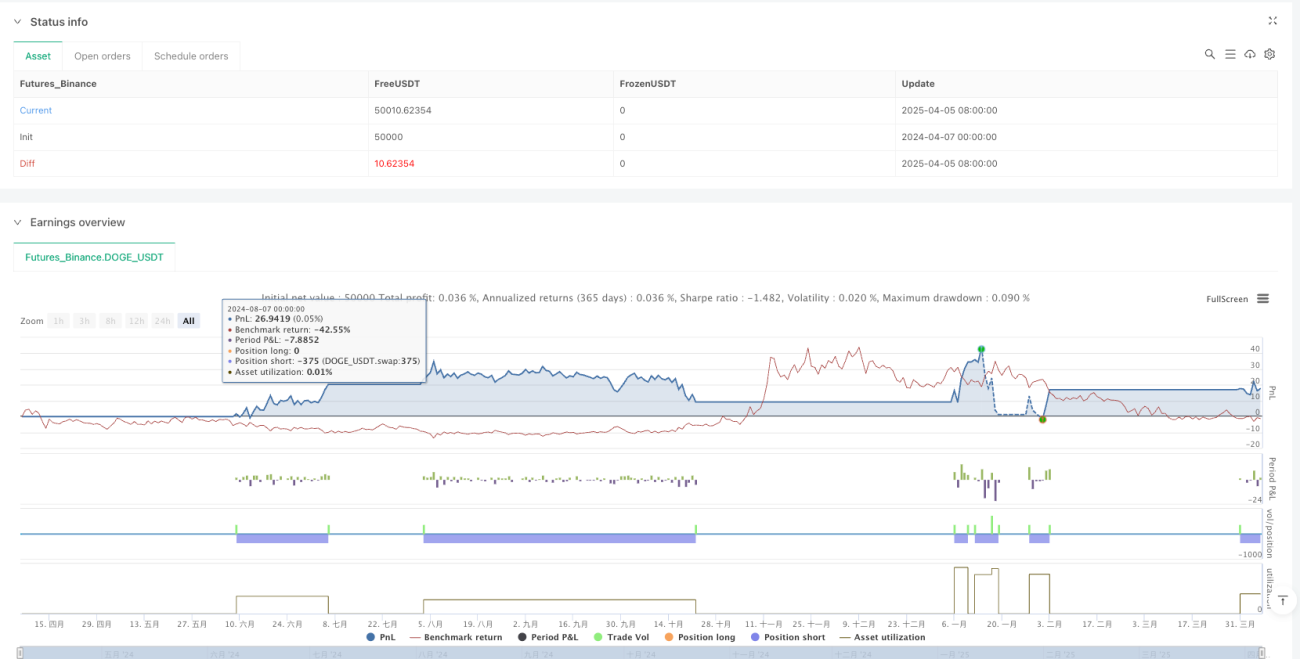
Risk Management Mechanism: Each trade uses a fixed position size of 375 contracts, with a 50-point stop loss and 50-point take profit, along with mandatory closing of all open positions before market close (15:24).
Strategy Advantages
-
Multi-layered Filtering System: By combining three different technical indicators (MA, EMA, and RSI), the strategy forms a robust multi-layered filtering system that effectively reduces false signals and improves trading accuracy.
-
Trend and Momentum Synergy: The strategy only enters trades when both trend and momentum are aligned, ensuring trades follow the main market direction, increasing the probability of success.
-
Precise Risk Control: With fixed stop loss and take profit levels (50 points), the risk and reward ratio for each trade is clear and predictable, contributing to stable money management.
-
Avoidance of Overnight Risk: The automatic position closing mechanism before market close effectively eliminates the gap risk and time value decay issues often associated with overnight options positions.
-
Liquidity Optimization: Focus on trading ATM options, which typically have the best liquidity and smallest bid-ask spreads, reduces transaction costs.
-
Clear Strategy Logic: Entry and exit conditions are specific and objective, without subjective judgment components, making it suitable for systematic automated trading implementation.
Strategy Risks
-
Moving Average Lag Risk: Moving averages are inherently lagging indicators and may produce delayed signals in volatile markets, leading to suboptimal entry timing.
-
Fixed Stop Loss Limitation: The strategy uses a fixed 50-point stop loss, which in environments of increased market volatility might lead to frequent stop-outs while the actual trend direction might still be correct.
-
Trend Reversal Point Risk: Near major trend turning points, indicator signals may become confusing, resulting in incorrect trading signals.
-
Liquidity Risk: Although ATM options typically have good liquidity, under specific market conditions (such as before and after major announcements), liquidity may suddenly decrease, leading to increased slippage.
-
Market Consolidation Risk: During sideways consolidation phases, price frequently fluctuates around moving averages, potentially causing frequent and unreliable signals, increasing trading costs and the possibility of erroneous trades.
Methods to mitigate these risks include: pausing strategy operation before important economic data or company announcements, adding additional market volatility filters, considering adjusting stop loss magnitude in different market conditions, and adding consolidation market identification mechanisms to avoid trading in unsuitable market environments.
Strategy Optimization Directions
-
Dynamic Stop Loss Mechanism: Replace the fixed 50-point stop loss with a volatility-based dynamic stop loss, such as setting stop loss based on multiples of the ATR (Average True Range), to better adapt to different market environments.
-
Add Volatility Filter: Introduce VIX or other volatility indicators as additional filtering conditions to avoid entering positions during extremely high volatility periods or to adjust position sizing.
-
Time-weighted Factors: Introduce trading session filtering to avoid high volatility periods at market opening and before closing, or adjust strategy parameters during these periods.
-
Multi-timeframe Confirmation: Add higher timeframe trend confirmation, such as incorporating daily trend judgment, only entering trades when daily trends and short-term signals are aligned.
-
Partial Profit Locking Mechanism: Implement a tiered profit-taking strategy, securing partial gains when trades reach certain profit levels, with the remainder set for more relaxed profit targets.
-
Parameter Optimization and Backtesting: Optimize the 9/15 EMA and 50/80 MA parameters to find the best parameter combinations across different market cycles.
-
Add Implied Volatility Analysis: Incorporate implied volatility considerations in options trading, prioritizing selling options series where implied volatility is relatively high.
These optimization directions aim to make the strategy more flexible, better able to adapt to different market environments, while improving profitability and reducing risk. Particularly, the introduction of dynamic stop loss mechanisms and volatility filters can significantly enhance strategy adaptability across different market conditions.
Conclusion
The Dynamic Trend-Filtered ATM Option Selling Strategy is a clearly structured, logically rigorous intraday option selling system that precisely captures high-probability trading opportunities through the combination of trend following and momentum confirmation techniques. The core advantages of this strategy lie in its multi-layered filtering mechanism and strict risk management system, which effectively control single trade risk while avoiding overnight risk through the pre-market close mandatory position closing mechanism.
Although the strategy has clear trading logic and risk control mechanisms, it still faces potential risks such as moving average lag, fixed stop loss limitations, and market environment changes. By introducing optimizations like dynamic stop losses, volatility filtering, and multi-timeframe confirmation, the strategy's robustness and adaptability can be further enhanced.
For investors looking to conduct systematic option selling in the intraday market, this strategy provides a reliable framework. However, in practical application, it is recommended that investors first conduct thorough testing in a simulated environment and make appropriate parameter adjustments based on personal risk tolerance and market conditions to achieve optimal trading results.
- 1