Multi-Timeframe Trend Breakout Strategy with RSI Filter and ATR-Based Risk Management

2
Follow
526
Followers
Overview
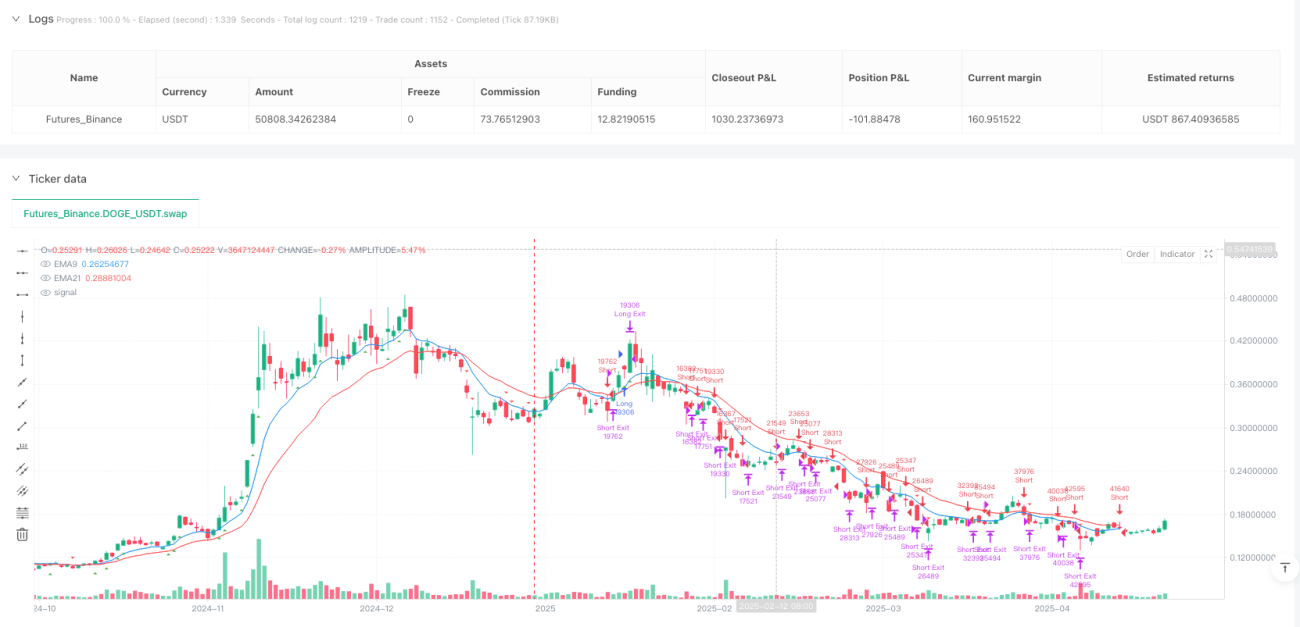
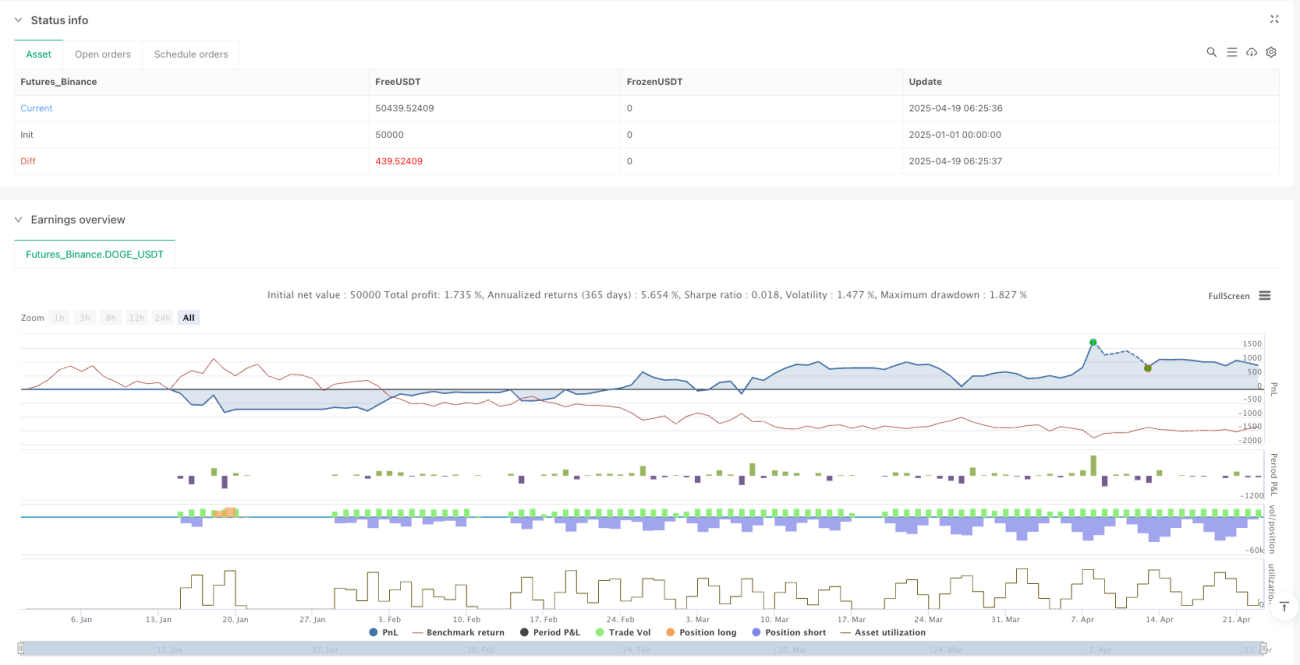
This strategy combines trend-following and breakout trading across multiple timeframes, using EMA crossovers as trend filters, RSI for momentum confirmation, and ATR for dynamic risk management. It features a separated alert system for precise entry/exit signal management and employs percentage-based money management to control risk.
Strategy Logic
- Trend Identification: Uses the crossover relationship between fast EMA(9) and slow EMA(21) to determine market trend direction.
- Momentum Confirmation: RSI indicator (period 14) confirms trend strength, requiring RSI>50 for long trades and RSI<50 for short trades.
- Breakout Signals: Generates trading signals when price breaks the previous bar's high/low points after trend confirmation.
- Risk Management: Uses ATR (period 14) to calculate dynamic stop-loss levels with fixed 2% account risk per trade. Take-profit is set at 3 times the stop-loss distance, with trailing stop activated after 50% profit.
- Position Sizing: Dynamically calculates position size based on stop-loss distance and risk percentage to ensure consistent risk exposure.
Advantages
- Multi-factor Verification: Combines trend, momentum and price action confirmation for higher signal quality.
- Dynamic Risk Management: ATR-based stops adapt to market volatility changes, with trailing stops protecting floating profits.
- Scientific Money Management: Fixed-percentage risk control prevents overtrading, with precise position sizing.
- Clear Visual Signals: plotshape function provides intuitive visual cues for monitoring.
- Separated Alert System: Independent entry/exit alerts facilitate automated trading integration.
Risks
- Range-bound Market Risk: May generate false breakout signals during trendless conditions. Solution: Add ADX filter.
- Parameter Sensitivity: Fixed parameters may fail in different instruments/market regimes. Solution: Parameter optimization or adaptive settings.
- Gap Risk: Price gaps may cause slippage. Solution: Reduce position before major news.
- Overfitting Risk: Historical optimization may not work forward. Solution: Robust out-of-sample testing.
Optimization Directions
- Adaptive Parameters: Replace fixed parameters with volatility-based adaptive settings.
- Composite Trend Filter: Add higher timeframe trend confirmation.
- Dynamic Take-profit: Replace fixed TP ratio with support/resistance or Fibonacci extensions.
- Machine Learning: Use reinforcement learning to dynamically adjust RSI thresholds and TP/SL ratios.
- Event Filtering: Integrate economic calendar to adjust risk parameters around major events.
Conclusion
This is a well-structured trend-following strategy that improves signal reliability through multi-indicator confirmation and controls downside risk with scientific money management. It performs best in trending markets with moderate volatility. Further enhancements in parameter adaptation and market regime detection could significantly improve robustness and adaptability.
Source
Pine
// @version=5
strategy("Trend Breakout Strategy with Separated Alerts", overlay=true, initial_capital=10, default_qty_type=strategy.percent_of_equity, default_qty_value=100)

// --- Parameters ---
var float risk_per_trade = 0.02 // 2% risk per trade
var int ema_fast = 9
var int ema_slow = 21
var int rsi_length = 14
var int atr_length = 14
var float atr_multiplier_sl = 2.0 // ATR multiplier for SL
var float tp_ratio = 3.0 // TP to SL ratio = 3:1
var float trail_trigger_ratio = 0.5 // Trailing stop triggers at 50% of TPRelated strategies
Comment
All comments (0)
No data
- 1