
Overview
The Multi-Timeframe Zero-Lag Trend Signals Trading Strategy is a quantitative trading system based on the Zero-Lag Exponential Moving Average (ZLEMA), designed to reduce the lag inherent in traditional moving averages and provide faster, more accurate trend identification signals. This strategy combines volatility channels to identify trend changes and integrates multiple flexible exit mechanisms, including risk-reward ratio exits, profit target exits, ATR-based stop-loss and take-profit, dynamic trailing stops, and EMA crossover exits. Particularly suitable for medium to long-term trading, the strategy can be configured for long-only or bidirectional trading and offers zero-line re-entry options, greatly enhancing the adaptability and risk management capabilities of the trading system.
Strategy Principles
The core principle of this strategy is based on the Zero-Lag Exponential Moving Average (ZLEMA), a technical indicator that improves the responsiveness of moving averages by eliminating or reducing price data lag. The specific implementation steps are as follows:
-
Zero-Lag Calculation: The strategy first calculates ZLEMA using the formula
zlema = ta.ema(src + (src - src[lag]), length), wherelagis derived based on half the length, effectively reducing the lag present in traditional EMAs. -
Trend Identification Mechanism:
- Volatility channels (similar to Bollinger Bands) are added around the ZLEMA, with channel width determined by the highest ATR value multiplied by a factor
- When price crosses above the upper band, the trend turns upward (1)
- When price crosses below the lower band, the trend turns downward (-1)
- The system also provides confirmation functionality through 5 consecutive bars of consistent ZLEMA direction, implemented via the
zlemaUpTrendandzlemaDownTrendvariables
-
Diversified Entry Conditions:
- Basic long entry: price crosses above the upper band and is within the date range
- Advanced long entry: basic conditions plus trend confirmation with ZLEMA rising for 5 consecutive bars
- Short entry: price crosses below the lower band and is within the date range (optional feature)
- ZLEMA zero-line re-entry: price briefly pulls back and then returns above ZLEMA, while still in an uptrend
-
Comprehensive Dynamic Exit System:
- Risk-reward ratio profit target: calculates target price based on entry price and stop-loss position at a specific risk-reward ratio
- ATR-based stop-loss and take-profit: dynamically calculates stop-loss and take-profit positions using ATR multipliers
- ATR trailing stop: automatically raises stop-loss position as price moves favorably
- Break-even stop-loss: moves stop-loss to entry price when profit reaches a specific risk-reward ratio
- Trend reversal exit: automatically exits when trend indicator reverses
- EMA exit: exits when price crosses a specific EMA
Strategy Advantages
The Multi-Timeframe Zero-Lag Trend Signals Trading Strategy offers significant advantages:
-
Reduced Signal Lag: Through ZLEMA technology, the lag of traditional moving averages is reduced, making trend identification more timely and enabling earlier capture of trend starting points.
-
Comprehensive Risk Management System: Integrates multi-level risk control mechanisms, from fixed stop-losses, ATR dynamic stop-losses, and trailing stops to break-even stop-losses, providing comprehensive protection for different market environments.
-
Flexible Trading Direction Options: Can be configured as either a long-only strategy or a bidirectional trading strategy, adapting to different market preferences and regulatory environments.
-
Re-entry Mechanism: Through the ZLEMA zero-line re-entry function, allows re-entry after short-term pullbacks in strong trends, maximizing trend profits.
-
Diversified Exit Strategies: Provides multiple exit solutions for different market conditions, either locking in profits through profit targets or letting profits run through trailing stops.
-
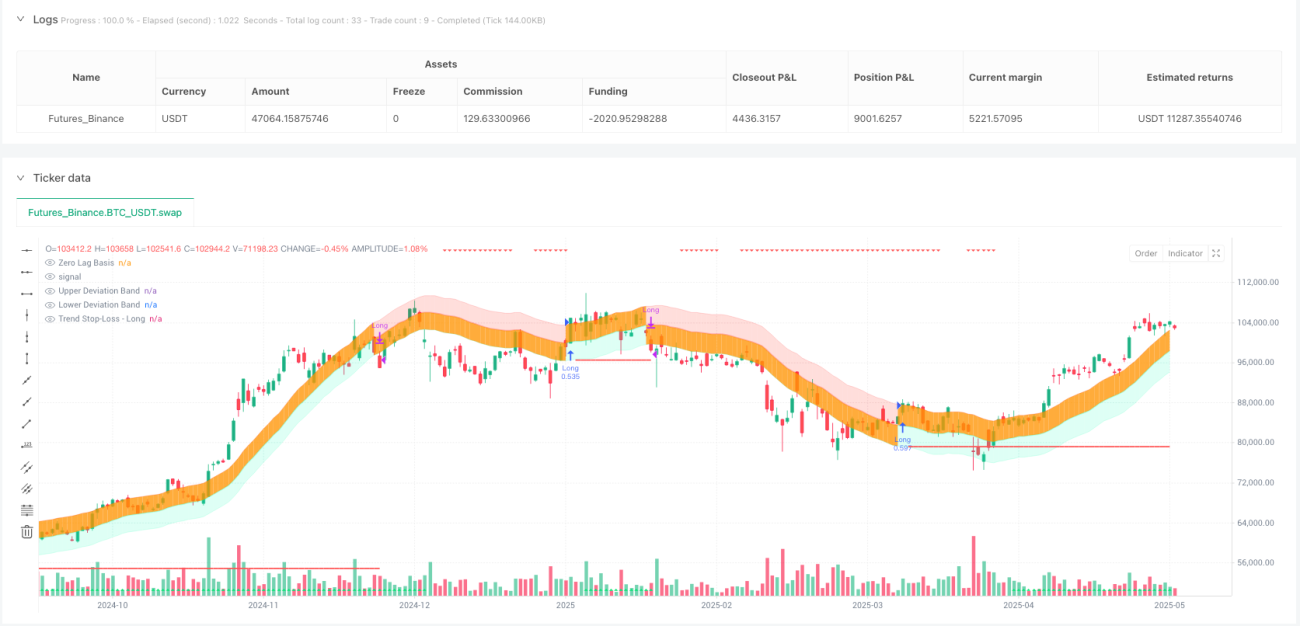
Visual Assistance: Through visualization elements such as trend shading, stop-loss lines, take-profit lines, and trend indicators, intuitively displays trading signals and risk management positions.
-
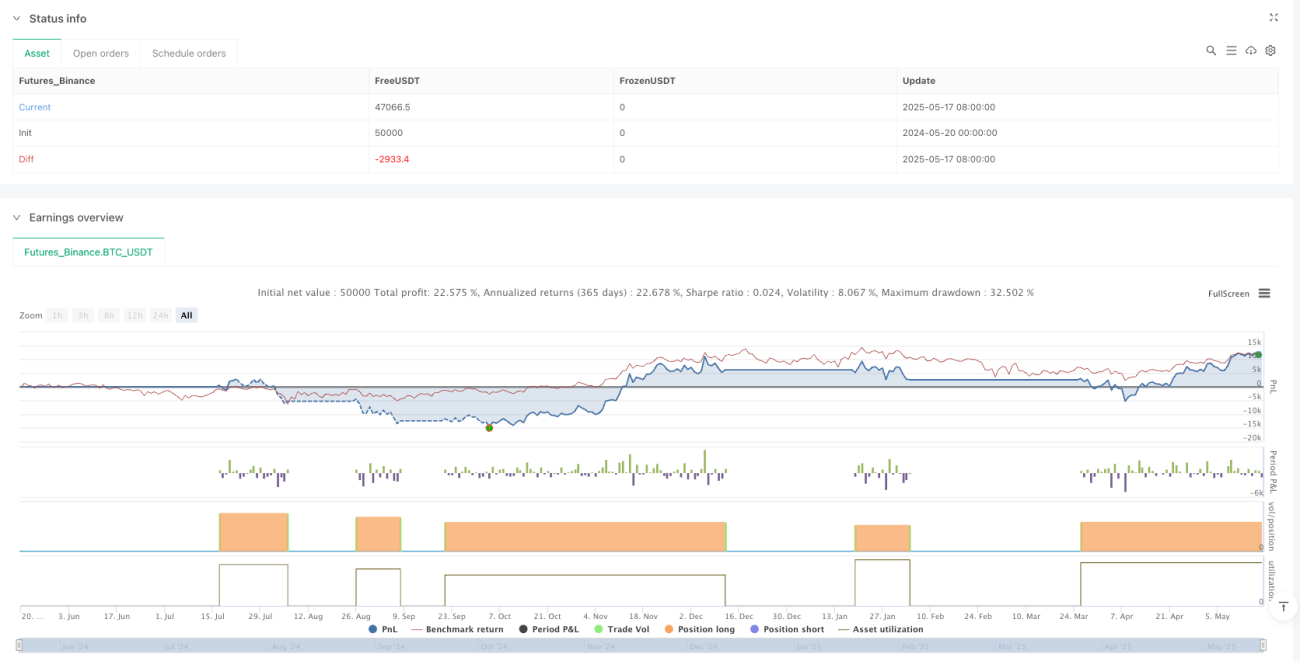
Detailed Performance Statistics: Integrates trade statistics tables showing key indicators such as win rate, net profit, and maximum drawdown, facilitating strategy evaluation and optimization.
Strategy Risks
Despite its well-designed nature, there are several potential risks that need attention:
-
Parameter Sensitivity: Core parameters such as ZLEMA length and ATR multipliers significantly impact strategy performance; improper settings may lead to too many or too few signals.
-
False Signals in Choppy Markets: In oscillating markets without clear trends, frequent false signals may occur, leading to consecutive losses.
-
Trend Reversal Risk: Although the strategy includes multiple exit mechanisms, in severe trend reversals, it may still suffer significant losses before exiting.
-
Overfitting Risk: The combination of multiple parameters may lead to overfitting historical data, resulting in poor performance in future market environments.
-
Infrequent Signals with Longer Periods: When using longer ZLEMA lengths, the strategy may generate fewer trading signals, affecting capital utilization efficiency.
-
Stop-Loss Width Challenges: ATR-based stops may be too wide in highly volatile markets, leading to excessive single-trade losses; in low-volatility markets, they may be too narrow, triggering frequent exits.
Methods to mitigate these risks include: rigorous parameter backtesting and forward validation, incorporating market state indicators to avoid trading in choppy markets, implementing strict money management rules, and periodically re-optimizing strategy parameters to adapt to market changes.
Strategy Optimization Directions
This strategy has multiple optimization opportunities to further enhance performance:
-
Dynamic Parameter Adaptation: Develop adaptive mechanisms to automatically adjust ZLEMA length and ATR multipliers based on market volatility, improving strategy adaptability across different market environments.
-
Market State Filtering: Introduce market state indicators (such as ADX, volatility indicators) to trade only under favorable market conditions, avoiding frequent trading in inefficient, choppy markets.
-
Multi-Timeframe Confirmation: Incorporate trend direction from higher timeframes, entering only when aligned with the larger trend direction to improve success rates.
-
Volume Confirmation: Integrate volume indicators as auxiliary confirmation, for example, confirming trend change signals only when accompanied by increased trading volume.
-
Machine Learning Optimization: Use machine learning algorithms to find optimal parameter combinations and entry timing, particularly training models to predict which signals are more likely to succeed.
-
Seasonality and Time Filters: Add trading session and calendar filters to avoid inefficient or high-risk trading periods.
-
Correlated Asset Analysis: Introduce correlation analysis of related assets, enhancing signal credibility when multiple assets confirm the same direction.
These optimization directions can not only improve the strategy's stability and profitability but also reduce risk, making it more suitable for different market environments and individual risk preferences.
Summary
The Multi-Timeframe Zero-Lag Trend Signals Trading Strategy is a comprehensive and flexible quantitative trading system that achieves fast and accurate trend identification through Zero-Lag Exponential Moving Average (ZLEMA) technology and volatility channels, while protecting capital safety through multi-level dynamic risk management mechanisms. This strategy can capture entry opportunities in the early stages of trends and maximize returns through re-entry mechanisms as trends develop, while providing multiple exit strategies adapted to different market environments.
The main advantages of the strategy lie in reducing signal lag, providing a comprehensive risk management system, and offering flexible trading configuration options. However, users need to be aware of potential risks such as parameter sensitivity, false signals in choppy markets, and overfitting. Through market state filtering, multi-timeframe confirmation, and dynamic parameter adaptation, strategy performance can be further enhanced.
As a technical indicator-based quantitative trading system, this strategy is particularly suitable for medium to long-term trend trading across various financial markets. However, any strategy needs to be customized according to individual trading goals, risk tolerance, and market preferences, and applied to actual trading in conjunction with strict money management principles.
//@version=6
// Quant Trading Pro www.quanttradingpro.com
// #1 Strategy Optimizer on the chrome extension store Quant Trading Strategy Optimizer


strategy(title="Quant Trading Zero Lag Trend Signals (MTF) Strategy", shorttitle="QT0️⃣Zero Lag Signals Strategy", overlay=true,
     commission_type=strategy.commission.percent,
     commission_value=0.1,
     slippage=3,
     default_qty_type=strategy.percent_of_equity,
     default_qty_value=100,
initial_capital=1000, - 1