
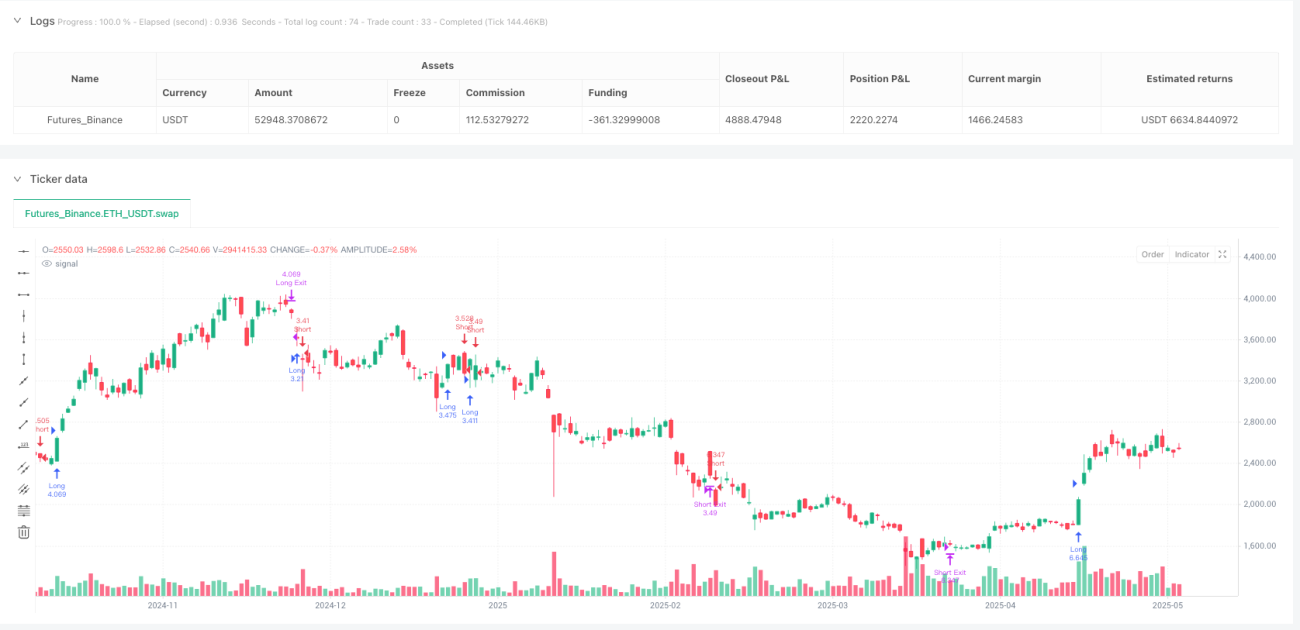
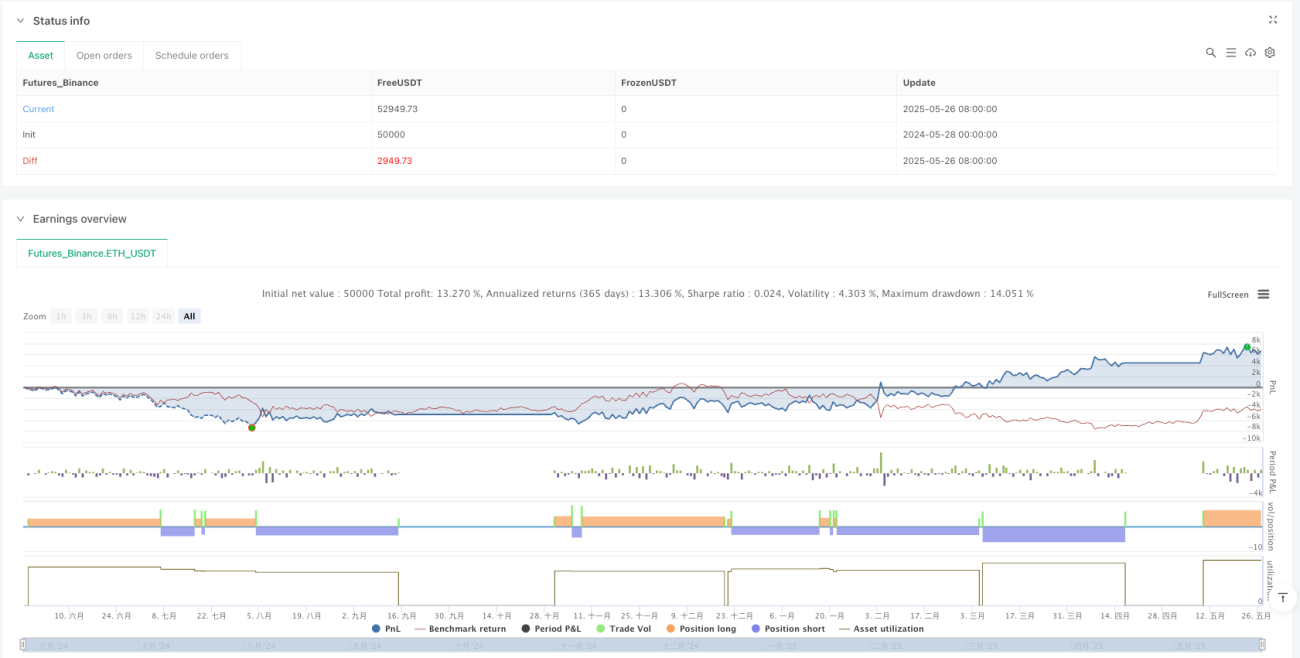
Strategy Overview
The Dynamic Volatility Pulse Breakout Strategy is a trading system based on market volatility expansion, designed to capture directional price movements following significant volatility increases. The strategy identifies potential breakout opportunities by monitoring abnormal expansions in Average True Range (ATR) and incorporates dynamic stop-loss and take-profit levels for risk management. The system is specifically designed to avoid low-volatility environments while implementing a time-based forced exit mechanism to prevent trades from lasting too long.
Strategy Principles
The core logic of this strategy is built upon three key conditions:
-
Volatility Expansion Detection: When the current ATR value significantly exceeds its 20-period moving average (specifically by 50%), the system identifies this as a volatility expansion event. This typically signals a potential important market breakout.
-
Momentum Confirmation: To ensure price movements have directionality rather than random noise, the strategy requires the current closing price to be above (for long positions) or below (for short positions) the closing price from 20 periods ago. This condition ensures the price has a clear trend direction.
-
Low Volatility Filter: The system avoids low-volatility market environments, which typically lead to poor trading opportunities and excessive false signals.
Once entry conditions are met, the strategy sets a dynamic stop-loss at 1x the current ATR distance, while the profit target is set at 2x ATR, creating a 2:1 reward-to-risk ratio. Notably, if a position remains open for more than 42 periods, the system forces a close regardless of whether targets are met, effectively preventing trades from remaining in a stagnant state for extended periods.
Strategy Advantages
-
Volatility-Based Adaptability: The strategy utilizes the ATR indicator to adjust entry points and risk parameters in real-time, enabling it to adapt to the volatility characteristics of different market environments.
-
Momentum Confirmation Mechanism: By requiring price direction to align with momentum, the risk of false breakouts is significantly reduced, improving trade quality.
-
Dynamic Risk Management: Stop-loss and take-profit levels are not fixed values but are dynamically set based on current market volatility, making risk management more precise and relevant.
-
Time Constraint Mechanism: The 42-period forced exit rule prevents capital from being locked in long-term inactive trades, improving capital utilization efficiency.
-
Market State Filtering: By avoiding low-volatility environments, the strategy can focus on market conditions more likely to produce significant price movements.
-
Realistic Trading Cost Considerations: The strategy incorporates a 0.05% commission and slippage factor, making backtest results closer to actual trading environments.
Strategy Risks
-
False Breakout Risk: Despite using momentum confirmation, price reversals may occur after volatility expansion in certain market conditions, triggering stop-losses. This risk can be mitigated by adding additional confirmation indicators (such as volume confirmation).
-
Parameter Sensitivity: Strategy performance is sensitive to parameter settings such as ATR length, momentum lookback period, and volatility thresholds. Comprehensive parameter optimization and robustness testing are recommended to find parameter combinations that perform well across different market conditions.
-
Trend Environment Dependency: This strategy performs best in markets with clear trends and may generate more losing trades in oscillating or sideways markets. Consider adding trend identification filters to improve this issue.
-
Early Exit Risk: The fixed 2:1 risk-reward setting may exit too early in strong trends, missing larger profits. Consider implementing dynamic or partial profit-taking strategies to optimize this aspect.
-
Potential Issues with Time-Based Exits: While forced time exits have their advantages, they may in some cases exit just as the market is about to turn favorable. Consider combining time exits with market conditions rather than purely basing them on period counts.
Strategy Optimization Directions
-
Adaptive Parameter Adjustment: Consider dynamically adjusting ATR length and momentum lookback periods based on market states. For example, use shorter periods in high-volatility environments and longer periods in low-volatility environments to better adapt to market conditions.
-
Multi-Timeframe Analysis: By incorporating trend direction from higher timeframes as an additional filter condition, entry quality can be improved. This can help avoid counter-trend trades and focus on breakouts that align with the primary trend.
-
Dynamic Risk-Reward Adjustment: Risk-reward ratios can be dynamically adjusted based on market states (such as volatility levels, trend strength) rather than fixed at 2:1. Set higher targets in strong trend environments and more conservative targets in environments with higher uncertainty.
-
Partial Profit-Taking Strategy: Implement a staged position-closing strategy, closing part of the position when initial targets are reached while allowing the remaining position to trail stops to capture larger trend movements.
-
Volatility Cyclicality Analysis: Analyze and incorporate cyclical characteristics of volatility to more accurately predict volatility expansion events. Some markets exhibit regular volatility increases at specific times (such as market openings, important data releases).
-
Correlation Filtering: For multi-market trading, correlation analysis can be added to avoid establishing similar directional positions in highly correlated markets simultaneously, thereby reducing portfolio risk.
Summary
The Dynamic Volatility Pulse Breakout Strategy is a well-structured trading system that cleverly combines volatility analysis, momentum confirmation, and time-constrained exit mechanisms. By focusing on directional price movements during periods of volatility expansion, the strategy aims to capture trading opportunities with favorable risk-reward characteristics.
The core advantage of this strategy lies in its adaptability and dynamic risk management architecture, allowing it to remain relevant across different market environments. Meanwhile, features such as time-constrained exits and low-volatility filtering further enhance its practicality, avoiding common trading pitfalls.
Despite some inherent risks, such as false breakouts and parameter sensitivity, the strategy's robustness and long-term performance can be further enhanced through suggested optimization directions, including adaptive parameter adjustment, multi-timeframe analysis, and dynamic risk-reward settings. Overall, this is a strategy framework that balances theoretical insights with practical trading constraints, providing a valuable trading tool for various market participants.
/*backtest
start: 2024-05-28 00:00:00
end: 2025-05-27 00:00:00
period: 1d
basePeriod: 1d
exchanges: [{"eid":"Futures_Binance","currency":"ETH_USDT"}]
*/

//@version=5
strategy("Volatility Pulse with Dynamic Exit", overlay=true, default_qty_type=strategy.percent_of_equity, default_qty_value=25, commission_type=strategy.commission.percent, commission_value=0.05, slippage=1, max_bars_back=300)

// === FIXED INPUTS ===- 1