Multi-Timeframe Stochastic RSI Crossover Strategy

Strategy Overview
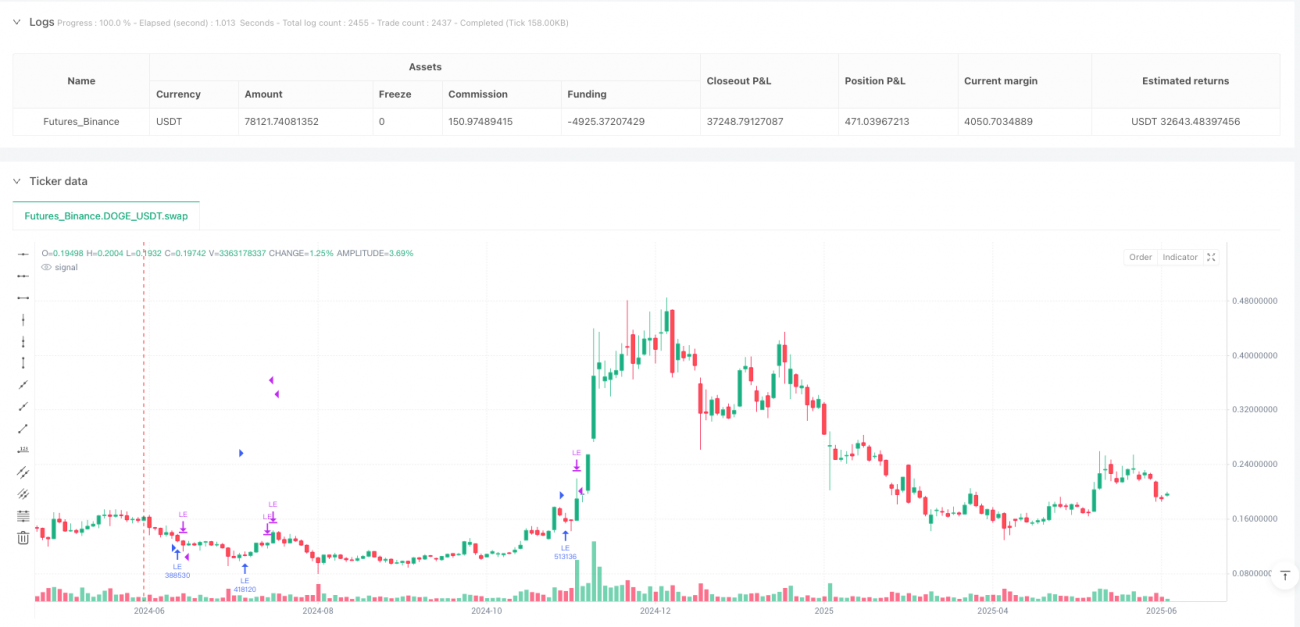
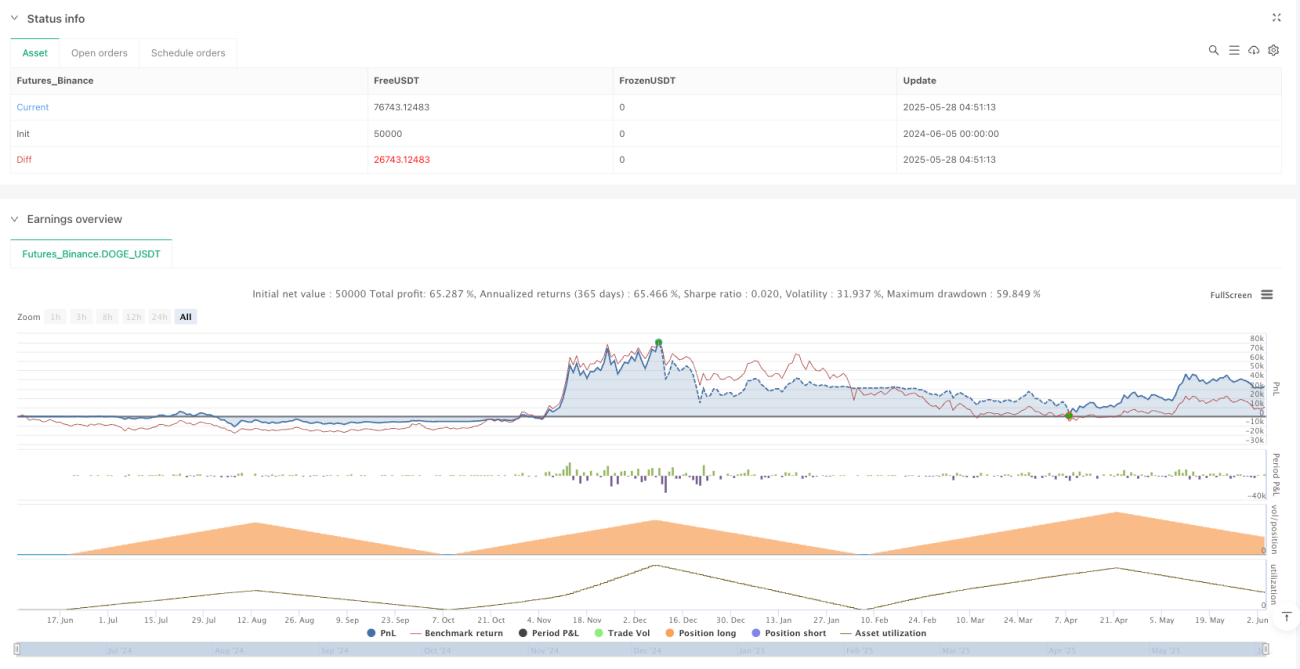
The Multi-Timeframe Stochastic RSI Crossover Strategy is a sophisticated trading system based on the Stochastic Relative Strength Index (Stoch RSI) indicator, employing data from both 5-minute and 15-minute timeframes for signal generation and confirmation. This comprehensive trading system includes clearly defined entry conditions, stop-loss controls, and a multi-stage profit-taking approach. The strategy specifically focuses on overbought/oversold market conditions, aiming to profit by capturing momentum shifts in price action.
The strategy operates on a 5-minute chart while referencing 15-minute data for confirmation, demonstrating a depth of multi-timeframe analysis. It employs different parameter settings for long and short trades, suggesting its design is tailored to perform in generally bullish market environments.
Strategy Principles
The core mechanism of this strategy is based on Stochastic RSI crossover signals, combined with a multi-timeframe confirmation process to filter out low-quality signals. The detailed workflow is as follows:
-
Initial Trigger Signal (5-minute timeframe):
- Long Signal: When the Stoch RSI K-line crosses above its D-line on the 5-minute chart, AND the K-value at the time of crossing is below a specified trigger level (stoch_5min_k_long_trigger).
- Short Signal: When the Stoch RSI K-line crosses below its D-line on the 5-minute chart, AND the K-value at the time of crossing is above a specified trigger level (stoch_5min_k_short_trigger).
-
Higher Timeframe Confirmation (15-minute timeframe):
- After a 5-minute initial signal is triggered, the strategy waits for confirmation from the 15-minute timeframe within a configurable waiting window (wait_window_5min_bars).
- Long Confirmation: The 15-minute Stoch RSI K-line must be strictly greater than its D-line, AND the 15-minute K-value must be below the stoch_15min_long_entry_level setting.
- Short Confirmation: The 15-minute Stoch RSI K-line must be strictly less than its D-line, AND the 15-minute K-value must be above the stoch_15min_short_entry_level setting.
-
Duplicate Signal Filtering:
- The strategy implements a cooldown mechanism (min_bars_between_signals) that requires a specified number of bars to pass before another signal in the same direction can be considered.
-
Position Management:
- Position Lock: No new entry signals are generated when an open position is already held.
- Stop-Loss Setting: Based on the low (for longs) or high (for shorts) of the entry bar, triggered if a subsequent 5-minute bar's closing price breaches this level.
- Stop-loss checks are prioritized over take-profit checks.
-
Two-Stage Profit-Taking Mechanism:
- First Stage (TP1): Closes 50% of the position, triggered by either:
- Priority A (Extreme K Levels): If the 5-minute OR 15-minute Stoch K value exceeds extreme_long_tp_level (for longs) or drops below extreme_short_tp_level (for shorts).
- Priority B (Conditional 5-min Cross + 15-min K-Reversal): When a 5-minute Stoch RSI K/D crossover occurs (K crosses below D for longs; K crosses above D for shorts) AND this is confirmed by a 15-minute Stoch K-value "reversal" (current 15m K < previous 15m K for longs; current 15m K > previous 15m K for shorts).
- Second Stage (TP2): Closes the remaining 50% of the position, only active after TP1 has been triggered, when the 5-minute or 15-minute Stoch K value reaches the same extreme level again.
- First Stage (TP1): Closes 50% of the position, triggered by either:
Strategy Advantages
-
Multi-Timeframe Confirmation Mechanism:
- By combining signals from 5-minute and 15-minute timeframes, the strategy reduces false signals and improves trade quality. The shorter timeframe provides entry opportunities while the longer timeframe offers trend confirmation, effectively filtering out short-term market noise.
-
Precise Identification of Overbought/Oversold Conditions:
- Stochastic RSI is more sensitive than traditional RSI, enabling earlier detection of changes in price momentum. The strategy leverages this feature to trade at potential reversal points, improving entry timing accuracy.
-
Staged Profit-Taking Approach:
- The two-stage profit-taking mechanism allows traders to secure partial profits while maintaining remaining positions to capture larger moves. This approach balances risk and reward, particularly suitable for volatile markets.
-
Adaptive Bias Settings:
- Strategy parameters can be adjusted to reflect market bias (such as the current strategy's more lenient approach to long positions), making it adaptable to different market environments and trading preferences.
-
Comprehensive Risk Management:
- Clear stop-loss mechanisms based on entry bar extremes provide quantifiable risk control for each trade. Stop-loss checks take priority over profit-taking checks, ensuring risk control remains the primary consideration.
-
Duplicate Signal Filtering:
- By implementing a signal cooldown period, the strategy avoids overtrading in the same direction within short periods, reducing transaction costs and improving signal quality.
Strategy Risks
-
Parameter Sensitivity:
- The strategy relies on multiple threshold parameters, such as various trigger levels and confirmation thresholds. Inappropriate parameter settings may result in excessive false signals or missed key trading opportunities. These parameters should be optimized through backtesting across different market conditions.
-
Potentially Wide Stop-Loss Points:
- Stop-losses based on entry bar extremes may be relatively loose in some situations, especially in volatile markets. This could lead to larger-than-expected losses on individual trades. Consider implementing maximum stop-loss limits to avoid excessive risk exposure.
-
Market Condition Dependency:
- Stochastic RSI performs well in range-bound markets but may generate premature reversal signals in strong trending markets. The strategy might underperform in rapid one-directional moves, as prices can remain in overbought or oversold territories without reversing.
-
Long Bias:
- The current strategy configuration shows a preference for long trades, which may lead to overtrading or inappropriate long signals in bearish market environments. Parameters should be adjusted according to market environment to maintain balance.
-
15-Minute Confirmation Delay:
- Waiting for 15-minute timeframe confirmation may introduce entry delays, potentially missing optimal entry points in fast-moving markets. In extremely volatile markets, this delay could significantly impact strategy performance.
Strategy Optimization Directions
-
Dynamic Profit-Taking Mechanism:
- The current fixed percentage profit-taking can be upgraded to ATR-based dynamic take-profits or trailing stop implementation to capture more profit in trending markets. Particularly for the second stage of profit-taking, consider using volatility or trend strength adjusted take-profit levels.
-
Market State Adaptation:
- Introduce market state detection mechanisms (such as ADX for trend strength assessment) to automatically adjust parameters based on different market environments. For example, relaxing reversal conditions in strong trending markets and tightening these conditions in ranging markets.
-
Multi-Indicator Synergy Confirmation:
- Integrate additional technical indicators such as MACD, Bollinger Bands, or moving averages as supplementary confirmation tools. Multi-indicator confluence can improve signal reliability and reduce false breakouts.
-
Risk Exposure Optimization:
- Implement dynamic position sizing based on current volatility or recent trading performance. Additionally, add maximum stop-loss distance limits to prevent extreme losses.
-
Multi-Timeframe Hierarchy Extension:
- Consider adding a third timeframe (such as 1-hour or 4-hour) to provide higher-level market context analysis, particularly for trend confirmation and major support/resistance identification.
-
Trading Session Filters:
- Add trading session filters to avoid trading during periods of inadequate liquidity or irregular volatility. For example, restrict trading during highly volatile periods around market opening and closing.
Summary
The Multi-Timeframe Stochastic RSI Crossover Strategy is a well-structured trading system that enhances trade quality through multi-timeframe analysis and a rigorous signal confirmation process. The strategy's core strengths lie in its comprehensive entry conditions and risk management system, particularly the two-stage profit-taking mechanism that allows for profit locking while maintaining partial positions to track trends.
However, the strategy's effectiveness is highly dependent on parameter settings and market conditions. It may perform well in oscillating markets but might require adjustments in strong trending or highly volatile environments. Traders are advised to optimize parameters through historical backtesting and consider adding features such as market state detection and dynamic profit-taking mechanisms to enhance adaptability.
This strategy is best suited for intermediate to advanced traders with programming knowledge who can understand and customize these complex trading rules. With proper parameter adjustment and risk management, this system can be a valuable component in day and short-term traders' toolkits, especially those focused on capturing market momentum shifts.
- 1