Multi-Layer Momentum Crossover Flip Strategy: A Smoothed Indicator-Based ETF Trading System

Overview
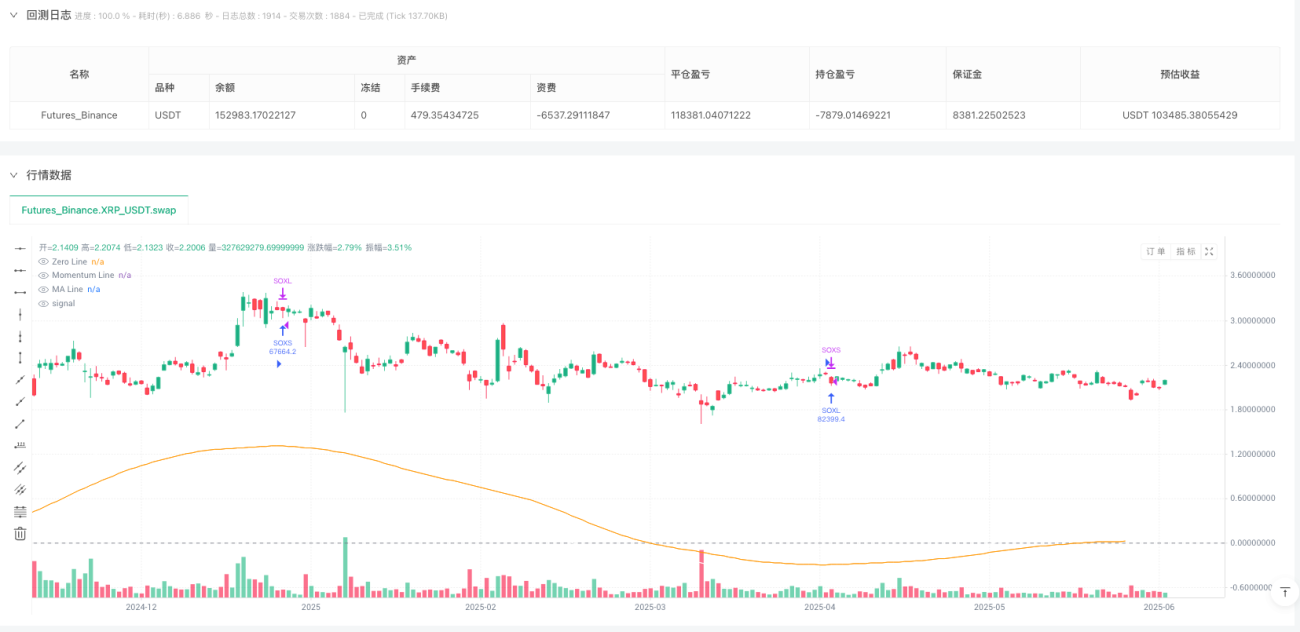
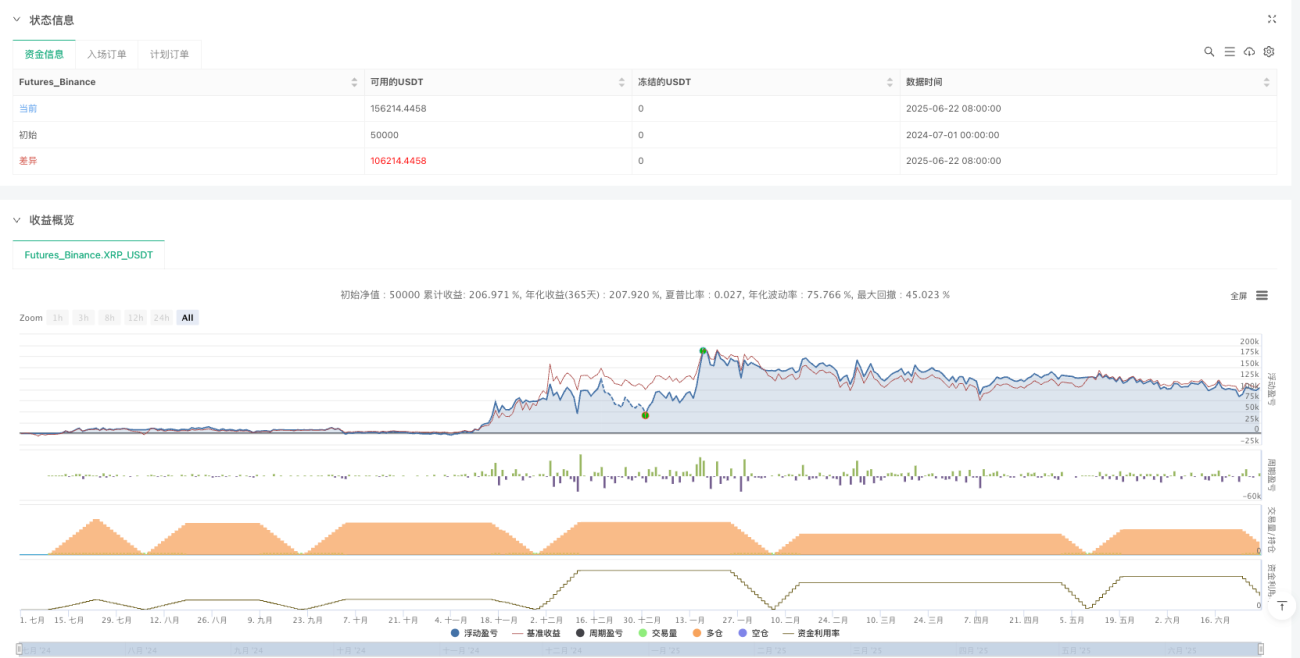
The Multi-Layer Momentum Crossover Flip Strategy is a market trend-following system based on momentum indicators that identifies potential trend changes by monitoring crossover points between a multi-layered smoothed price momentum line and its moving average. The strategy is designed to automatically switch trades between two inversely related ETFs, closing existing positions and establishing new positions in the opposite direction when market trends change. The core of the strategy lies in using a multi-smoothed momentum indicator as a predictive signal for market direction, confirming through crossovers to trigger trading signals, while using state tracking mechanisms to avoid duplicate trades.
Strategy Principles
The core logic of the strategy is based on the calculation and interaction of four main technical indicators:
-
Raw Momentum Calculation: First, the
ta.mom()function calculates the price change over a specific period (default 50 periods), capturing the initial signal of price momentum. -
Multi-Layer Smoothing:
- First layer smoothing: The raw momentum is smoothed through an Exponential Moving Average (EMA) with a default smoothing period of 50, reducing market noise.
- Second layer smoothing: The already smoothed momentum is further smoothed through a Weighted Moving Average (WMA) with a default period of 4, further eliminating short-term fluctuations.
-
Signal Line Calculation: An EMA is calculated on the twice-smoothed momentum line to serve as a signal line (default period of 24).
-
Crossover Signal Determination:
- Bullish signal: Generated when the smoothed momentum line crosses above the signal line.
- Bearish signal: Generated when the smoothed momentum line crosses below the signal line.
-
State Tracking Logic:
- Uses two boolean variables
inSOXLandinSOXSto track current position status. - Avoids issuing the same buy signal when already holding a specific ETF.
- Uses two boolean variables
Strategy Advantages
-
Trend Capture Capability: Through multi-layered smoothed momentum indicators, the strategy can filter market noise and more accurately capture medium to long-term trend changes.
-
Adaptability: The strategy automatically switches between two inversely related ETFs, seeking profit opportunities in both bull and bear markets, not limited to a single market direction.
-
Reduced False Signals: Multiple smoothing processes significantly reduce false signals in momentum indicators, improving the reliability of trading decisions.
-
State Management Mechanism: By tracking current positions through state variables, the system effectively avoids the problem of generating duplicate trading signals.
-
Visualization Support: The strategy provides visualization of momentum and signal lines, allowing traders to intuitively observe market trends and potential crossover points.
-
Parameter Adjustability: All key parameters (momentum length, smoothing periods, etc.) can be customized through input controls, allowing the strategy to adapt to different market conditions and trading preferences.
Strategy Risks
-
Crossover Delay: Due to the use of multi-layered smoothed indicators, signal generation may lag behind actual market turning points, potentially missing optimal entry or exit points in rapidly fluctuating markets.
-
Frequent Trading in Oscillating Markets: In sideways or trendless market environments, momentum and signal lines may cross frequently, leading to overtrading and increased transaction costs.
-
Parameter Sensitivity: Strategy performance is highly dependent on the chosen parameter values. Inappropriate parameter settings may result in excessively lagging or overly sensitive signals.
-
ETF-Specific Risks: Leveraged ETFs (as mentioned in the code) have price decay risks, and holding them long-term may result in capital loss even if the underlying index merely oscillates within a range.
-
Lack of Stop-Loss Mechanism: The current strategy does not integrate stop-loss mechanisms, which may lead to significant losses under extreme market conditions.
Risk Mitigation Measures:
- Add appropriate stop-loss mechanisms to limit maximum loss per trade.
- Consider adding trend strength filters to only trade when trends are clear.
- Regularly backtest and adjust parameters to adapt to changing market conditions.
- Limit strategy capital allocation as part of an overall portfolio rather than the entirety.
Strategy Optimization Directions
-
Add Trend Strength Filtering:
Introduce ADX (Average Directional Index) or similar indicators to evaluate trend strength, executing trades only when trends are clear, avoiding frequent trading in sideways markets. -
Integrate Volatility Adjustment:
Dynamically adjust momentum and smoothing parameters based on market volatility, using longer smoothing periods in high-volatility environments and shorter periods in low-volatility environments. -
Add Stop-Loss and Profit Targets:
Set stop-loss positions and profit targets based on ATR (Average True Range) to protect capital and lock in profits. -
Time Filters:
Add trading time filters to avoid trading during high-volatility periods around market open and close. -
Volume Confirmation:
Require signals to be confirmed by trading volume, increasing the reliability of trading decisions. -
Position Time Limits:
Set maximum position holding time limits; if signals don't reverse within a specific time, automatically close positions to avoid the risks of long-term leveraged ETF holdings. -
Multi-Timeframe Confirmation:
Require signals to be confirmed across multiple timeframes to reduce false signals.
Summary
The Multi-Layer Momentum Crossover Flip Strategy is a technically sophisticated trading system that captures market trend changes through multi-layered smoothed momentum indicators. It triggers automatic switching between two inversely related ETFs through crossovers between momentum and signal lines. The strategy's main advantages lie in its trend capture capability and adaptability, seeking opportunities in different market environments. However, it also faces risks such as signal delay, parameter sensitivity, and frequent trading.
By incorporating optimizations such as trend strength filtering, volatility adjustment, stop-loss mechanisms, and multi-timeframe confirmation, the strategy can further improve its robustness and performance. For investors seeking systematic trend-following trading in ETF markets, this is a promising methodology, but it should be used as part of a broader portfolio with appropriate risk management measures.
/*backtest
start: 2024-07-01 00:00:00
end: 2025-06-29 08:00:00
period: 1d
basePeriod: 1d
exchanges: [{"eid":"Futures_Binance","currency":"XRP_USDT"}]
*/

//@version=6
strategy("Ghost Momentum Strategy [SOXL/SOXS Flip]", overlay=true, default_qty_type=strategy.percent_of_equity, default_qty_value=100)

// === INPUTS ===- 1