Advanced Multi-Timeframe Breakout-Retest Trading Strategy

Strategy Overview
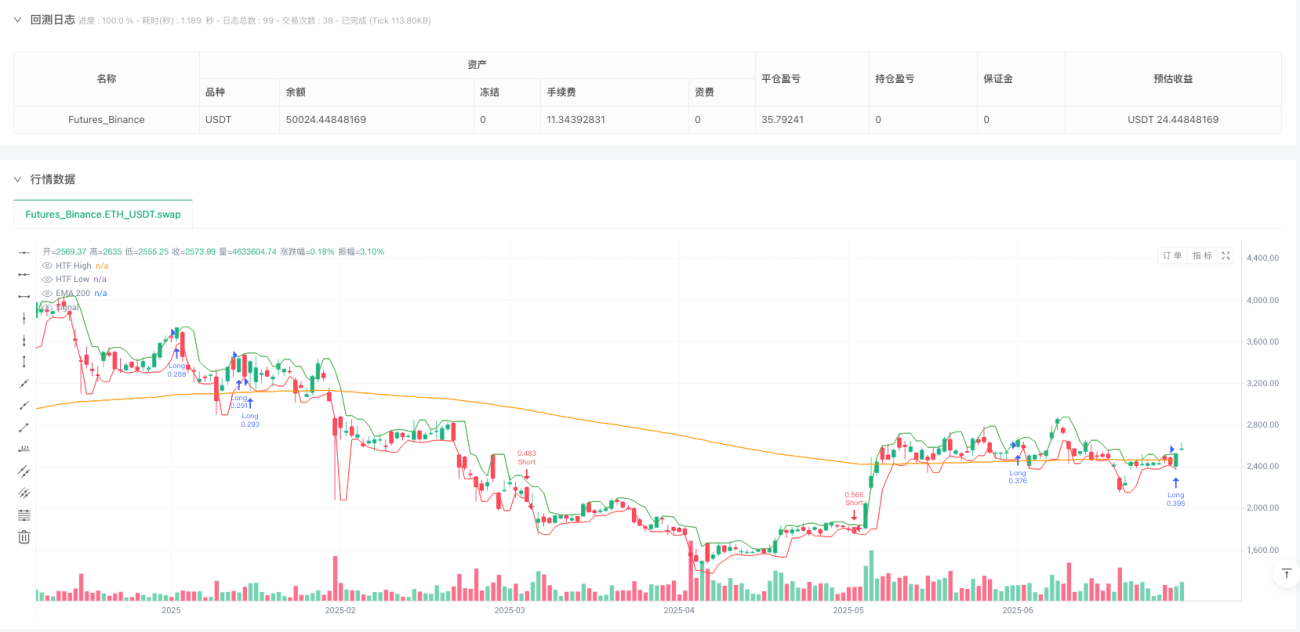
The "Advanced Multi-Timeframe Breakout-Retest Trading Strategy" is a quantitative trading system that combines higher timeframe structure with precise 5-minute entries. This strategy identifies consolidation zones on the 4-hour chart, waits for strong breakouts, and then enters on retests confirmed by engulfing patterns on the 5-minute timeframe. The strategy employs a 200 EMA as a trend filter to ensure trades align with the dominant trend, while applying a strict 1:3 risk-to-reward ratio to maximize profitability. The entire system is designed to reduce false breakouts and optimize small account growth through tight stop losses and high probability setups during active trading hours.
Strategy Principles
The core principles of this strategy are based on multi-timeframe market analysis and price action theory, including the following key elements:
-
Multi-Timeframe Analysis: The strategy uses the 4-hour (240-minute) timeframe to determine market structure and consolidation zones, while utilizing the 5-minute chart for precise entries, creating a perfect blend of macro trend and micro entry points.
-
Consolidation Zone Identification: The system identifies consolidation zones by analyzing the highest high and lowest low of the past 12 4-hour candles, with a minimum consolidation range filter (0.002) to ensure only zones with sufficient volatility potential are traded.
-
Breakout Confirmation Mechanism: The strategy requires not only price breaking above the consolidation high or below the low, but also demands that the breakout candle be strong (body representing over 70% of the candle's range), with an added buffer value (0.0005) to reduce false breakout risk.
-
Trend Alignment: Uses a 200-period Exponential Moving Average (EMA) as a trend filter, ensuring trades are only taken when price action is aligned with the dominant trend direction.
-
Retest Entry Confirmation: The strategy waits for price to retest the breakout level and uses engulfing patterns as additional entry confirmation signals, significantly improving entry precision and success rate.
-
Risk Management: The system employs fixed stop loss points (20 pips) and a strict 1:3 risk-reward ratio, providing clear exit strategies for each trade while protecting capital.
-
Time Filtering: The strategy optionally trades only during active market hours between UTC 8 and 18, avoiding low liquidity and high volatility periods.
Strategy Advantages
-
High Probability Trade Signals: By combining higher timeframe market structure with lower timeframe precise entries, the reliability of trading signals is significantly enhanced. The triple confirmation mechanism of breakout + retest + engulfing pattern greatly reduces false signals.
-
Market Rhythm Adaptation: The strategy effectively adapts to different market conditions, capturing high-quality trading opportunities in the consolidation-breakout-retest market cycle, particularly suitable for volatile market environments.
-
Superior Risk Control: Through clear stop loss settings and fixed risk-reward ratios, risk is strictly controlled for each trade, avoiding emotional trading decisions.
-
Capital Efficiency: Using percentage equity allocation (2% of equity), position sizes automatically adjust with account growth, achieving efficient capital utilization and compound growth.
-
Operational Clarity: The strategy logic is clear, with specific entry and exit rules that are easy to understand and execute, reducing operational complexity and psychological pressure.
-
Avoidance of Low-Quality Periods: Through time filtering, the strategy avoids low liquidity and high volatility market periods, concentrating operations during the most efficient trading hours.
-
Quantitative Parameter Optimization: Various parameters in the strategy (such as consolidation lookback period, breakout buffer, minimum consolidation range) can be optimized according to different markets and instrument characteristics, offering high flexibility.
Strategy Risks
-
False Breakout Risk: Despite multiple filtering mechanisms, the market may still experience quick reversals after breakouts, triggering stop losses. The solution is to further optimize breakout confirmation conditions or consider adding volume confirmation.
-
Timeframe Conflict: Under certain market conditions, higher and lower timeframes may provide contradictory signals, causing system confusion. It is recommended to prioritize the higher timeframe direction in such cases.
-
Parameter Sensitivity: Strategy performance is sensitive to parameters such as consolidation period length, breakout buffer, and minimum consolidation range, with different parameter combinations potentially yielding significantly different results. Backtesting optimization is recommended to find the most suitable parameter settings for specific markets.
-
Stop Loss Risk: Fixed point stop losses may not be flexible enough, potentially being too small in highly volatile markets or too large in low volatility markets. Consider using ATR-based dynamic stop losses to optimize risk management.
-
Trend Change Lag: Trend determination based on the 200 EMA may exhibit lag, potentially causing incorrect signals near trend turning points. Consider combining additional trend indicators or price patterns to identify trend changes earlier.
-
Backtest Pitfalls: Slippage, trading costs, and liquidity issues in actual trading may cause disparities between backtest results and actual performance. It is recommended to conduct thorough simulation trading verification before live trading.
Strategy Optimization Directions
-
Dynamic Risk Management: Replace fixed point stop losses with ATR (Average True Range) based dynamic stops to better adapt to market volatility changes. For example, stops could be set at 1.5 times ATR distance to adapt to different market conditions.
-
Multi-Indicator Trend Confirmation: Add other trend confirmation indicators beyond the 200 EMA, such as Directional Movement Index (DMI) or MACD, to establish a more comprehensive trend determination system and reduce trend judgment lag.
-
Volume Confirmation: Add volume analysis at breakout and retest points, confirming signals only when volume supports price action, further reducing false breakout risk.
-
Adaptive Parameter System: Develop an adaptive parameter adjustment mechanism that automatically adjusts consolidation period length, breakout buffer, and minimum consolidation range based on market volatility and liquidity conditions, making the strategy more adaptable.
-
Scaled Entry and Exit: Implement scaled entry and exit strategies to reduce full position pressure and capture more profit when trends continue to develop. For example, consider closing 33% of the position at 1:1, 1:2, and 1:3 risk-reward ratios respectively.
-
Incorporate Intraday Seasonality: Analyze and leverage intraday seasonality patterns of the trading instrument, increasing position sizes during statistically advantageous time periods to optimize capital allocation efficiency.
-
Machine Learning Integration: Use machine learning algorithms to analyze historical data and predict which breakout-retest formations are more likely to succeed, improving signal quality. This can be achieved by training models to identify price patterns and market conditions with the highest profit potential.
Summary
The "Advanced Multi-Timeframe Breakout-Retest Trading Strategy" is a carefully designed quantitative trading system that effectively captures high-quality breakout trading opportunities by combining 4-hour timeframe market structure analysis with precise 5-minute timeframe entries. The core advantages of this strategy lie in its multi-layered confirmation mechanism, clear risk management rules, and flexible parameter optimization space, enabling it to adapt to different market conditions and trading instruments.
By implementing multiple conditions including breakout buffer, strong candle filtering, trend alignment checks, and engulfing pattern confirmation, the strategy successfully reduces false breakout risk and improves trading signal reliability. The fixed risk-reward ratio and percentage equity allocation ensure capital safety and efficient growth.
While there are potential risks such as parameter sensitivity and trend determination lag, these can be effectively controlled and mitigated through the suggested optimization directions, including dynamic risk management, multi-indicator trend confirmation, and adaptive parameter systems. Overall, this is a logically clear, operationally strong, and risk-controllable advanced trading strategy suitable for experienced traders to apply in volatile markets.
/*backtest
start: 2024-07-08 00:00:00
end: 2025-07-04 08:00:00
period: 1d
basePeriod: 1d
exchanges: [{"eid":"Futures_Binance","currency":"ETH_USDT"}]
*/

//@version=5
strategy("Improved Breakout-Retest Strategy (5M Entry)", overlay=true, default_qty_type=strategy.percent_of_equity, default_qty_value=2)

// === User Inputs ===- 1