
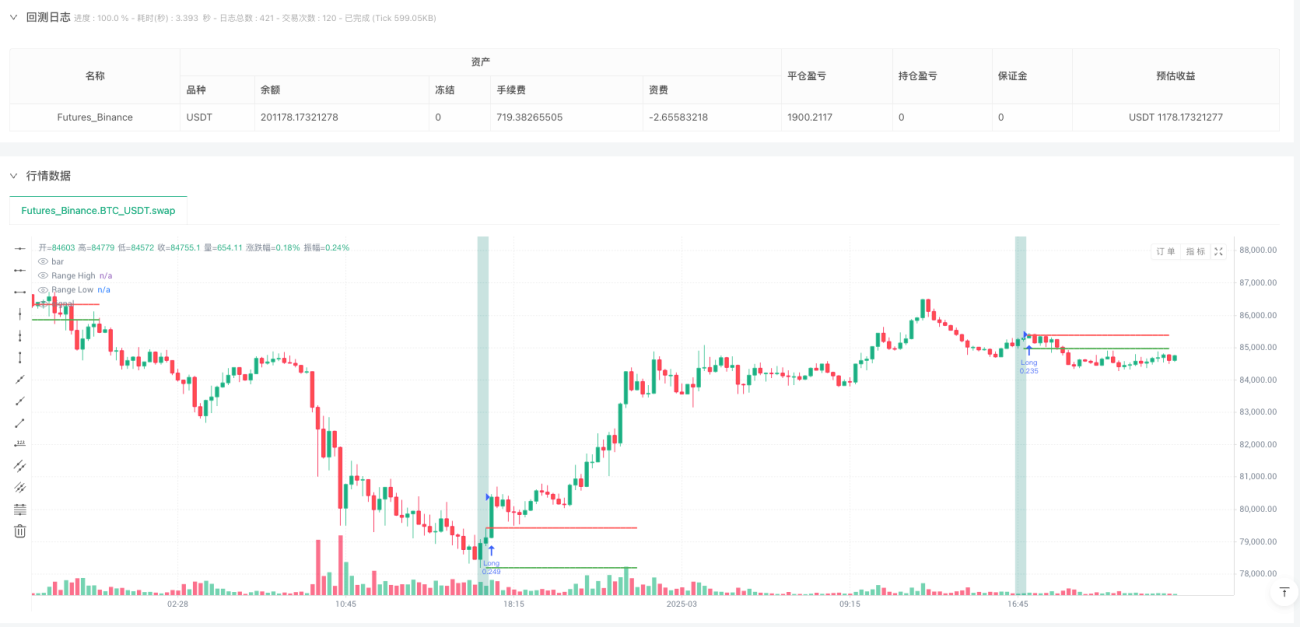
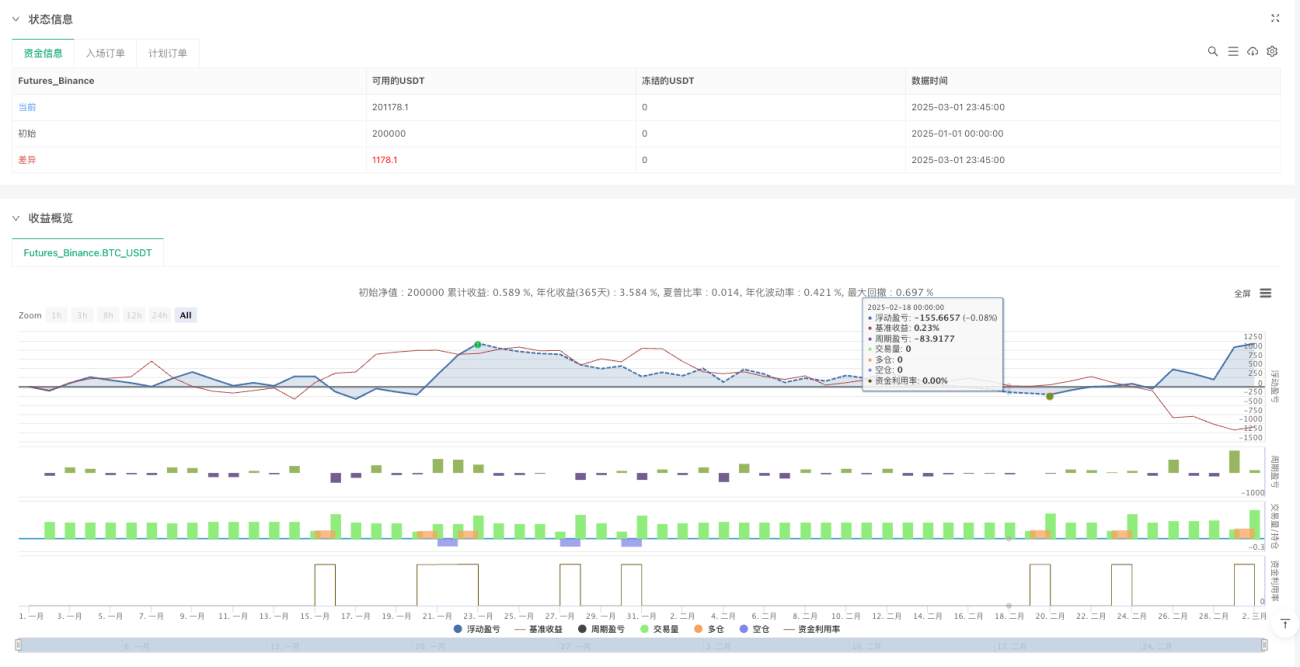
Overview
The Time-Range Breakout Trading Strategy is a quantitative trading system designed to capture momentum opportunities that arise when markets transition from low volatility to high volatility periods. The core concept of this strategy is to identify a price range during a specific low-volatility time window (19:15-19:30 IST) and then execute trades when price breaks out of this range. This approach leverages the characteristic pattern where markets typically undergo a consolidation period before major trading sessions begin, followed by directional breakouts as trading activity increases. The strategy incorporates comprehensive risk management through clearly defined stop-loss placements and customizable risk-reward ratios to protect capital.
Strategy Principles
The Time-Range Breakout Trading Strategy is based on market time cyclicality and price breakout dynamics. The specific implementation logic is as follows:
-
Range Definition: The system monitors the market during the 19:15-19:30 IST period, recording the highest and lowest prices within this 15-minute window to form a price range. This time slot is selected because it typically represents a period of relatively low trading volume with minimal price fluctuations.
-
Trading Session Setup: The strategy's trading session is set from 19:00 IST to 05:30 IST the following day, covering Asian trading sessions and the European early market, which are key periods for market activity.
-
Entry Signals:
- Long Entry: When price breaks above the upper boundary of the range
- Short Entry: When price breaks below the lower boundary of the range
-
Risk Management:
- Long trades use the lower range boundary as the stop-loss point
- Short trades use the upper range boundary as the stop-loss point
- The system automatically calculates profit targets using a customizable risk-reward ratio (default 2:1)
-
Session Management:
- Only one trade is allowed per trading session
- All open positions are automatically closed at session end (05:30 IST)
- All variables are reset at the beginning of a new session
The strategy execution process is highly automated: first defining the price range, then trading on range breakouts according to preset risk parameters, and finally ensuring all positions are closed at session end. This approach not only captures momentum when markets transition from low to high volatility but also minimizes subjective decision-making through clear entry and exit rules.
Strategy Advantages
Deep analysis of the strategy's code structure and logic reveals the following significant advantages:
-
Clear Timeframe Focus: The strategy concentrates on specific market sessions (Asian and early European trading sessions), which are key transition periods from low to high market activity, providing good breakout trading opportunities.
-
Objective Entry Criteria: Using clearly defined price ranges as breakout reference points eliminates subjective factors in trading decisions, increasing the system's consistency and repeatability.
-
Integrated Risk Management: Each trade has a predefined stop-loss position (the opposite boundary of the range) and automatically calculated profit targets through risk-reward ratios, ensuring systematic capital management.
-
Session Control Mechanism: Executing only one trade per trading session avoids overtrading and consecutive loss risks, while ensuring opportunities are reassessed under new market conditions.
-
Automated Execution: The entire process from range definition and signal confirmation to position management is automated, reducing emotional interference and improving execution efficiency.
-
Visual Feedback System: The strategy provides visual aids such as range display, entry markers, and background color indicators to help traders intuitively understand market status and strategy operation.
-
Alert Functionality: Automatically generates entry and exit alerts, ensuring traders are promptly informed of trading signals even when not actively monitoring charts.
-
Adjustable Risk-Reward Ratio: Allows users to adjust the risk-reward ratio according to personal risk preferences and market conditions, enhancing the strategy's flexibility and adaptability.
Strategy Risks
Despite its numerous advantages, the strategy still faces several potential risks and limitations:
-
False Breakout Risk: Markets may briefly break through the range before reversing, leading to false signals and potential losses. Solution: Consider adding confirmation mechanisms, such as requiring the price to maintain beyond the breakout level for a certain time or reach a specific magnitude before triggering entry.
-
Lack of Market Environment Filtering: The current strategy does not consider the overall market environment (such as trend strength, volatility levels), which may execute trades in market conditions unsuitable for breakout trading. Solution: Introduce market environment indicators as trading filters, such as ATR (Average True Range) or trend strength indicators.
-
Fixed Time Range Limitations: Using a fixed time period (19:15-19:30 IST) to define the price range may not be applicable to all market conditions or seasonal variations. Solution: Consider using dynamic time ranges or automatically adjusting the range definition period based on market activity indicators.
-
Single Session Restriction: Allowing only one trade per session may miss subsequent good opportunities. Solution: Design more flexible re-entry mechanisms while maintaining appropriate risk control.
-
Stop-Loss Setting Risk: Using range boundaries as stop-loss points may result in larger stop distances in high-volatility markets. Solution: Consider introducing maximum stop-loss amount limits or ATR-based dynamic stop-loss settings.
-
Forced Session-End Closure: Automatically closing positions at session end may terminate potentially profitable trades at unfavorable price levels. Solution: Allow position continuation to the next session under specific conditions or decide whether to retain positions based on market status.
-
Time Zone Dependency: The strategy heavily relies on specific time zone (IST) settings, which may require adjustment for traders operating in different time zones. Solution: Provide time zone conversion functionality or parameter setting options based on local time.
Strategy Optimization Directions
Based on in-depth analysis of the strategy code, here are several possible optimization directions:
-
Add Breakout Confirmation Mechanisms: Introduce price action confirmation or technical indicator filtering to reduce false breakout signals. For example, require increased volume after breakout or use indicators like RSI to confirm momentum direction. Such optimizations can significantly improve signal quality and reduce erroneous trades.
-
Incorporate Market Environment Assessment: Before executing breakout trades, first evaluate whether the current market environment is suitable for such trades. Indicators that can be used include:
- Volatility indicators (such as ATR) to determine if the market has sufficient momentum
- Trend indicators (such as moving averages) to determine the dominant trend direction
- Market structure analysis to avoid excessive trading in rangebound markets
-
Dynamic Range Width Adjustment: Automatically adjust the width of the price range based on historical volatility. Use wider ranges in high-volatility environments and narrower ranges in low-volatility environments. This adaptive adjustment enables the strategy to better adapt to different market conditions.
-
Optimize Time Parameters: Analyze the success rate of breakouts during different time periods to find the optimal range definition period and trading session time. This may involve backtesting historical data to determine which time periods have the highest success rate for breakout trades.
-
Introduce Partial Profit Locking Mechanism: When a trade reaches a certain profit level, move the stop loss to breakeven or lock in partial profits to protect realized gains. This technique can balance risk-reward ratios and improve overall profitability.
-
Add Filtering Conditions: Introduce other technical or fundamental filtering conditions, such as:
- Avoiding trading before and after important economic data releases
- Considering market sentiment indicators
- Adding volume confirmation requirements
-
Multi-Timeframe Analysis: Before executing breakout trades on the 15-minute timeframe, first consider the market structure and trend direction on higher timeframes (such as 1-hour or 4-hour). This top-down analysis method can improve the directional accuracy of trades.
-
Optimize Risk Management Parameters: Based on historical performance data, adjust risk-reward ratio settings and position sizing calculation methods. Consider implementing a dynamic risk management system that automatically adjusts risk parameters based on the strategy's recent performance and market conditions.
Summary
The Time-Range Breakout Trading Strategy is a systematic quantitative trading approach focused on capturing momentum opportunities that arise when markets transition from low volatility to high volatility periods. By defining price ranges during specific time periods (19:15-19:30 IST) and executing trades when price breaks out of these ranges, the strategy effectively leverages market cyclicality and trading session transitions to capture price momentum.
The strategy's main advantages lie in its objective entry criteria, integrated risk management system, and fully automated execution process, which reduce emotional interference and improve trading consistency. However, the strategy also faces challenges such as false breakout risks, limitations of fixed time parameters, and lack of market environment filtering.
Through optimizations such as introducing breakout confirmation mechanisms, market environment assessment, dynamic parameter adjustment, and multi-timeframe analysis, the strategy has the potential to further improve its performance and adaptability. In particular, adding technical indicator filtering and dynamic risk management mechanisms may be the most valuable improvement directions.
Overall, the Time-Range Breakout Trading Strategy provides traders with a structured approach to capturing market momentum opportunities and managing risk through clear rules and automated execution. For quantitative traders seeking systematic trading methods, this strategy provides a reliable foundation framework that can be further customized and optimized according to individual needs and market conditions.
/*backtest
start: 2025-01-01 00:00:00
end: 2025-03-02 00:00:00
period: 15m
basePeriod: 15m
exchanges: [{"eid":"Futures_Binance","currency":"BTC_USDT","balance":200000}]
*/

//@version=6
strategy("BTC 15m Range Breakout Strategy", overlay=true, default_qty_type=strategy.percent_of_equity, default_qty_value=10)

// Input parameters- 1