Momentum EMA Pullback Trading Strategy: High-Precision EMA Retracement Entry System

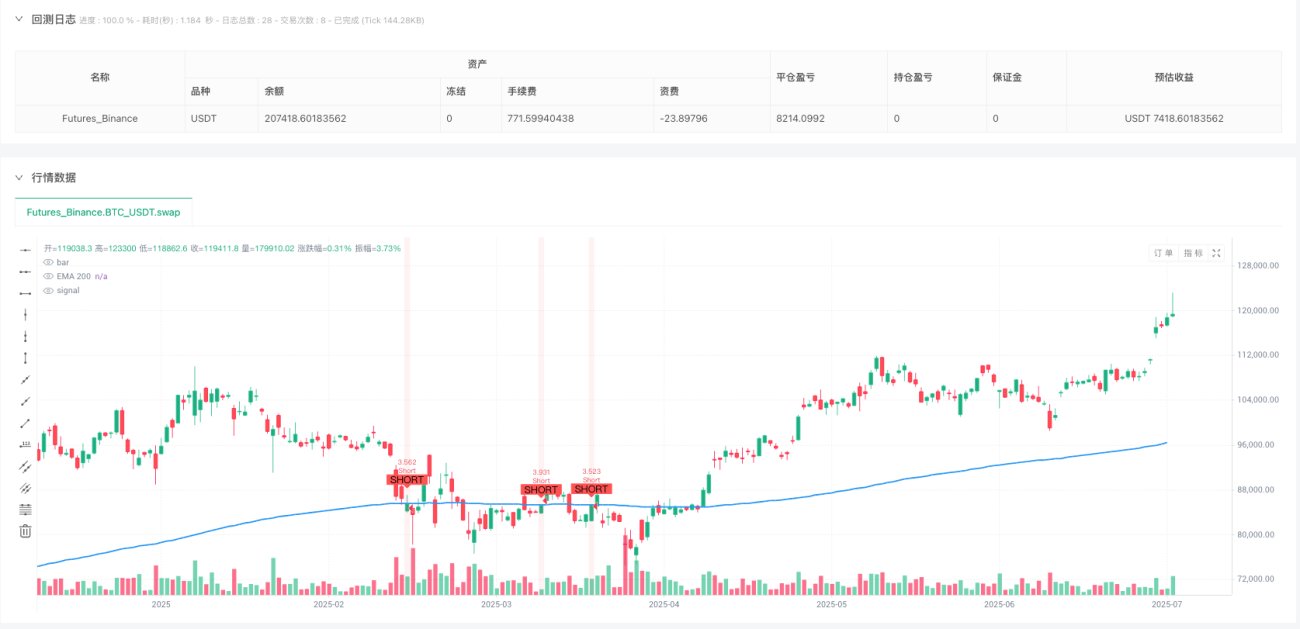
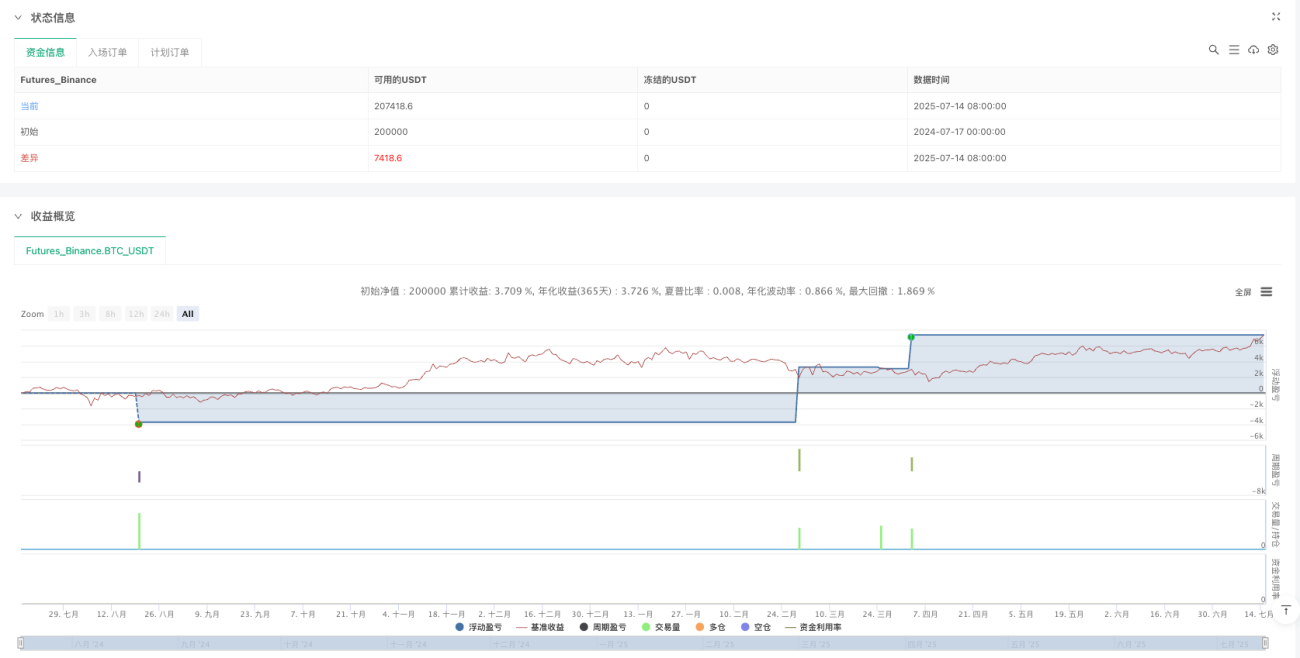
Overview
The Momentum EMA Pullback Trading Strategy is an intelligent momentum-based entry system designed to capture high-probability pullbacks to the Exponential Moving Average (EMA). The core principle of this strategy is to wait for price to "tap" or pull back to the 200 EMA from above or below, combined with additional confirmation conditions such as RSI, MACD, and ADX to filter for stronger signals. This strategy is particularly suitable for trend-following traders, providing them with precise entry points, strict risk management, and automatic take-profit and stop-loss execution mechanisms based on risk-reward ratios.
The strategy includes automatic position sizing, customizable filters, and clear visualization of stop-loss, take-profit, and signal confirmations. Whether for scalping, swing trading, or automated trading, this strategy provides a reliable framework for EMA-based trades.
Strategy Principle
The core of this strategy is based on using the Exponential Moving Average (EMA) as a dynamic support/resistance level, combined with price pullback behavior to identify high-probability entry points. The specific principles are as follows:
-
EMA Pullback Identification:
- Uses a long-period EMA (default 200) as a trend reference line
- Defines a "tap zone" as a certain percentage range (default 0.2%) above and below the EMA value
- Long signal: price is above EMA and within the tap zone
- Short signal: price is below EMA and within the tap zone
-
Filtering Mechanisms:
- Trend flip filter: option to only enter on the first pullback after a trend reversal
- RSI filter: requires RSI>50 for longs, RSI<50 for shorts
- MACD filter: requires MACD line above signal line for longs, opposite for shorts
-
Risk Management and Position Calculation:
- Calculates position size based on account equity and risk percentage (default 1%)
- Sets stop-loss at a certain percentage (default 0.5%) beyond the EMA
- Automatically calculates take-profit based on risk-reward ratio (default 2.0, meaning twice the risk)
-
Real-Time Signal Processing:
- Generates signals on the current candle without waiting for candle close
- Automatically calculates and sets take-profit and stop-loss levels
- Generates real-time trade alerts including take-profit and stop-loss values
Strategy Advantages
Through deep analysis of the strategy code, I've summarized the following advantages:
-
Precise Entry Timing: The strategy identifies exact entry points through strictly defined "tap zones" rather than simply relying on price crosses of the EMA, improving signal quality.
-
Multiple Confirmation Mechanisms: Combines indicators like RSI and MACD as additional filters, greatly reducing the possibility of false signals. Traders can flexibly choose which filters to enable based on market conditions.
-
Dynamic Risk Management:
- Automatically calculates position size based on account equity
- Calculates stop-loss distance based on the specific circumstances of each trade
- Automatically sets take-profit targets based on risk-reward ratios
-
Real-Time Trading Capability: The strategy generates signals without waiting for candle closes, ensuring trading opportunities aren't missed in fast-moving markets.
-
Visual Trading Signals: Intuitively displays trading signals, stop-loss, and take-profit levels through background color changes and labels, enhancing user experience.
-
High Adaptability: Can be applied to various markets such as cryptocurrencies, forex, and indices, and can be used under different timeframes.
-
Automation-Friendly: Built-in alert functionality allows easy integration with webhooks or other automation systems.
Strategy Risks
Despite its well-designed nature, the strategy still has some potential risks:
-
Choppy Market Risk: In consolidating or choppy markets, price frequently touching the EMA may lead to excessive trading signals, increasing the risk of false breakouts.
- Solution: Use in clearly trending markets; enable the "First Tap Only" option; combine with higher timeframe analysis to confirm trend direction.
-
Tap Setting Sensitivity: Setting the tap threshold (default 0.2%) too small may miss trading opportunities, while setting it too large may reduce entry precision.
- Solution: Backtest and optimize tap thresholds for different markets and timeframes; adjust parameters considering market volatility.
-
Stop-Loss Placement Risk: Fixed percentage stop-losses may not be suitable for all market conditions, especially in cases of sudden increased volatility.
- Solution: Dynamically adjust stop-loss distance based on market volatility; consider using volatility indicators like ATR to assist in setting stop-losses.
-
System Dependency: The strategy relies on real-time data and execution, which may lead to missed signals or execution discrepancies in cases of network delays or system failures.
- Solution: Set up backup execution mechanisms; regularly monitor system performance; consider adding confirmation mechanisms.
-
Over-Optimization Risk: Excessive parameter adjustment to fit historical data may lead to poor future performance.
- Solution: Use out-of-sample testing; avoid excessive parameters; keep strategy logic simple and clear.
Strategy Optimization Directions
Based on code analysis, here are directions for further optimization of this strategy:
-
Adaptive Parameter Optimization:
- Dynamically adjust tap threshold and stop-loss distance based on market volatility
- Consider introducing the ATR (Average True Range) indicator for automatic parameter adjustment
- This can help the strategy maintain stable performance under different volatility conditions
-
Enhanced Trend Recognition Capability:
- Introduce multi-timeframe analysis (MTF), using higher timeframes to confirm the main trend direction
- Add dynamic thresholds for trend strength indicators like ADX
- This will help avoid generating false signals in weak trend or reversal markets
-
Improved Position Management:
- Implement dynamic risk adjustment based on market volatility
- Add pyramid position building functionality to increase position size in favorable trends
- Design partial take-profit mechanisms to lock in some profits while retaining upside potential
-
Add Market State Analysis:
- Implement market state classification (trending/ranging)
- Use different parameters or even completely different strategies in different market states
- This can significantly improve the strategy's adaptability across various market conditions
-
Signal Quality Scoring:
- Develop a signal quality scoring system to evaluate each signal based on multiple factors
- Factors to consider include: trend strength, volatility, volume confirmation, multi-timeframe consistency, etc.
- Dynamically adjust position size based on signal score, increasing risk exposure for high-quality signals
Summary
The Momentum EMA Pullback Trading Strategy is a well-designed quantitative trading system that identifies high-probability entry points by capturing price pullbacks to the EMA. It combines technical analysis, momentum indicators, and risk management principles to provide a comprehensive trading framework.
The strategy's greatest strengths lie in its precise entry mechanism, automated risk management, and real-time execution capability. By waiting for price pullbacks to key moving averages, traders can enter trends with favorable risk-reward ratios while using multiple filters to reduce the risk of false signals.
However, like all trading strategies, it faces challenges in certain market conditions, particularly in ranging, choppy markets. By implementing the suggested optimizations, especially adaptive parameters and market state analysis, the strategy's robustness and adaptability can be further enhanced.
For traders seeking a systematic approach to capturing market trends, this strategy provides a solid foundation that can be further customized and optimized according to individual trading styles and objectives.
/*backtest
start: 2024-07-17 00:00:00
end: 2025-07-15 08:00:00
period: 1d
basePeriod: 1d
exchanges: [{"eid":"Futures_Binance","currency":"BTC_USDT","balance":200000}]
*/

//@version=5
strategy("Craig Tap Bot Strategy ✨ – Real-Time Upgrade", overlay=true, default_qty_type=strategy.percent_of_equity, default_qty_value=100)

// === INPUTS ===- 1