
Overview
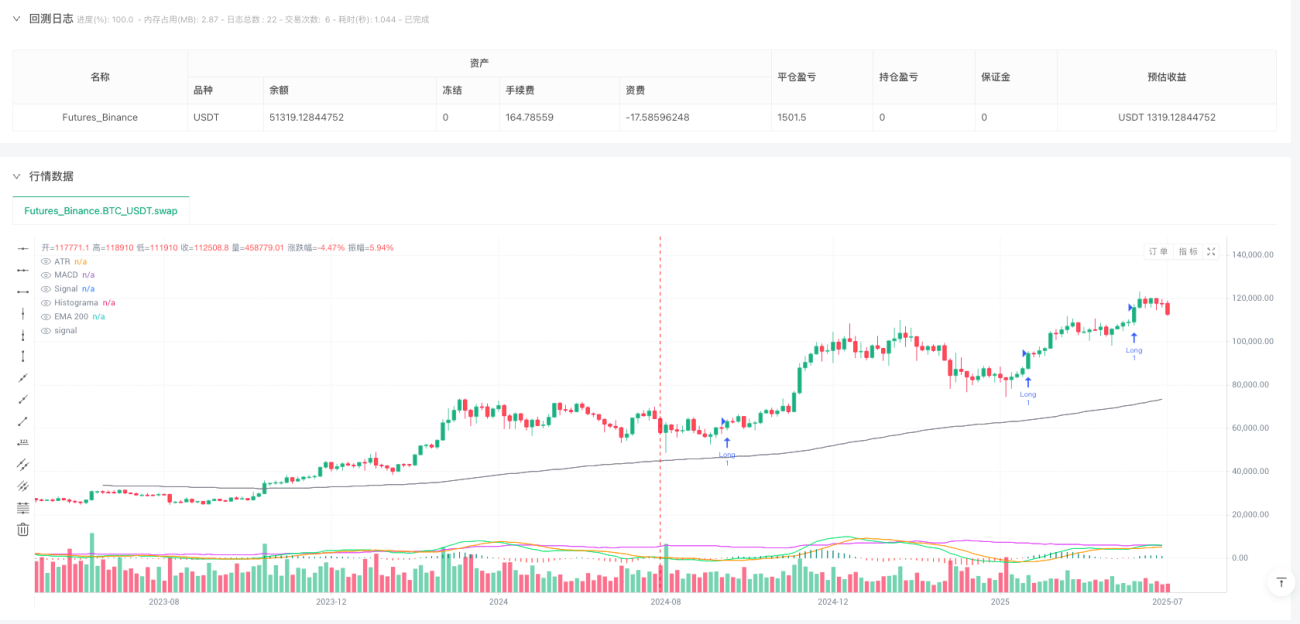
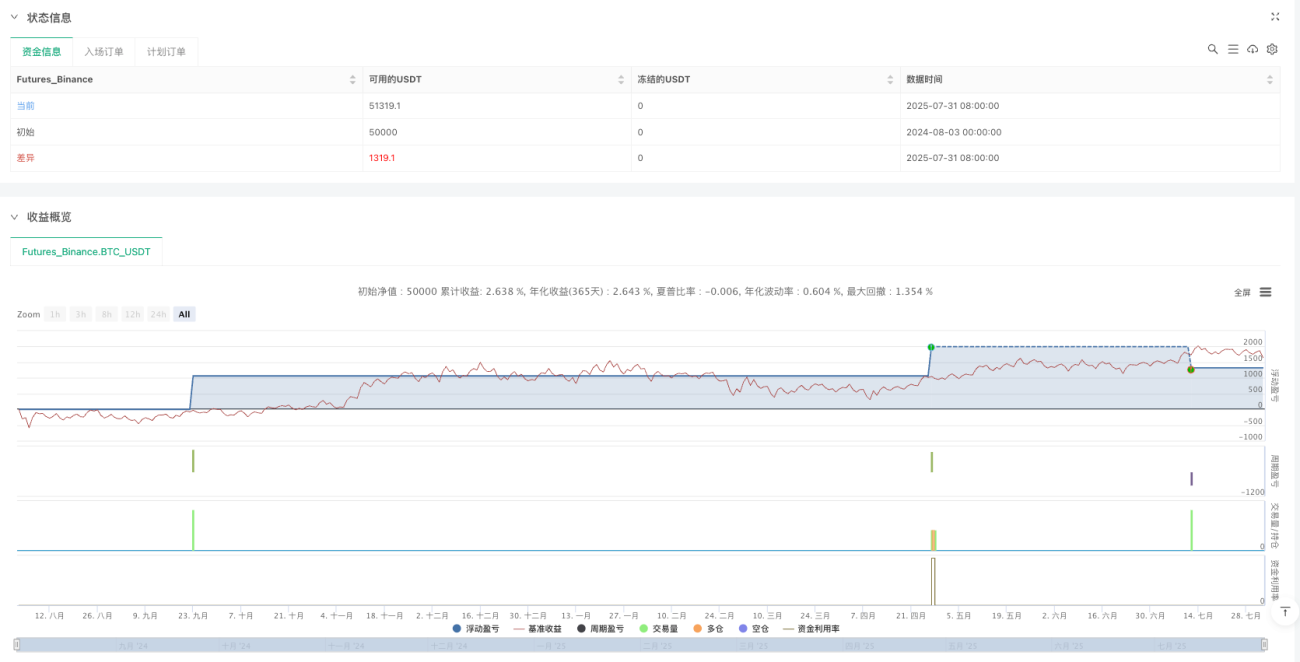
The Multi-Timeframe MACD Impulse Volatility Filtered Trading Strategy is a precision scalping system designed for short-term traders seeking to capture fast and effective entries on trending moves. This strategy cleverly combines multi-timeframe Moving Average Convergence Divergence (MACD), histogram impulse filtering, Average True Range (ATR) volatility filtering, and optional 200-period Exponential Moving Average (EMA200) trend confirmation to identify high-probability trade setups. This multi-layered filtering mechanism ensures trades are only executed when market conditions are most favorable, significantly improving the success rate of trades.
Strategy Principles
The core principles of this strategy are based on the synergistic action of multiple technical indicators, forming a comprehensive trading decision framework:
-
Multi-Timeframe MACD Analysis: The strategy utilizes the MACD indicator calculated on a user-selected timeframe (default 60 minutes) rather than solely relying on the current chart timeframe. This multi-timeframe approach provides a broader market perspective, helping to capture more reliable trend signals.
-
Histogram Impulse Filtering: Beyond traditional MACD and signal line crossovers, the strategy requires the MACD histogram to show sufficient "impulse" or momentum, implemented through the
histImpulseUpandhistImpulseDownvariables. Entry signals are only considered valid when histogram changes exceed a set threshold (default 0.015). -
Volatility Confirmation: The strategy employs the ATR indicator to ensure market volatility is sufficient, only considering trades when the 14-period ATR value exceeds a minimum threshold (default 0.10). This avoids trading in low-volatility environments where signals may be unreliable.
-
Trend Direction Filtering: The optional EMA200 filter ensures trade direction aligns with the overall trend, only allowing long positions when price is above EMA200 and short positions when below.
Entry conditions are precisely defined as follows:
- Long Entry: When MACD crosses above the Signal Line, histogram rises with sufficient impulse, ATR confirms adequate volatility, and price is above EMA200 (if trend filtering is enabled).
- Short Entry: When MACD crosses below the Signal Line, histogram falls with sufficient impulse, ATR confirms adequate volatility, and price is below EMA200 (if trend filtering is enabled).
Exit strategies are equally well-designed:
- Fixed percentage Take Profit (default 1%) and Stop Loss (default 0.4%) levels.
- Immediate position closure when MACD reverses and crosses the signal line in the opposite direction, regardless of profit or loss.
- The strategy does not use trailing stops, allowing trades to fully reach their target when conditions are favorable.
Strategy Advantages
After deep analysis of the code, this strategy demonstrates the following significant advantages:
-
Precise Entry Filtering: By combining multiple filtering conditions (MACD crossover, histogram impulse, volatility, and trend confirmation), the strategy greatly reduces false signals, executing trades only on high-probability setups.
-
Flexible Timeframe Application: Multi-timeframe MACD analysis allows traders to operate on short-period charts while leveraging MACD signals from longer periods, combining the advantages of short-term precise entries with long-term trend confirmation.
-
Strong Adaptability: Strategy parameters can be optimized and adjusted for different market conditions and trading instruments, including MACD parameters, histogram impulse threshold, minimum ATR value, and take profit/stop loss percentages.
-
Comprehensive Risk Management: Through fixed percentage take profit/stop loss settings and MACD reversal signal exit mechanism, the strategy protects capital while allowing profits to grow.
-
Clear Visual Feedback: The strategy plots MACD components, EMA200, and ATR indicators on the chart, enabling traders to visually understand and verify trading signals.
-
High Execution Efficiency: The strategy code structure is clear and efficient, using functions to encapsulate MACD calculations and employing request.security for multi-timeframe analysis, ensuring calculation accuracy and execution efficiency.
Strategy Risks
Despite its excellent design, the strategy still presents some potential risks:
-
False Breakout Risk: In highly volatile markets, MACD may generate false breakout signals, leading to premature entries that quickly reverse. Solution: Add confirmation periods requiring signals to persist for multiple periods, or incorporate additional confirmation indicators.
-
Parameter Sensitivity: Strategy performance is highly dependent on parameter settings, and different markets and time periods may require different parameter combinations. Solution: Regularly backtest and optimize parameters, or consider implementing an adaptive parameter system.
-
Trend Change Risk: During trend transition periods, the strategy may incur consecutive losses due to frequent MACD crossovers. Solution: Pause trading in obvious ranging markets, or add trend strength filters.
-
Small Stop Loss Risk: The default 0.4% stop loss setting may be too small for some high-volatility instruments, leading to easy triggering. Solution: Adjust stop loss percentages based on the average true range of the trading instrument, or use ATR multiples rather than fixed percentages for stop loss.
-
Lack of Market Structure Consideration: The strategy relies solely on indicator signals without considering key support/resistance levels or market structure. Solution: Integrate price action analysis or key level identification algorithms.
Strategy Optimization Directions
Based on code analysis, here are possible optimization directions for this strategy:
-
Adaptive Parameter System: Implement a mechanism to automatically adjust MACD parameters and filtering thresholds based on market volatility or trend strength. This would allow the strategy to better adapt to different market conditions without manual intervention.
-
Volume Analysis Integration: Add volume filtering conditions to signal confirmation, executing trades only when volume supports price movement. This can be implemented by checking volume position relative to moving averages or volume impulse indicators.
-
Improved Exit Strategy: Introduce partial position management, such as moving stop loss to breakeven after reaching certain profit levels or implementing staged exits, to better balance risk and reward.
-
Time Filters: Add trading session filters to avoid low liquidity or high volatility periods, such as important economic data releases or market opening/closing times.
-
Market State Classification: Develop a market state classification system (trending, ranging, high volatility, etc.) and apply different trading parameters or even completely different strategy variants based on different market states.
-
Machine Learning Optimization: Utilize machine learning algorithms to dynamically predict optimal parameter combinations or signal reliability, improving strategy adaptability and accuracy.
Summary
The Multi-Timeframe MACD Impulse Volatility Filtered Trading Strategy is a well-designed scalping system that provides high-quality entry points through multi-layered signal filtering and strict risk management. This strategy is particularly suitable for traders who want to capture short-term market opportunities while maintaining discipline.
The core strength of the strategy lies in its multi-dimensional filtering mechanism and clear execution rules, which objectify trading decisions and reduce emotional interference. Additionally, through multi-timeframe analysis, the strategy can execute trades on short-period charts while maintaining sensitivity to longer-term trends.
However, traders should be aware of the strategy's limitations when using it, particularly parameter sensitivity and market state dependency. Through continuous optimization and possible extensions (such as integrating volume analysis, market structure considerations, or adaptive parameters), strategy performance can be further enhanced.
Overall, this is a strategy framework with solid theoretical foundations and clear implementation methods, suitable for experienced short-term traders to apply in appropriate market environments, especially in markets with sufficient volatility. Most importantly, this strategy provides traders with a reliable starting point that can be further customized and developed according to personal trading styles and market preferences.
/*backtest
start: 2024-08-03 00:00:00
end: 2025-08-02 08:00:00
period: 4d
basePeriod: 4d
exchanges: [{"eid":"Futures_Binance","currency":"BTC_USDT"}]
*/

//@version=6
strategy("Invencible MACD Strategy Scalping 5M", overlay=true, default_qty_type=strategy.fixed, default_qty_value=1)

// === Configuración General ===- 1