First Day Range Breakout Trading Strategy: High-Frequency Quantitative Trading System with ATR Trailing Stop Loss

Overview
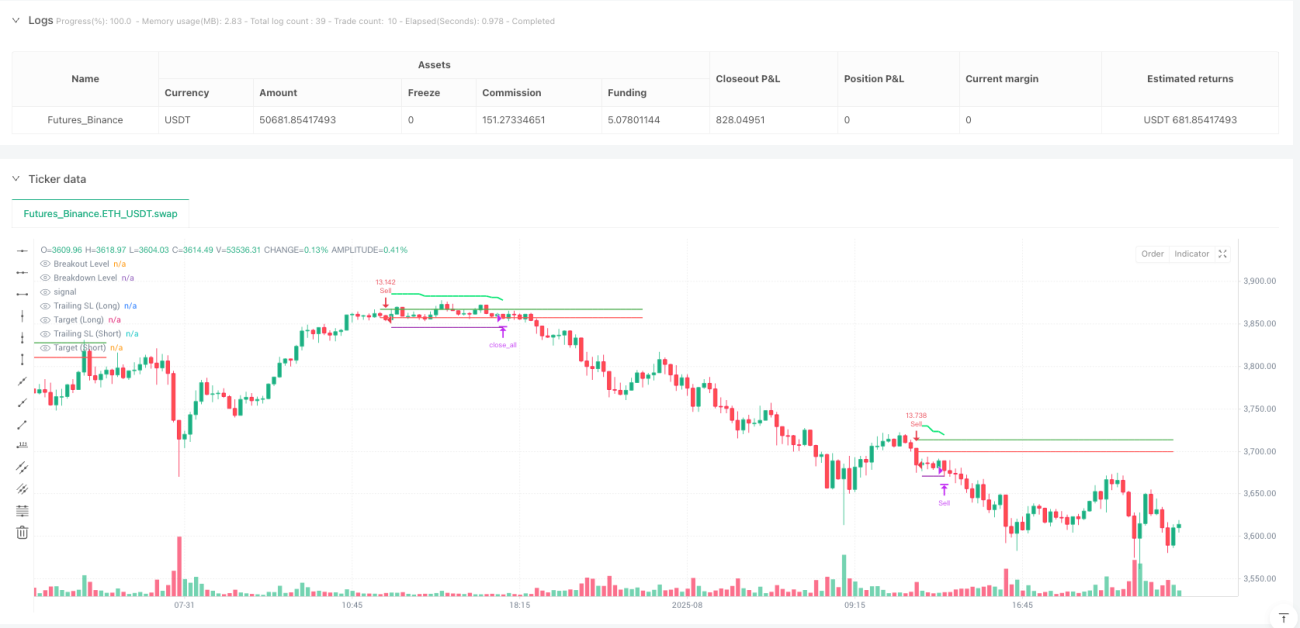
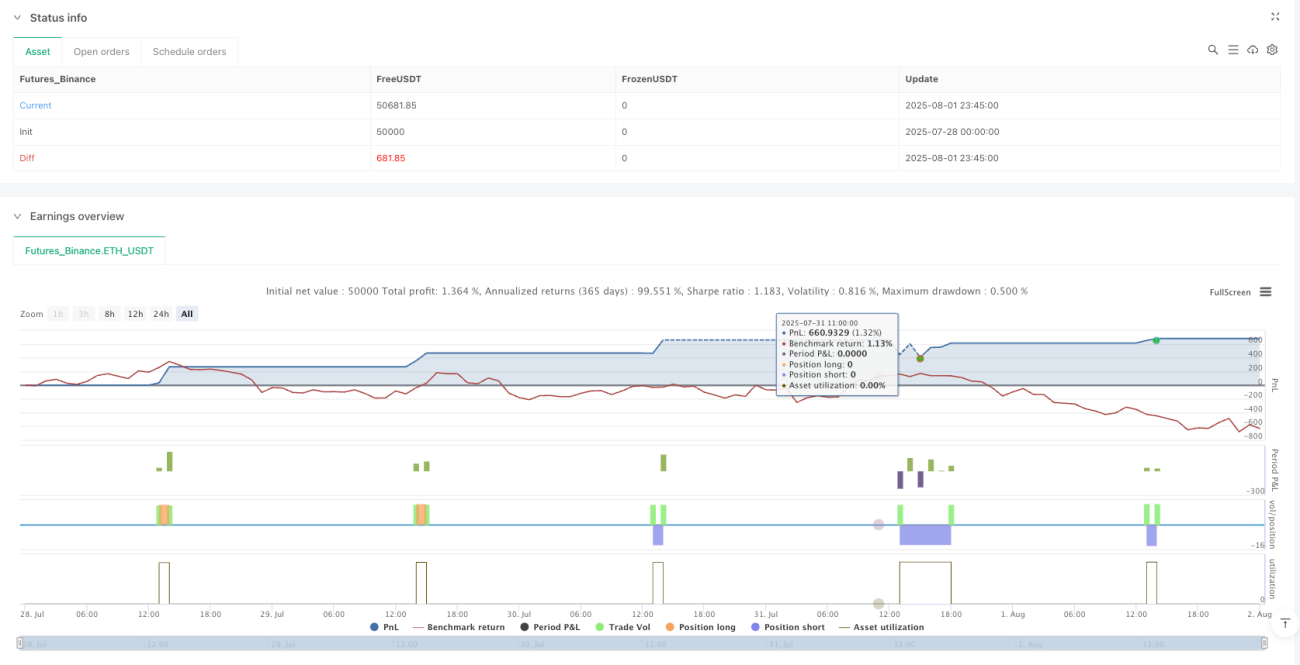
The First Day Range Breakout Trading Strategy is a high-frequency quantitative trading system specifically designed for the Indian Nifty and Bank Nifty indices, optimized particularly for the 15-minute timeframe. This strategy establishes breakout or breakdown signals based on the price range formed during the early trading session (9:15-9:30), combined with volume confirmation and an ATR (Average True Range) trailing stop loss mechanism to manage risk. The core of the strategy is to capture directional market movements after the opening, utilizing the high and low points formed during the early session as key support and resistance levels, entering when an effective breakout occurs, and automatically managing the trading process through dynamic stop-losses and target prices.
Strategy Principles
The core principle of this strategy is based on the concept that the price range formed during the early market session often provides significant guidance for the entire day's trading. The specific implementation logic is as follows:
-
Time Period Division: The strategy specifically focuses on price activity from 9:15-9:30, recording the highest price (first3High) and lowest price (first3Low) during this period.
-
Range Confirmation: Calculates the price range of the early 15 minutes (targetRange = first3High - first3Low), which serves as the basis for subsequent breakout trading direction and target setting.
-
Volume Filter: Uses a 5-period simple moving average (SMA) of trading volume as a filter condition, ensuring that breakout signals are only confirmed when volume increases, avoiding false breakouts.
-
Breakout/Breakdown Signal Generation:
- Upward Breakout (isBreakout): After 9:30, the closing price is higher than the early session's highest point and volume is greater than the average level
- Downward Breakdown (isBreakdown): After 9:30, the closing price is lower than the early session's lowest point and volume is greater than the average level
-
ATR Trailing Stop Loss: Employs 2 times the 20-period ATR as a dynamic stop-loss distance, providing an adaptive risk control mechanism for trades.
-
Automated Target Management: The profit target set after entry equals the width of the early price range, providing a reasonable risk-reward ratio.
-
Time-Based Exit Mechanism: The strategy forces the closing of all unfinished trades before 15:00 (IST), avoiding overnight risk.
Strategy Advantages
Analyzing the code implementation of this strategy in depth, we can summarize the following significant advantages:
-
Simple Yet Effective Logic: The strategy concept is clear, based on support/resistance zones established early in the market, a method historically considered an important price reference area in technical analysis.
-
Adaptive Risk Management: Using ATR as the basis for stop-loss allows the strategy to automatically adjust risk exposure according to market volatility, providing wider stop-loss space when volatility increases and tightening stops when volatility decreases.
-
Dynamic Stop-Loss Mechanism: Employing a trailing stop rather than a fixed stop-loss can lock in profits while giving prices enough breathing room, improving the risk-reward efficiency of the strategy.
-
Volume Confirmation: Combining price breakouts with volume increases greatly reduces the risk of false breakouts, improving signal quality.
-
Automated Execution: The entire process from signal generation to entry, stop-loss management, and target achievement is automated, reducing human intervention and emotional influence.
-
Time Risk Control: Through forced intraday position closing, overnight position risk is avoided, particularly suitable for day traders.
-
Market Specialization: The strategy is optimized specifically for the 15-minute charts of Nifty and Bank Nifty indices, with strong targeting, avoiding the uncertainties of generic strategies.
Strategy Risks
Despite its reasonable design, the strategy still has the following risk factors that need attention:
-
High Specialization Risk: The strategy is optimized only for specific markets and timeframes and may not be applicable to other markets or time periods, limiting its application range.
-
False Breakout Risk: Although there is volume filtering, the market may still experience false breakouts followed by quick retracements, especially on highly volatile days.
-
Stop-Loss Slippage Risk: In rapidly fluctuating markets, ATR trailing stop-losses may not execute at the expected price, resulting in actual stops being larger than planned.
-
Dependency on Early Session Range: If the early session (9:15-9:30) trading is abnormal or has extremely low volatility, it may lead to a decrease in subsequent signal quality or difficulty meeting trigger conditions.
-
Time Dependency: The strategy's effectiveness heavily depends on market behavior during specific time windows; if market characteristics change or time patterns shift, the strategy's effectiveness may decrease.
-
Fixed Target Setting: Using the early session range width as a fixed profit target may, in some cases, exit strong trends too early, missing out on greater profit opportunities.
-
Intraday Trading Limitations: Forced position closing before 15:00 may result in inability to fully utilize intraday trends in some cases, especially trends that begin later in the afternoon.
Solutions include: adding more filter conditions, adjusting the ATR multiplier, introducing dynamic target management, combining other technical indicators to confirm signals, and periodically re-optimizing strategy parameters.
Strategy Optimization Directions
Based on code analysis, the strategy has the following possible optimization directions:
-
Adaptive Parameter Adjustment: Introduce adaptive mechanisms to dynamically adjust the ATR multiplier and volume filter conditions, allowing the strategy to automatically adjust parameters based on the current market environment. It is recommended to establish a mapping relationship between parameters and market conditions by backtesting optimal parameters under different market conditions.
-
Multi-Timeframe Confirmation: Add confirmation mechanisms across multiple timeframes, such as referencing the daily trend direction and only trading breakouts in the direction of the daily trend, which can improve signal quality. This is because trend-following trades typically have a higher success rate.
-
Dynamic Target Management: Replace fixed targets with a dynamic target system, such as adjusting target prices based on market volatility or trend strength, or implementing partial profit strategies, moving the stop-loss to breakeven after achieving a certain profit.
-
Add Market Sentiment Indicators: Integrate VIX or other market sentiment indicators to adjust or suspend strategy execution under extreme market conditions, avoiding trading in highly uncertain environments.
-
Time-Weighted Signals: Adjust signal weights based on proximity to the opening time, as early session breakouts are typically more meaningful than breakouts near the close. This can be implemented by increasing breakout confirmation conditions as time progresses.
-
Correlation Filtering: For cases trading both Nifty and Bank Nifty simultaneously, add correlation checks, increasing position size when signals from both indices align and reducing position size or waiting when they diverge.
-
Machine Learning Enhancement: Introduce machine learning models to predict the success probability of breakouts, scoring signals based on historically similar patterns, and only executing high-probability trades. This can be achieved by training models to identify characteristic patterns of successful breakouts.
These optimization directions can not only improve the strategy's robustness but also increase its adaptability to different market environments while maintaining the simplicity and effectiveness of the strategy's core logic.
Summary
The First Day Range Breakout Trading Strategy is a high-frequency quantitative trading system based on early session price ranges and volume confirmation, particularly suitable for the 15-minute timeframe of Nifty and Bank Nifty indices. The strategy provides a complete trading decision framework by capturing breakouts at key price levels, combined with ATR trailing stops and target management.
The main advantages of the strategy lie in its clear logic, adaptive risk management, and automated execution capabilities, but it also faces challenges such as strong specialization, false breakout risk, and time dependency. By introducing adaptive parameters, multi-timeframe confirmation, dynamic target management, and other optimization measures, the strategy's robustness and adaptability can be further enhanced.
For traders seeking intraday trading opportunities, this strategy provides a structured method to identify and execute high-probability trades, especially when its limitations are fully understood and appropriate optimizations are applied. Successful application of the strategy requires rigorous backtesting, continuous monitoring, and necessary parameter adjustments to adapt to constantly changing market environments.
/*backtest
start: 2025-07-28 00:00:00
end: 2025-08-02 00:00:00
period: 15m
basePeriod: 15m
exchanges: [{"eid":"Futures_Binance","currency":"ETH_USDT"}]
*/

// This Pine Script® code is subject to the terms of the Mozilla Public License 2.0 at https://mozilla.org/MPL/2.0/

//@version=5
strategy("Breakout Strategy: Nifty only and only at 15 min Timeframe", overlay=true, default_qty_type=strategy.percent_of_equity, default_qty_value=100)- 1