
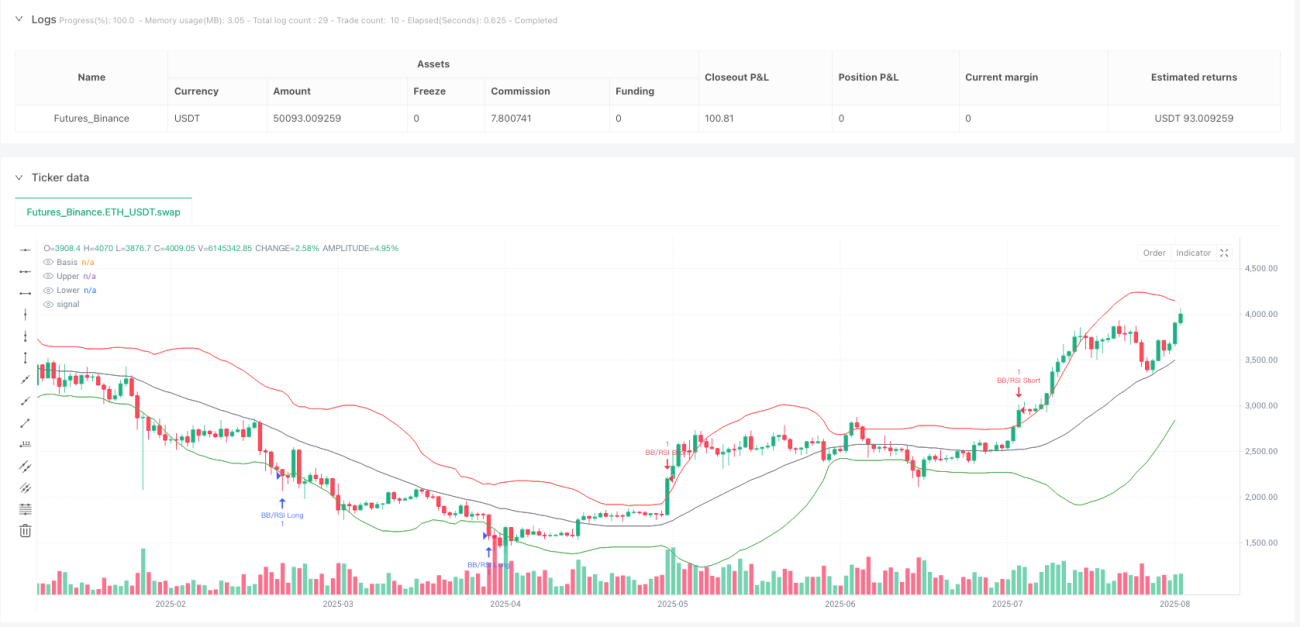
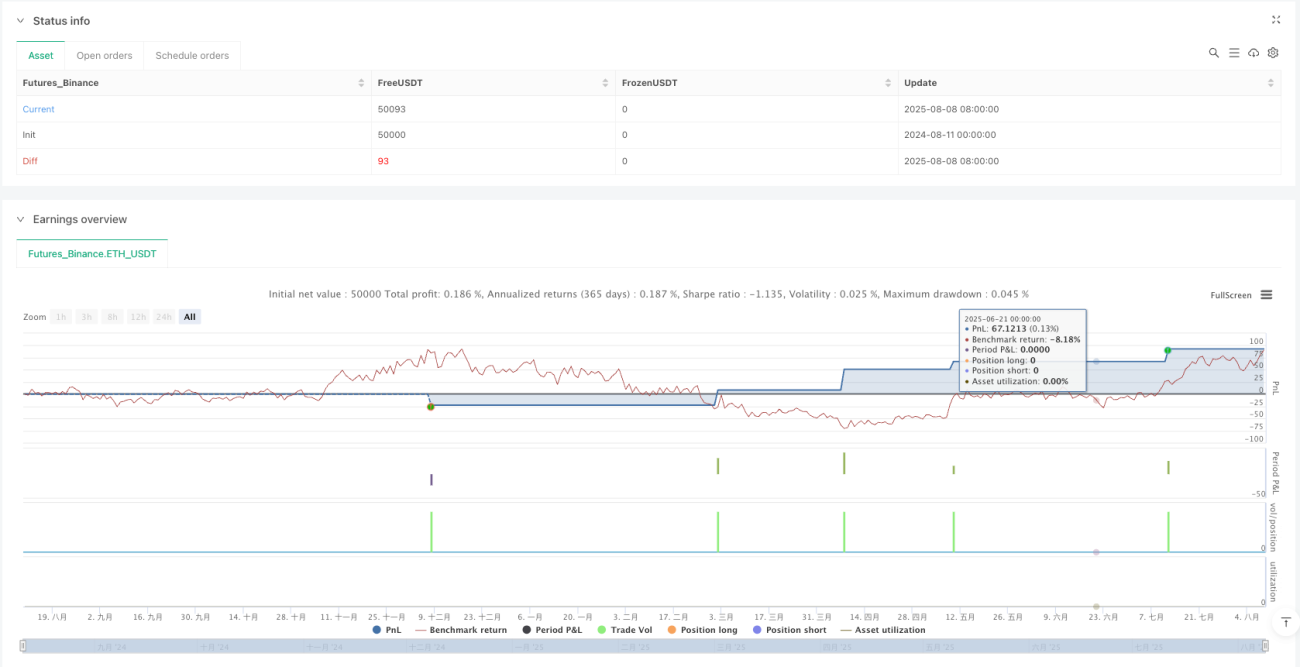
Overview
This strategy combines Bollinger Bands and RSI indicators to identify potential market reversals through a dual confirmation approach. It enters long positions when price crosses below the lower Bollinger Band while RSI confirms oversold conditions, and enters short positions when price crosses above the upper Bollinger Band while RSI confirms overbought conditions. The strategy implements both fixed and trailing stop mechanisms for risk management, aiming to capture high-probability reversal trading opportunities while protecting capital.
Strategy Principles
The strategy operates on the principle of mean reversion with momentum confirmation. Bollinger Bands help identify price extremes relative to recent volatility, while RSI confirms whether the market is actually overbought or oversold. The core principles include:
- Using Bollinger Bands (standard deviation-based bands around an SMA) to identify when price has moved significantly away from its average
- Confirming potential reversals with RSI readings to filter out false signals
- Implementing both fixed and trailing stops for comprehensive risk management
- Trading both long and short opportunities based on the same technical principles
In code implementation, the strategy uses a 30-day period SMA to calculate the Bollinger Band centerline with a standard deviation multiplier of 2.0, while employing a 14-day period RSI as momentum confirmation. Short signals are triggered when price crosses above the upper band and RSI is above 70; long signals are triggered when price crosses below the lower band and RSI is below 30. Each trade applies both a fixed 40-point stop loss and a 40-point trailing stop to ensure risk control.
Strategy Advantages
- Dual confirmation reduces false signals by requiring both price action (Bollinger Bands) and momentum (RSI) to align
- Mean reversion approach capitalizes on the tendency of markets to return to their average after extreme movements
- Flexible parameter settings allow adaptation to different market conditions and instruments
- Comprehensive stop-loss strategy with both fixed and trailing stops helps preserve capital and lock in profits
- Relatively simple implementation makes the strategy accessible while still being sophisticated enough to filter out noise
- The strategy is symmetrical, working for both long and short positions using the same principles
- Clear code structure and parameterized design allow for optimization adjustments based on different market characteristics
Risk Analysis
- During strong trends, mean reversion strategies can face multiple consecutive losses
- Fixed stop values may not be optimal across different market volatility regimes
- RSI and Bollinger Bands can remain in extreme territories during prolonged trends, leading to premature entries
- The 40-point fixed value for stops doesn't adapt to different instruments and their typical price ranges
- No position sizing logic could lead to uneven risk exposure across trades
- No time-based exit mechanisms could result in positions being held too long in sideways markets
- In high volatility environments, the fixed stop point value may be insufficient to protect capital
Optimization Directions
- Implement adaptive stop-loss and trailing stop values based on ATR (Average True Range) or historical volatility
- Add trend filter to avoid taking countertrend positions in strong trending markets
- Incorporate volume confirmation to improve signal quality
- Develop dynamic position sizing based on volatility or risk metrics
- Add time-based exit rules to avoid holding positions too long
- Test alternative band calculation methods (e.g., using EMA instead of SMA, or different standard deviation multipliers)
- Explore optimizing entry timing by adding secondary confirmation indicators
- Consider adding partial profit-taking rules to improve overall risk-reward ratio
- Explore adding volatility adjustment mechanisms to make the strategy perform more consistently across different volatility environments
Summary
The Bollinger-RSI Dual Confirmation Mean Reversion Strategy with Trailing Stop Protection represents a thoughtful approach to trading market reversals. By combining the volatility-based signals from Bollinger Bands with momentum confirmation from RSI, the strategy aims to capture high-probability reversal points while filtering out false signals. The built-in risk management through fixed and trailing stops adds an important protective layer. While the strategy has clear strengths in identifying potential reversal points with dual confirmation, it could benefit from further optimization, particularly in adapting to different market conditions and implementing more sophisticated position sizing and exit mechanisms. Overall, this is a solid foundation for a mean reversion trading approach that balances signal quality with risk management.
/*backtest
start: 2024-08-11 00:00:00
end: 2025-08-09 08:00:00
period: 1d
basePeriod: 1d
exchanges: [{"eid":"Futures_Binance","currency":"ETH_USDT"}]
*/

//@version=5
strategy("BB & RSI Trailing Stop Strategy", overlay=true, initial_capital=10000)

// --- Inputs for Bollinger Bands, RSI, and Trade Management ---- 1