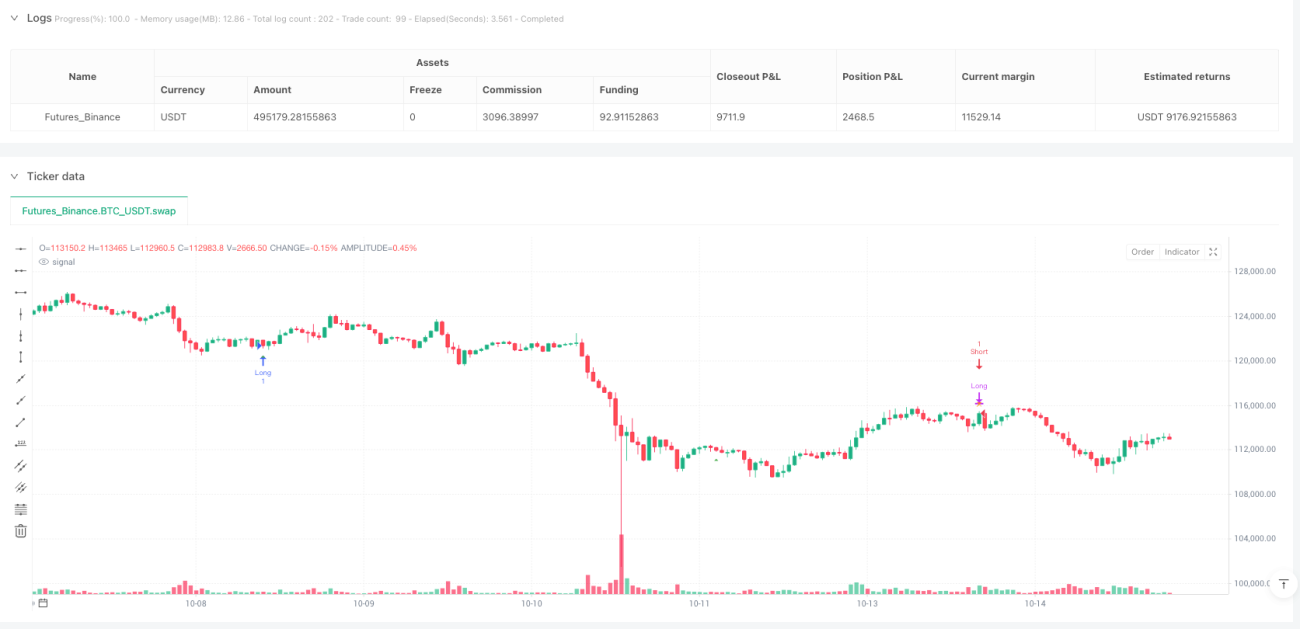
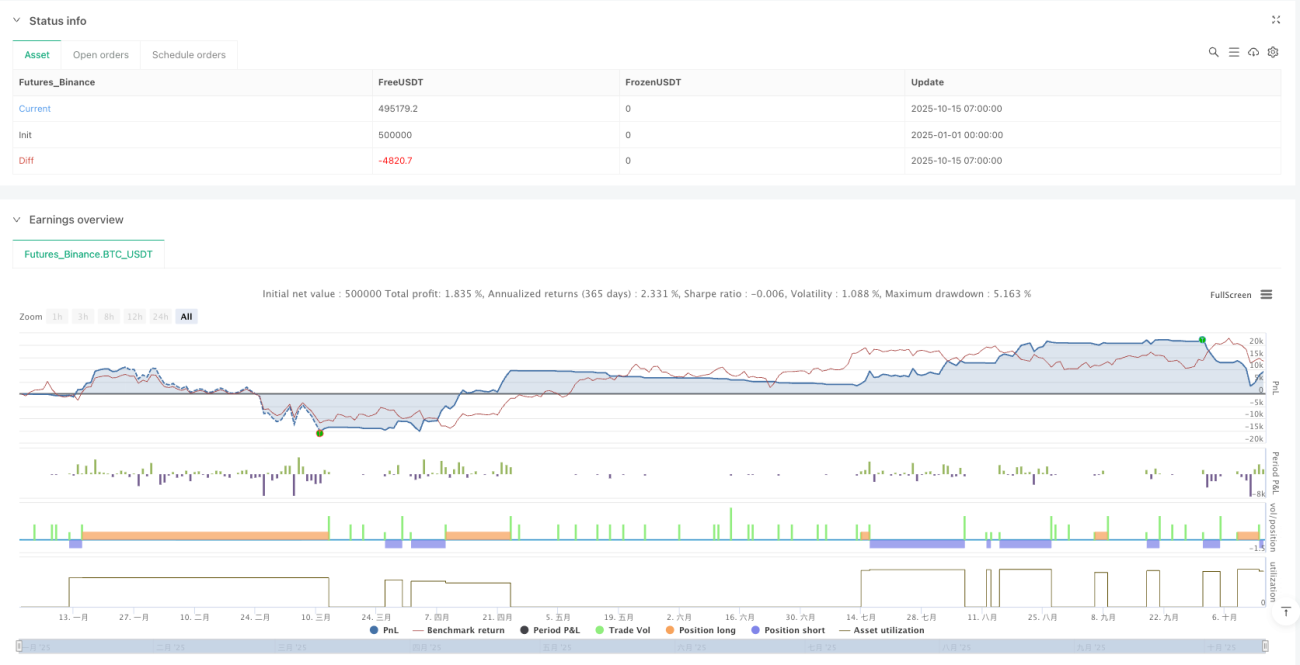
You know what? This strategy is like installing an âemotion detectorâ for the market! đĄ It uses a two-pole smoothing oscillator to sense the marketâs âmoodsâ - when the market gets too excited (overbought) or too depressed (oversold), it sends out trading signals. Key point! This isnât your ordinary oscillator, but a premium version with âdouble beauty filterâ processing that effectively filters out market noise, helping you see the real trend direction.
Imagine this strategy as a super-sensitive âmarket thermometerâ đĄď¸. First, it calculates how much prices deviate from the 25-period moving average, then standardizes this (like converting people of different heights to standard height ratios). Next comes the crucial âdouble smoothingâ process, like applying two beauty filters to a photo consecutively, making signals clearer and more reliable. When the oscillator breaks through set thresholds, the strategy strikes decisively!
Pitfall guide incoming! The most powerful feature is its âreverse signal exitâ mechanism - as smart as hitting the brakes immediately when seeing a red light while driving! đŚ When opposite signals appear, the strategy closes positions immediately without stubbornly holding on. Plus thereâs 5-period fixed stop-loss protection, like adding an âairbagâ to your capital. Most thoughtfully, it comes with complete trading statistics, keeping you informed of strategy performance at all times!
Key point! While this strategy is excellent, itâs not omnipotent. In strong trending markets, the oscillator might get âlost,â like using city navigation on a highway - not quite suitable. Fixed threshold settings might not adapt well to different market environments, requiring flexible adjustments based on actual conditions. Remember, any strategy needs good risk management - donât put all your eggs in one basket!
/*backtest
start: 2025-01-01 00:00:00
end: 2025-10-15 08:00:00
period: 1h
basePeriod: 1h
exchanges: [{"eid":"Futures_Binance","currency":"BTC_USDT","balance":500000}]
*/
//@version=6
strategy("Two-Pole Threshold Entries + Opposite-Signal & Stop Exits + Stats",
overlay=true,
max_labels_count=500)
// === Inputs ===
length = input.int(20, minval=1, title="Filter Length")
buyTrig = input.float(-0.8, title="Buy Threshold (osc â)")
sellTrig = input.float( 0.8, title="Sell Threshold (osc â)")
stopLossPts = input.int(10, minval=1, title="Stop Loss (pts)")
// === Two-Pole Oscillator ===
sma25 = ta.sma(close, 25)
dev = (close - sma25) - ta.sma(close - sma25, 25)
norm = dev / ta.stdev(close - sma25, 25)
alpha = 2.0 / (length + 1)
var float s1 = na
var float s2 = na
s1 := na(s1) ? norm : (1 - alpha) * s1 + alpha * norm
s2 := na(s2) ? s1 : (1 - alpha) * s2 + alpha * s1
osc = s2
prevOsc = osc[4]
// === Trigger Cross Signals ===
isLongSig = ta.crossover(osc, buyTrig) and barstate.isconfirmed
isShortSig = ta.crossunder(osc, sellTrig) and barstate.isconfirmed
// === State & Stats Vars ===
var int tradeDir = 0 // 1=long, -1=short, 0=flat
var float entryPrice = na
var int entryBar = na
var int buyTotal = 0
var int buyFailed = 0
var float sumMoveB = 0.0
var int cntMoveB = 0
var float sumPLptsB = 0.0
var int sellTotal = 0
var int sellFailed = 0
var float sumMoveS = 0.0
var int cntMoveS = 0
var float sumPLptsS = 0.0
// === Exit Marker Flags ===
var bool longStopHit = false
var bool shortStopHit = false
var bool longSigExit = false
var bool shortSigExit = false
longStopHit := false
shortStopHit := false
longSigExit := false
shortSigExit := false
// === 1) Opposite-Signal Exit ===
if tradeDir == 1 and isShortSig
float ptsL = close - entryPrice
sumMoveB += ptsL
sumPLptsB += ptsL
cntMoveB += 1
strategy.close("Long")
longSigExit := true
tradeDir := 0
if tradeDir == -1 and isLongSig
float ptsS = entryPrice - close
sumMoveS += ptsS
sumPLptsS += ptsS
cntMoveS += 1
strategy.close("Short")
shortSigExit := true
tradeDir := 0
// === 2) 5-Bar, Bar-Close 10-pt Stop Exit ===
inWindow = (tradeDir != 0) and (bar_index <= entryBar + 5)
longStopPrice = entryPrice - stopLossPts
shortStopPrice = entryPrice + stopLossPts
if tradeDir == 1 and inWindow and close <= longStopPrice
buyFailed += 1
sumPLptsB -= stopLossPts
strategy.close("Long")
longStopHit := true
tradeDir := 0
if tradeDir == -1 and inWindow and close >= shortStopPrice
sellFailed += 1
sumPLptsS -= stopLossPts
strategy.close("Short")
shortStopHit := true
tradeDir := 0
// === 3) New Entries (only when flat) ===
if tradeDir == 0 and isLongSig
buyTotal += 1
entryPrice := close
entryBar := bar_index
strategy.entry("Long", strategy.long)
tradeDir := 1
if tradeDir == 0 and isShortSig
sellTotal += 1
entryPrice := close
entryBar := bar_index
strategy.entry("Short", strategy.short)
tradeDir := -1
// === Stats Computation ===
float avgMoveB = cntMoveB > 0 ? sumMoveB / cntMoveB : na
float successPctB = buyTotal > 0 ? (buyTotal - buyFailed) / buyTotal * 100 : na
float pnlUSD_B = sumPLptsB * 50.0
float avgMoveS = cntMoveS > 0 ? sumMoveS / cntMoveS : na
float successPctS = sellTotal > 0 ? (sellTotal - sellFailed) / sellTotal * 100 : na
float pnlUSD_S = sumPLptsS * 50.0
string tf = timeframe.period
// === On-Chart Markers ===
plotshape(isLongSig, title="Long Entry", style=shape.triangleup, location=location.belowbar, color=color.green, size=size.tiny)
plotshape(isShortSig, title="Short Entry", style=shape.triangledown, location=location.abovebar, color=color.red, size=size.tiny)
plotshape(longSigExit, title="Exit on Sell Sig", style=shape.xcross, location=location.abovebar, color=color.orange, size=size.tiny)
plotshape(shortSigExit, title="Exit on Buy Sig", style=shape.xcross, location=location.belowbar, color=color.orange, size=size.tiny)
plotshape(longStopHit, title="Stop Exit Long", style=shape.xcross, location=location.abovebar, color=color.purple, size=size.tiny)
plotshape(shortStopHit, title="Stop Exit Short", style=shape.xcross, location=location.belowbar, color=color.purple, size=size.tiny)