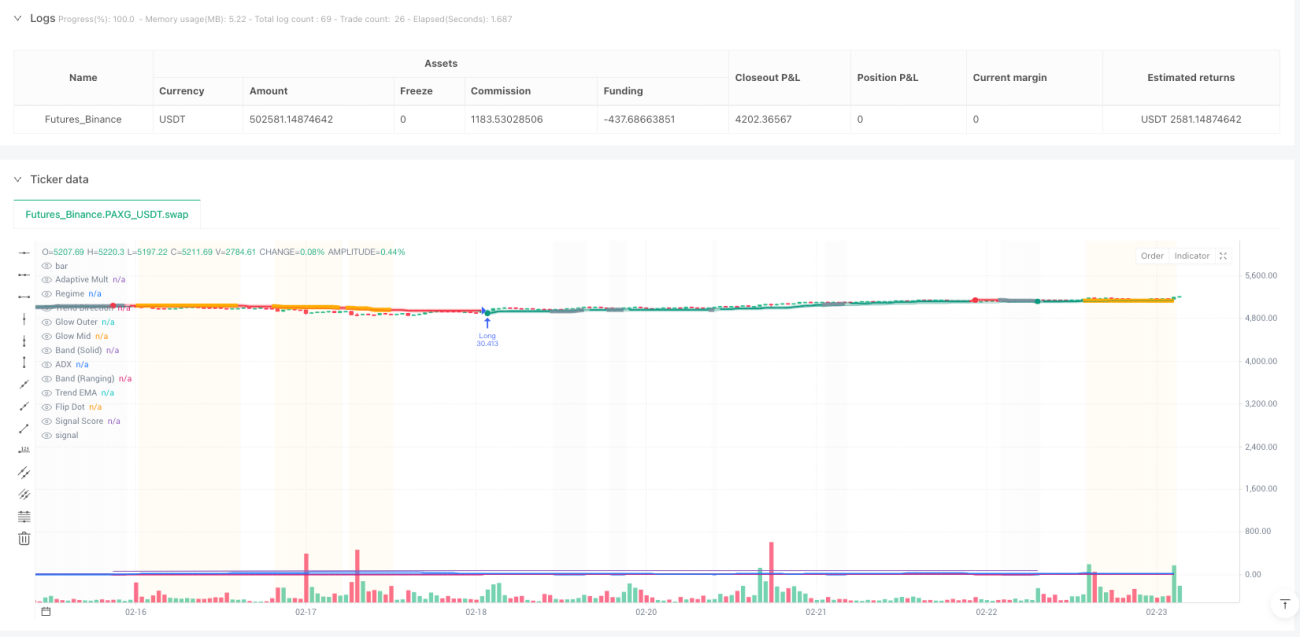
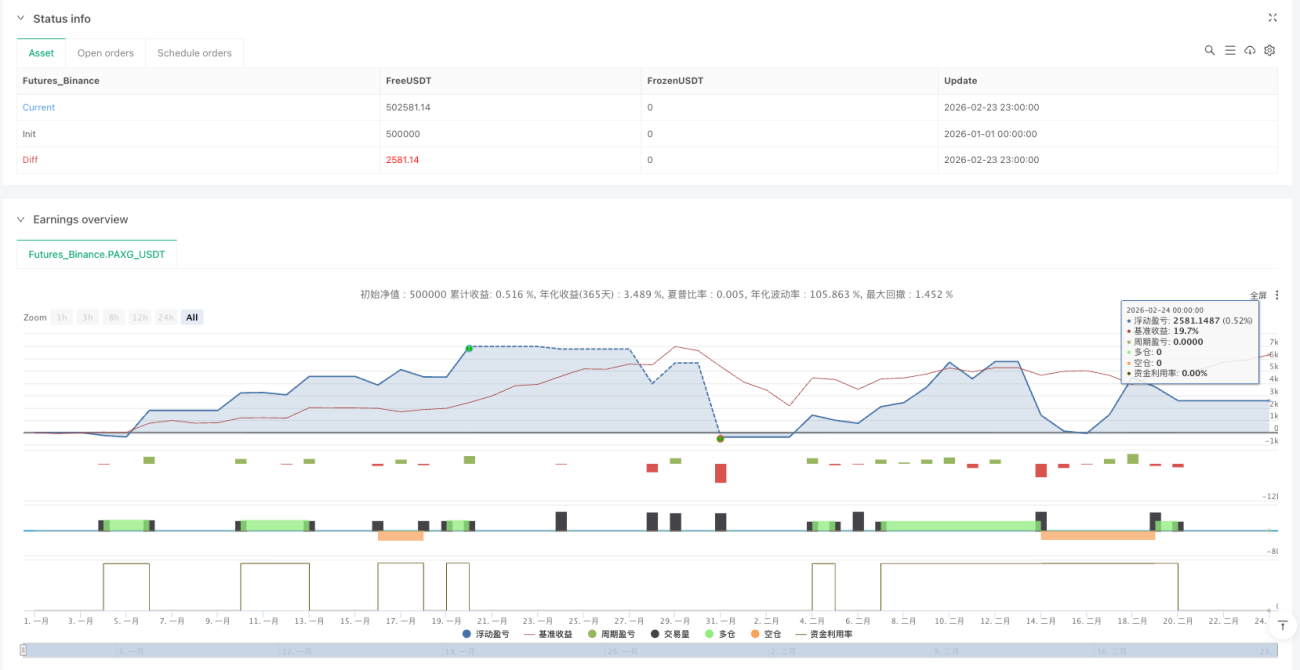
SUPERTREND, ATR, ADX, EMA, AI
The biggest pain point of traditional SuperTrend strategies? Fixed parameters perform drastically differently across market environments. This AI-enhanced version dynamically adjusts ATR multipliers, increasing them up to 2x the base value during high volatility periods and reducing to 0.85x during low volatility. Backtesting data shows this adaptive mechanism significantly reduces false signals in ranging markets.
The core innovation lies in a three-layer filtering system: market regime identification, AI signal scoring, and multiple confirmation mechanisms. Instead of simply entering on price breaks above/below the SuperTrend line, trades require AI scores above 65 points. This scoring system comprehensively evaluates 5 dimensions including volume surges, price displacement, and trend alignment.
The scoring mechanism is elegantly designed: volume surge carries 20-point weight, price displacement from SuperTrend line carries 25 points, EMA trend alignment 20 points, market regime quality 15 points, and previous price-to-line distance 20 points. With a total of 100 points, the default 65-point threshold ensures only high-quality signals pass the filter.
Specifically, volume exceeding 2.5x the 20-period average earns full 20 points, while price displacement beyond 1.5x ATR from the SuperTrend line scores maximum 25 points. This quantified scoring eliminates subjective judgment, providing clear data backing for every signal. In practice, adjust the minimum score requirement based on different asset characteristics.
The strategy identifies three market states through ATR ratio and ADX indicators: trending (regime=1), high volatility (regime=2), and ranging (regime=0). High volatility is detected when ATR ratio exceeds 1.4, while ranging occurs when ADX falls below 20 and ATR ratio drops below 0.9.
Adaptive multiplier logic: high volatility periods increase multiplier by 40% × (ATR ratio - 1.0), ranging periods reduce to 85% of base value. This means a 3.0 base multiplier could adjust to 4.2 during extreme volatility and drop to 2.55 during ranging periods. This dynamic adjustment significantly enhances strategy adaptability across market environments.
ATR dynamic stop loss is the preferred approach, with default 2.5x ATR distance balancing normal fluctuation tolerance with timely loss cutting. Percentage stops suit assets with relatively stable volatility, while SuperTrend mode exits immediately on trend reversals.
Take profit settings support risk-reward ratio mode, with the default 2.5:1 ratio statistically advantageous. When trailing stops are enabled, profitable position stop levels adjust dynamically based on 2.5x ATR distance, maximizing returns in trending markets.
EMA trend filter ensures entries only occur in alignment with the 50-period EMA direction, avoiding counter-trend trades. Ranging period filter directly skips regime=0 signals, potentially missing some opportunities but significantly reducing false signal rates.
Volume filter requires entry volume above the 20-period average, ensuring sufficient market participation supports price breakouts. A 10-bar cooldown period prevents overtrading and reduces transaction costs.
For cryptocurrencies, consider raising minimum AI score to 70 points; traditional stocks can use 60 points. High-frequency traders can reduce cooldown to 5 bars, while long-term investors should extend to 15 bars.
The ATR length parameter of 10 represents an optimized balance point - shorter periods create oversensitivity, longer periods introduce lag. The base multiplier of 3.0 suits most assets; high volatility assets can use 3.5, low volatility assets 2.5.
Important Risk Disclaimer: Historical backtesting results do not guarantee future performance. The strategy may experience consecutive losses under extreme market conditions. Strictly limit individual position size to no more than 30% of total capital. Strategy performance varies significantly across different market environments, requiring continuous monitoring and parameter adjustments.
/*backtest
start: 2026-01-01 00:00:00
end: 2026-02-24 00:00:00
period: 1h
basePeriod: 1h
exchanges: [{"eid":"Futures_Binance","currency":"PAXG_USDT","balance":500000}]
*/
// This source code is subject to the terms of the Mozilla Public License 2.0 at https://mozilla.org/MPL/2.0/
// © DefinedEdge
//@version=6
strategy("SuperTrend AI Strategy [Adaptive]", "ST AI Strategy ◈",
overlay = true,
initial_capital = 10000,
default_qty_type = strategy.percent_of_equity,
default_qty_value= 30,
commission_type = strategy.commission.percent,
commission_value = 0.06,
slippage = 2,
pyramiding = 0,
calc_on_every_tick = false,
max_labels_count = 500)
// ============================================================================
// INPUTS
// ============================================================================
// --- SuperTrend Core ---
GRP_ST = "◈ SuperTrend"
i_atLen = input.int(10, "ATR Length", minval=1, maxval=50, group=GRP_ST)
i_bMult = input.float(3.0, "Base Multiplier", minval=0.5, maxval=10.0, step=0.1, group=GRP_ST)
i_src = input.source(hl2, "Source", group=GRP_ST)
// --- Regime Detection ---
GRP_REG = "◈ Regime Detection"
i_regLen = input.int(40, "Regime Lookback", minval=10, maxval=100, group=GRP_REG)
i_adxLen = input.int(14, "ADX Length", minval=5, maxval=50, group=GRP_REG)
i_adxThr = input.float(20, "ADX Trend Threshold", minval=10, maxval=40, step=1, group=GRP_REG)
i_adapt = input.bool(true, "Adaptive Multiplier", group=GRP_REG)
// --- AI Scoring ---
GRP_AI = "◈ AI Engine"
i_trendLen = input.int(50, "Trend EMA Length", minval=10, maxval=200, group=GRP_AI)
i_volLen = input.int(20, "Volume MA Length", minval=5, maxval=50, group=GRP_AI)
i_minSc = input.int(65, "Min Signal Score", minval=0, maxval=90, group=GRP_AI, tooltip="Only enter trades when the AI score meets this threshold.")
// --- Risk Management ---
GRP_RISK = "◈ Risk Management"
i_slMode = input.string("ATR", "Stop Loss Mode", options=["ATR", "Percent", "SuperTrend"], group=GRP_RISK, tooltip="ATR: dynamic SL based on volatility. Percent: fixed %. SuperTrend: exit on trend flip.")
i_slAtr = input.float(2.5, "SL ATR Multiplier", minval=0.5, maxval=8.0, step=0.1, group=GRP_RISK)
i_slPct = input.float(3.0, "SL Percent", minval=0.5, maxval=10.0, step=0.1, group=GRP_RISK)
i_tpMode = input.string("RR", "Take Profit Mode", options=["RR", "Percent", "None"], group=GRP_RISK, tooltip="RR: risk/reward ratio based on SL distance. Percent: fixed %. None: hold until SL or flip.")
i_tpRR = input.float(2.5, "TP Risk:Reward", minval=0.5, maxval=10.0, step=0.1, group=GRP_RISK)
i_tpPct = input.float(6.0, "TP Percent", minval=0.5, maxval=20.0, step=0.1, group=GRP_RISK)
i_trail = input.bool(true, "Trailing Stop", group=GRP_RISK, tooltip="When enabled, SL trails in the direction of the trade after entry.")
i_trailAtr = input.float(2.5, "Trail ATR Mult", minval=0.5, maxval=8.0, step=0.1, group=GRP_RISK)
// --- Filters ---
GRP_FLT = "◈ Trade Filters"
i_trendF = input.bool(true, "EMA Trend Filter", group=GRP_FLT, tooltip="Only take longs above EMA, shorts below EMA.")
i_regF = input.bool(true, "Skip Ranging", group=GRP_FLT, tooltip="Skip entries during ranging regime. Reduces whipsaws.")
i_volF = input.bool(true, "Volume Filter", group=GRP_FLT, tooltip="Only enter if volume is above average.")
i_sigCD = input.int(10, "Cooldown (bars)", minval=0, maxval=50, group=GRP_FLT)
// --- Backtest Window ---
GRP_BT = "◈ Backtest"
bool inWindow = true
// --- Visuals ---
GRP_VIS = "◈ Visuals"
i_sGlow = input.bool(true, "Band Glow Effect", group=GRP_VIS)
i_sRegBg = input.bool(true, "Regime Background", group=GRP_VIS)
// --- Colors ---
GRP_COL = "◈ Colors"
i_cBull = input.color(color.new(#089981, 0), "Bull", inline="c1", group=GRP_COL)
i_cBear = input.color(color.new(#f23645, 0), "Bear", inline="c1", group=GRP_COL)
// ============================================================================
// CORE CALCULATIONS
// ============================================================================
int n = bar_index
float atr = ta.atr(i_atLen)
float safeAtr = nz(atr, 0.001)
// ── Regime Detection ──
float atrMa = ta.sma(atr, i_regLen)
float atrRatio = atrMa > 0 ? atr / atrMa : 1.0
// ADX
float upMove = high - high[1]
float dnMove = low[1] - low
float plusDM = upMove > dnMove and upMove > 0 ? upMove : 0
float minusDM = dnMove > upMove and dnMove > 0 ? dnMove : 0
float trueR = ta.tr
float smoothTR = ta.rma(trueR, i_adxLen)
float smoothPD = ta.rma(plusDM, i_adxLen)
float smoothND = ta.rma(minusDM, i_adxLen)
float plusDI = smoothTR > 0 ? 100 * smoothPD / smoothTR : 0
float minusDI = smoothTR > 0 ? 100 * smoothND / smoothTR : 0
float diSum = plusDI + minusDI
float dx = diSum > 0 ? 100 * math.abs(plusDI - minusDI) / diSum : 0
float adx = ta.rma(dx, i_adxLen)
var int regime = 1
if atrRatio > 1.4
regime := 2
else if adx < i_adxThr and atrRatio < 0.9
regime := 0
else
regime := 1
// ── Adaptive Multiplier ──
float adaptMult = i_bMult
if i_adapt
if regime == 2
adaptMult := i_bMult * (1.0 + (atrRatio - 1.0) * 0.4)
else if regime == 0
adaptMult := i_bMult * 0.85
adaptMult := math.max(math.min(adaptMult, i_bMult * 2.0), i_bMult * 0.5)
// ── SuperTrend ──
var float stBand = na
var int stDir = 1
float upperBase = i_src + adaptMult * atr
float lowerBase = i_src - adaptMult * atr
float prevBand = nz(stBand[1], stDir == 1 ? lowerBase : upperBase)
if stDir == 1
stBand := math.max(lowerBase, prevBand)
if close < stBand
stDir := -1
stBand := upperBase
else
stBand := math.min(upperBase, prevBand)
if close > stBand
stDir := 1
stBand := lowerBase
bool trendFlip = stDir != stDir[1]
// ── Trend EMA ──
float trendMa = ta.ema(close, i_trendLen)
bool trendUp = close > trendMa
bool trendDn = close < trendMa
// ── Volume ──
float volMa = ta.sma(volume, i_volLen)
// ============================================================================
// AI SIGNAL SCORING
// ============================================================================
scoreSignal(bool isBull) =>
float score = 0
// Factor 1: Volume surge (0-20)
float vRat = volMa > 0 ? volume / volMa : 1.0
score += vRat >= 2.5 ? 20 : vRat >= 1.5 ? 14 : vRat >= 1.0 ? 8 : 3
// Factor 2: Displacement beyond band (0-25)
float disp = isBull ? (close - stBand) : (stBand - close)
float dispAtr = safeAtr > 0 ? disp / safeAtr : 0
score += dispAtr >= 1.5 ? 25 : dispAtr >= 0.8 ? 18 : dispAtr >= 0.3 ? 12 : dispAtr > 0 ? 5 : 0
// Factor 3: EMA trend alignment (0-20)
bool aligned = (isBull and trendUp) or (not isBull and trendDn)
float emaDist = math.abs(close - trendMa) / safeAtr
score += aligned and emaDist > 0.5 ? 20 : aligned ? 14 : emaDist < 0.3 ? 8 : 2
// Factor 4: Regime quality (0-15)
score += regime == 1 ? 15 : regime == 2 ? 8 : 3
// Factor 5: Band distance before flip (0-20)
float prevDist = not na(stBand[1]) ? math.abs(close[1] - stBand[1]) / safeAtr : 0
score += prevDist >= 2.0 ? 20 : prevDist >= 1.0 ? 14 : prevDist >= 0.5 ? 8 : 3
int(math.min(math.round(score), 100))
// ============================================================================
// TRADE LOGIC
// ============================================================================
var int lastEntryBar = 0
var float entryPrice = 0.0
var float slPrice = 0.0
var float tpPrice = 0.0
var int lastSigScore = 0
var int lastSigDir = 0
var bool lastSigBright = false
bool longEntry = false
bool shortEntry = false
int sigScore = 0
// Cooldown check
bool cdOk = (n - lastEntryBar) > i_sigCD
if trendFlip and inWindow and cdOk and barstate.isconfirmed
if stDir == 1
sigScore := scoreSignal(true)
// Apply filters
bool passScore = sigScore >= i_minSc
bool passTrend = not i_trendF or trendUp
bool passReg = not i_regF or regime != 0
bool passVol = not i_volF or (volume > volMa)
if passScore and passTrend and passReg and passVol
longEntry := true
else
sigScore := scoreSignal(false)
bool passScore = sigScore >= i_minSc
bool passTrend = not i_trendF or trendDn
bool passReg = not i_regF or regime != 0
bool passVol = not i_volF or (volume > volMa)
if passScore and passTrend and passReg and passVol
shortEntry := true
// ── Calculate SL/TP Levels ──
float slDist = 0.0
if i_slMode == "ATR"
slDist := atr * i_slAtr
else if i_slMode == "Percent"
slDist := close * i_slPct / 100
else // SuperTrend mode
slDist := math.abs(close - stBand)
float tpDist = 0.0
if i_tpMode == "RR"
tpDist := slDist * i_tpRR
else if i_tpMode == "Percent"
tpDist := close * i_tpPct / 100
// ── Execute Entries ──
if longEntry
// Close any existing short
if strategy.position_size < 0
strategy.close("Short")
entryPrice := close
slPrice := close - slDist
tpPrice := i_tpMode != "None" ? close + tpDist : na
strategy.entry("Long", strategy.long)
if not na(slPrice) and i_tpMode != "None" and not na(tpPrice)
strategy.exit("Long Exit", "Long", stop=slPrice, limit=tpPrice,
trail_points = i_trail ? slDist / syminfo.mintick : na,
trail_offset = i_trail ? (atr * i_trailAtr) / syminfo.mintick : na)
else if not na(slPrice)
strategy.exit("Long SL", "Long", stop=slPrice,
trail_points = i_trail ? slDist / syminfo.mintick : na,
trail_offset = i_trail ? (atr * i_trailAtr) / syminfo.mintick : na)
lastEntryBar := n
lastSigScore := sigScore
lastSigDir := 1
lastSigBright := sigScore >= 70
if shortEntry
// Close any existing long
if strategy.position_size > 0
strategy.close("Long")
entryPrice := close
slPrice := close + slDist
tpPrice := i_tpMode != "None" ? close - tpDist : na
strategy.entry("Short", strategy.short)
if not na(slPrice) and i_tpMode != "None" and not na(tpPrice)
strategy.exit("Short Exit", "Short", stop=slPrice, limit=tpPrice,
trail_points = i_trail ? slDist / syminfo.mintick : na,
trail_offset = i_trail ? (atr * i_trailAtr) / syminfo.mintick : na)
else if not na(slPrice)
strategy.exit("Short SL", "Short", stop=slPrice,
trail_points = i_trail ? slDist / syminfo.mintick : na,
trail_offset = i_trail ? (atr * i_trailAtr) / syminfo.mintick : na)
lastEntryBar := n
lastSigScore := sigScore
lastSigDir := -1
lastSigBright := sigScore >= 70
// ── SuperTrend Flip Exit (if SL mode is SuperTrend) ──
if i_slMode == "SuperTrend" and trendFlip
if strategy.position_size > 0 and stDir == -1
strategy.close("Long", comment="ST Flip")
if strategy.position_size < 0 and stDir == 1
strategy.close("Short", comment="ST Flip")
// ============================================================================
// VISUALS
// ============================================================================
// ── Band Color ──
color bandCore = stDir == 1 ? i_cBull : i_cBear
color bandColor = regime == 2 ? color.new(#ffab00, 0) : regime == 0 ? color.new(#78909c, 20) : bandCore
// ── Glow ──
plot(i_sGlow ? stBand : na, "Glow Outer", color=color.new(bandColor, 85), linewidth=6, style=plot.style_linebr)
plot(i_sGlow ? stBand : na, "Glow Mid", color=color.new(bandColor, 70), linewidth=4, style=plot.style_linebr)
// ── Band ──
plot(regime != 0 ? stBand : na, "Band (Solid)", color=bandColor, linewidth=2, style=plot.style_linebr)
plot(regime == 0 ? stBand : na, "Band (Ranging)", color=bandColor, linewidth=2, style=plot.style_linebr)
// ── Flip Dot ──
plot(trendFlip ? stBand : na, "Flip Dot", color=bandCore, style=plot.style_circles, linewidth=5, join=false)
// ── Regime Background ──
bgcolor(i_sRegBg and regime == 2 ? color.new(#ffab00, 95) : na, title="Volatile BG")
bgcolor(i_sRegBg and regime == 0 ? color.new(#78909c, 96) : na, title="Ranging BG")
// ── Trend EMA ──
plot(trendMa, "Trend EMA", color=color.new(trendUp ? i_cBull : i_cBear, 65), linewidth=1)
// ============================================================================
// HIDDEN PLOTS
// ============================================================================
plot(sigScore > 0 ? sigScore : na, "Signal Score", display=display.none)
plot(adaptMult, "Adaptive Mult", display=display.none)
plot(adx, "ADX", display=display.none)
plot(float(regime), "Regime", display=display.none)
plot(float(stDir), "Trend Direction", display=display.none)