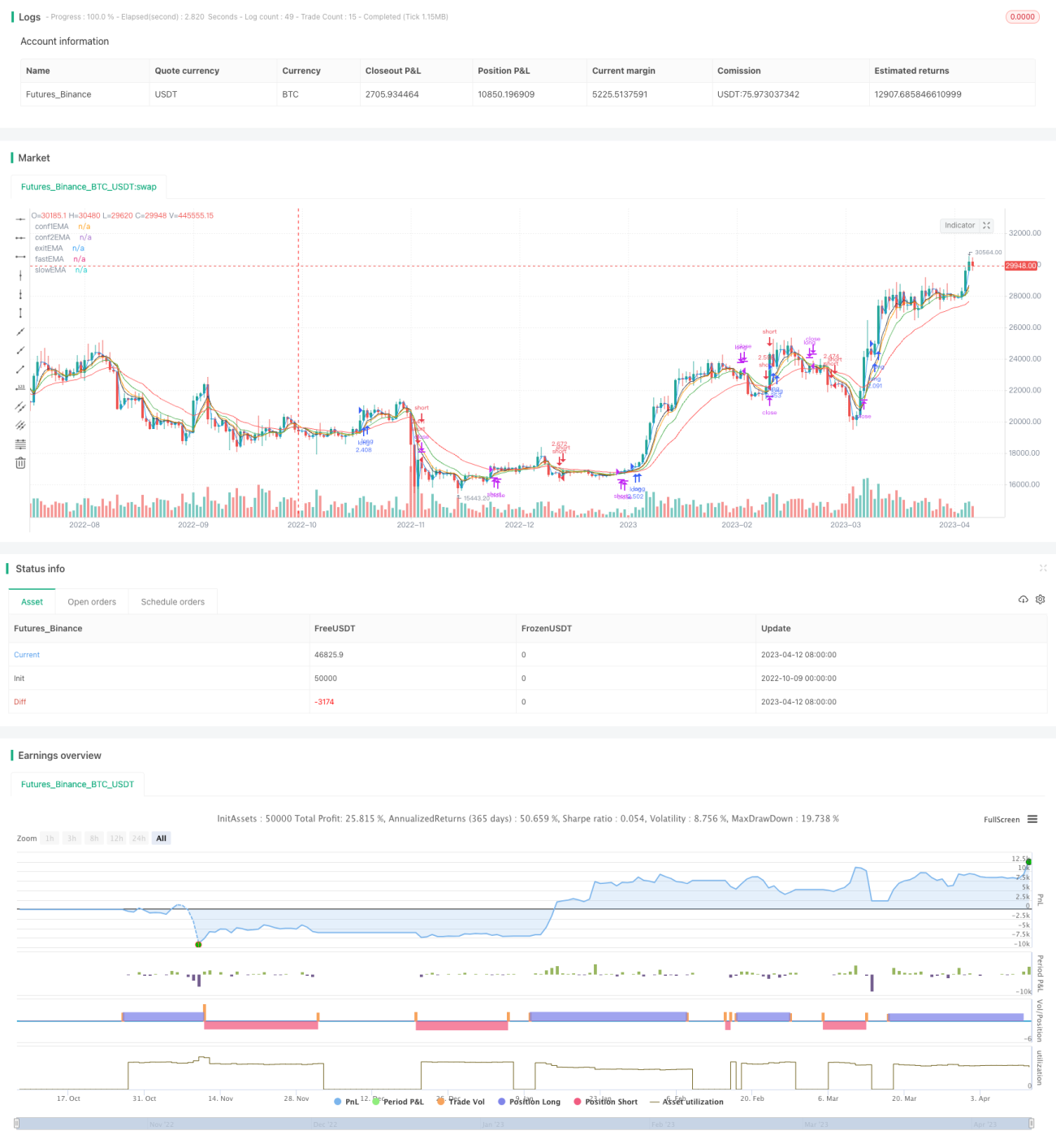
Estrategia de trading con ruptura de doble EMA


Fecha de creación: 2023-10-16 16:24:00 Última modificación: 2023-10-16 16:24:00
Copiar: 1 Número de Visitas: 738
1
Seguir
1617
Seguidores

Estrategia de trading con ruptura de doble EMA

Descripción general

La estrategia de breakout de doble EMA es una estrategia de seguimiento de tendencias que utiliza las medias de EMA de dos períodos diferentes para juzgar las señales de compra y venta. La estrategia combina al mismo tiempo los indicadores de EMA adicionales para filtrar las señales de negociación y obtener un mejor momento de entrada en la tendencia.

El principio

La estrategia utiliza un EMA de línea rápida ((9 ciclos) y un EMA de línea lenta ((21 ciclos) para determinar el momento de comprar y vender. Se genera una señal de compra cuando la línea rápida atraviesa la línea lenta y una señal de venta cuando la línea rápida atraviesa la línea lenta. Para filtrar las señales falsas, la estrategia también introduce un EMA auxiliar ((5 ciclos) y otros dos EMA ((1 y 4 ciclos). El EMA auxiliar solo se encuentra entre la línea rápida y lenta cuando ocurre un EMA de línea rápida y un EMA de ciclo 1 es superior al EMA de ciclo 4.

Cuando se activa la señal de negociación, la estrategia establece un stop loss y un stop loss según el valor de ATR. TP1 es 6 veces el ATR, para obtener una parte de las ganancias de la velocidad más rápida. Si el precio no activa TP1, cuando la línea rápida EMA vuelve a cruzar la EMA auxiliar, se aplanará la posición directamente para lograr el stop TP2.

Las ventajas

  • El uso de combinaciones de doble EMA para filtrar falsas señales mejora la calidad de las señales de negociación
  • Los indicadores auxiliares de EMA pueden verificar aún más la dirección de la tendencia y reducir el riesgo de inversión
  • El diseño de un parche doble permite obtener ganancias rápidas y seguir tendencias de manera sostenible
  • El Stop Loss Stop ATR se puede ajustar a la volatilidad del mercado para reducir el riesgo

Riesgo y optimización

  • Los EMA son propensos a la ajuste de la curva y las señales de negociación pueden retrasarse
  • Las combinaciones de EMA de corto período pueden generar más señales de negociación de ruido
  • Operaciones de línea corta son más vulnerables a eventos inesperados, con mayor riesgo de pérdida

La dirección de la optimización:

  • Prueba de combinaciones de varios grupos de EMA para encontrar los mejores
  • Aumentar la verificación de otros indicadores, como el volumen de transacciones, la volatilidad, etc.
  • Ampliar adecuadamente el rango de parálisis para reducir la probabilidad de que se active el parálisis
  • Optimización de la proporción de la configuración de doble parada, equilibrando la velocidad de ganancias y la eficiencia de la utilización de fondos

Resumir

La estrategia de negociación de ruptura de doble EMA utiliza el cruce de dos EMA para juzgar la tendencia, complementada con filtros de EMA múltiples y paradas de pérdidas dinámicas de ATR, para seguir la tendencia de manera efectiva. Sin embargo, se debe tener en cuenta la adaptación de la curva de EMA, el riesgo de pérdidas.

Overview

The dual EMA crossover trading strategy utilizes two EMA lines of different periods to generate buy and sell signals by identifying trend direction. It also incorporates additional EMA indicators for signal filtering, allowing better entry timing in trending markets.

Principles

The strategy uses a fast EMA line (9 periods) and a slow EMA line (21 periods) to determine entries. A golden cross where the fast EMA crosses above the slow EMA generates a buy signal, while a death cross with the fast EMA crossing below the slow EMA produces a sell signal. To filter out false signals, the strategy also employs an auxiliary EMA (5 periods) and two more EMAs (1 period, 4 periods). A real trading signal is only triggered when the fast and slow EMAs cross while the auxiliary EMA is between the two, and the 1-period EMA is above the 4-period EMA.

Once a trading signal is triggered, the strategy utilizes ATR values to set stop loss and take profit levels. TP1 is set at 6 x ATR for faster profit taking. If price doesn’t hit TP1, the strategy will close the position directly when the fast EMA crosses back over the auxiliary EMA, realizing TP2.

Advantages

  • Dual EMA design filters false signals and improves signal quality
  • Auxiliary EMA adds trend direction verification, reducing reverse trade risks
  • Dual take profit allows fast profit and sustained trend following
  • Dynamic ATR stop loss/take profit adjusts to market volatility

Risks and Improvements

  • EMAs can lag prices and generate late signals
  • Shorter EMA combos may produce more noise
  • Tighter stops face larger sudden event risks

Improvement directions:

  • Test multiple EMA combos for better parameters
  • Add other confirmation indicators like volume, volatility etc.
  • Widen stop loss to lower stop out odds
  • Optimize take profit ratios for profit vs capital efficiency

Conclusion

The dual EMA crossover strategy leverages EMA crosses for trend direction, along with multiple EMA filtering and dynamic ATR stop loss/profit taking. This allows effective trend following and profit harvesting. However, EMA fitting limitations and stop loss risks require caution. Proper optimization, risk management etc. can lead to more robust performance. The strategy suits experienced traders to achieve high capital efficiency in trending markets.

[/trans]

Código Fuente de la Estrategia
/*backtest
start: 2022-10-09 00:00:00
end: 2023-04-13 00:00:00
period: 1d
basePeriod: 1h
exchanges: [{"eid":"Futures_Binance","currency":"BTC_USDT"}]
*/

// This source code is subject to the terms of the Mozilla Public License 2.0 at https://mozilla.org/MPL/2.0/
// @author ADHDCRYPT0

//@version=4
strategy(title = "EMA double crossover", shorttitle = "(TEST) double cross over", overlay = true, default_qty_value = 100, initial_capital = 1000,default_qty_type=strategy.percent_of_equity, pyramiding=0, process_orders_on_close=true)


// Variables
ema_len1 = input(9 , title="Fast EMA")
ema_len2 = input(21, title="Slow EMA")
ema_len3 = input(5, title="Exit EMA")
ema_len4 = input(1, title="FastConf EMA")
ema_len5 = input(4, title="SlowConf EMA")

fastEMA = ema(open, ema_len1)
slowEMA = ema(open, ema_len2)
exitEMA = ema(open, ema_len3)
conf1EMA = ema(open, ema_len4)
conf2EMA = ema(open, ema_len5)
plot(fastEMA, title='fastEMA', transp=0, color=color.green)
plot(slowEMA, title='slowEMA', transp=0, color=color.red  )
plot(exitEMA, title='exitEMA', transp=0, color=color.orange)
plot(conf1EMA, title='conf1EMA', transp=0, color=color.blue)
plot(conf2EMA, title='conf2EMA', transp=0, color=color.black)

vol = volume 
volma = sma(volume,7)
vol_cond = vol>volma

atr = atr(5)


// Entry Conditions and vol_cond
long = crossover(fastEMA, slowEMA) and (conf1EMA > conf2EMA) and (fastEMA < exitEMA)
short= crossunder(fastEMA, slowEMA) and (conf1EMA < conf2EMA) and (fastEMA > exitEMA)

tradeType = input("BOTH", title="What trades should be taken : ", options=["LONG", "SHORT", "BOTH", "NONE"])

pos = 0.0

if tradeType=="BOTH"
    pos:= long? 1 : short? -1 : pos[1]
if tradeType=="LONG"
    pos:= long? 1 : pos[1]
if tradeType=="SHORT"
    pos:=short? -1 : pos[1]

longCond  = long  and (pos[1]!= 1 or na(pos[1]))
shortCond = short and (pos[1]!=-1 or na(pos[1]))

// EXIT FUNCTIONS //
sl  = input(1, title="Stop Loss (ATR)", minval=0)
tp  = input(6, title="Take Profit 1 (ATR)", minval=0)

// Simple Stop Loss + 2 Take Profits
sl_long   =  valuewhen(longCond , low - atr * sl, 0)
sl_short  =  valuewhen(shortCond, high+ atr * sl, 0)

tp_long  = valuewhen(longCond , high + atr * tp, 0)
tp_short = valuewhen(shortCond, low  - atr * tp, 0)


long_exit = crossover(fastEMA, exitEMA) and pos[1]==1
short_exit= crossover(exitEMA, fastEMA) and pos[1]==-1

if long_exit or short_exit
	pos:=0


// Position Adjustment
long_sl  = low <sl_long [1] and pos[1]==1
short_sl = high>sl_short[1] and pos[1]==-1

if long_sl or short_sl
    pos:=0
    
//  Strategy Backtest Limiting Algorithm
i_startTime = input(defval = timestamp("01 Sep 2002 13:30 +0000"), title = "Backtesting Start Time", type = input.time)
i_endTime = input(defval = timestamp("30 Sep 2099 19:30 +0000"), title = "Backtesting End Time", type = input.time)
timeCond = true


// Make sure we are within the bar range, Set up entries and exit conditions
if strategy.equity >0
    strategy.entry("long" , strategy.long , when=longCond  and timeCond and tradeType!="SHORT" , alert_message="INSERT MESSAGE HERE")
    strategy.entry("short", strategy.short, when=shortCond and timeCond and tradeType!="LONG" , alert_message="INSERT MESSAGE HERE")
    
    strategy.exit("SL/TP1", from_entry = "long" , stop=sl_long , limit=tp_long , alert_message="INSERT MESSAGE HERE")
    strategy.exit("SL/TP1", from_entry = "short", stop=sl_short, limit=tp_short, alert_message="INSERT MESSAGE HERE")

    strategy.exit("SL", from_entry = "long" , stop=sl_long, alert_message="INSERT MESSAGE HERE")
    strategy.exit("SL", from_entry = "short", stop=sl_short, alert_message="INSERT MESSAGE HERE")
    
    strategy.close("long", when=long_exit , comment="TP2", alert_message="INSERT MESSAGE HERE")
    strategy.close("short", when=short_exit, comment="TP2", alert_message="INSERT MESSAGE HERE")