Estrategia de backtesting de soporte y resistencia dinámica

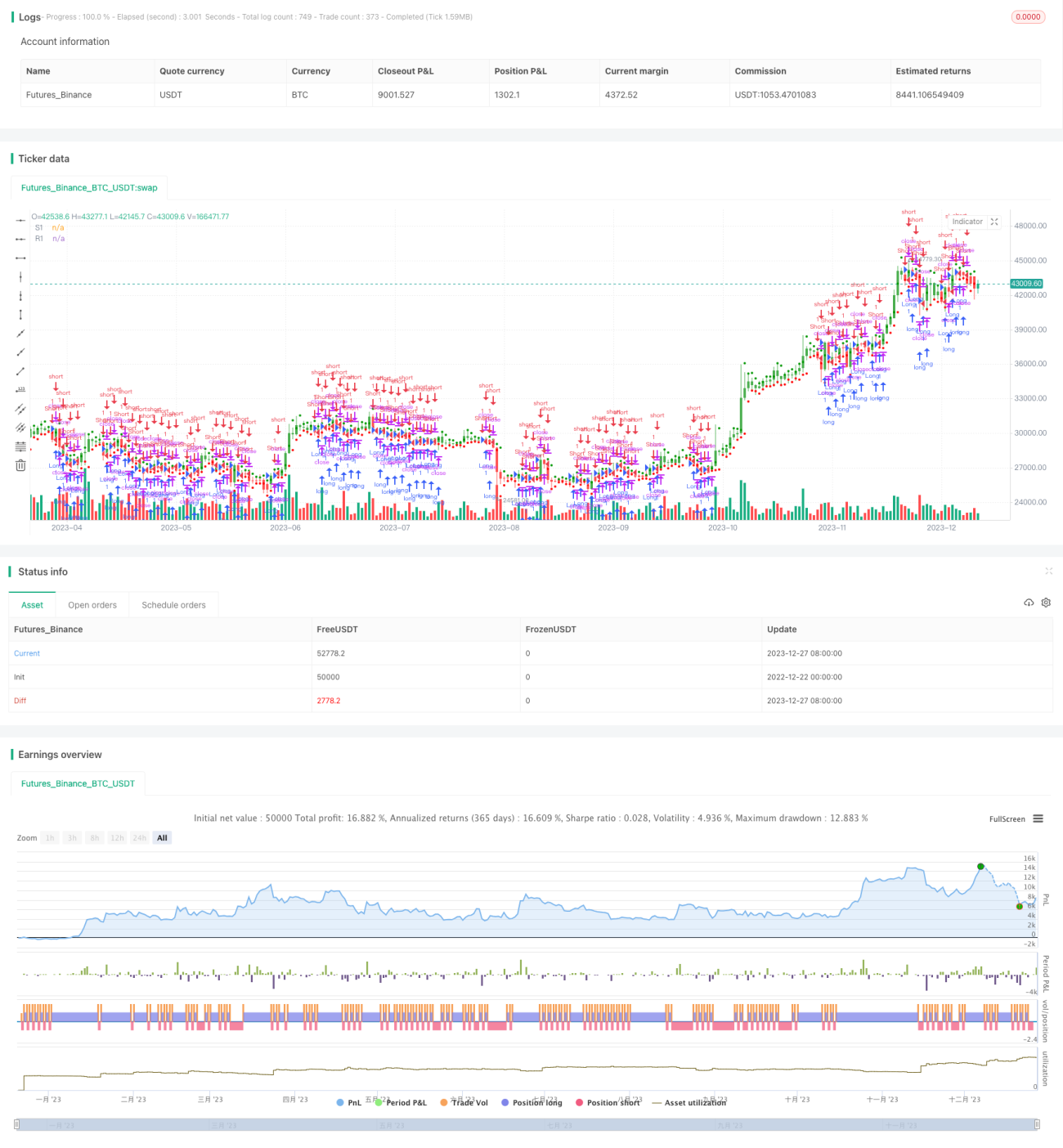
Resumen
Esta estrategia opera en posiciones largas o cortas durante la sesión actual basándose en los niveles de soporte y resistencia calculados a partir del precio máximo, mínimo y de cierre de la sesión anterior. Cuando el precio supera el nivel de resistencia R1, se abre una posición larga; cuando cae por debajo del nivel de soporte S1, se abre una posición corta. Se trata de una estrategia de soporte y resistencia dinámicos.
Principio de la estrategia
-
Se calculan el nivel de soporte S1, el nivel de resistencia R1 y el punto pivote vPP del día actual a partir del precio máximo (xHigh), mínimo (xLow) y de cierre (xClose) de la sesión anterior.
vPP = (xHigh + xLow + xClose) / 3
vR1 = vPP + (vPP - xLow)
vS1 = vPP - (xHigh - vPP)
-
Se determina si el precio supera vR1 o cae por debajo de vS1. Si supera vR1, se abre una posición larga; si cae por debajo de vS1, se abre una posición corta. La variable
posregistra la dirección de la operación.pos = iff(close > vR1, 1,
iff(close < vS1, -1, nz(pos[1], 0))) -
possigregistra la dirección real de la operación. Si la reversión está activada (reverse = true), la señal de trading se invierte. -
De acuerdo con la señal de
possig, se abre una posición larga al superar vR1 y una posición corta al romper vS1.
Ventajas de la estrategia
- La estrategia utiliza indicadores de soporte y resistencia dinámicos, lo que permite capturar movimientos de ruptura.
- Los niveles de soporte y resistencia se actualizan diariamente, lo que aporta dinamismo.
- Permite elegir entre trading directo o inverso, adaptándose a diferentes entornos de mercado.
- El planteamiento de la estrategia es simple y claro, fácil de entender e implementar.
- Visualiza los niveles de soporte y resistencia, lo que permite identificar de forma intuitiva los puntos de inflexión de la tendencia.
Análisis de riesgos
- Si el mercado se mueve en un rango lateral, puede generar múltiples señales de compra y venta innecesarias.
- En caso de una tendencia anormal, los niveles de soporte y resistencia podrían ser superados y continuar su recorrido, provocando pérdidas.
- El método de cálculo del punto pivote y los niveles de soporte/resistencia es relativamente simple y puede mejorarse.
Soluciones a los riesgos:
- Ajustar adecuadamente el tamaño de la posición para controlar la pérdida por operación.
- Establecer niveles de stop loss para evitar pérdidas que excedan lo tolerable.
- Combinar con otros indicadores para filtrar las señales y evitar operar con frecuencia en mercados laterales.
Direcciones de optimización
- Optimizar el método de cálculo de los niveles de soporte y resistencia para hacerlos más predictivos.
- Incorporar indicadores de tendencia y momento (momentum) para evitar operaciones innecesarias.
- Añadir una estrategia de stop loss para controlar la pérdida por operación y la pérdida máxima.
- Utilizar métodos de aprendizaje automático para optimizar dinámicamente el cálculo de los niveles de soporte y resistencia.
Resumen
Esta estrategia se basa en indicadores de soporte y resistencia dinámicos, tomando posiciones según la dirección de la ruptura del precio. El planteamiento es simple, fácil de entender e implementar, y permite capturar eficazmente los puntos de inflexión de la tendencia. Sin embargo, también conlleva ciertos riesgos y requiere una optimización adicional mediante la combinación con otros indicadores para que las señales de trading sean más precisas y fiables. En general, esta estrategia es adecuada como indicador de apoyo o como una de las estrategias básicas en el trading cuantitativo.
//@version=2
////////////////////////////////////////////////////////////
//  Copyright by HPotter v1.0 14/06/2018
// This Pivot points is calculated on the current day.
// Pivot points simply took the high, low, and closing price from the previous period and
// divided by 3 to find the pivot. From this pivot, traders would then base their
// calculations for three support, and three resistance levels. The calculation for the most
// basic flavor of pivot points, known as ‘floor-trader pivots’, along with their support and
// resistance levels.
//
// You can change long to short in the Input Settings
// WARNING:- 1