Estrategia de seguimiento de tendencia con media móvil adaptativa de Kaufman

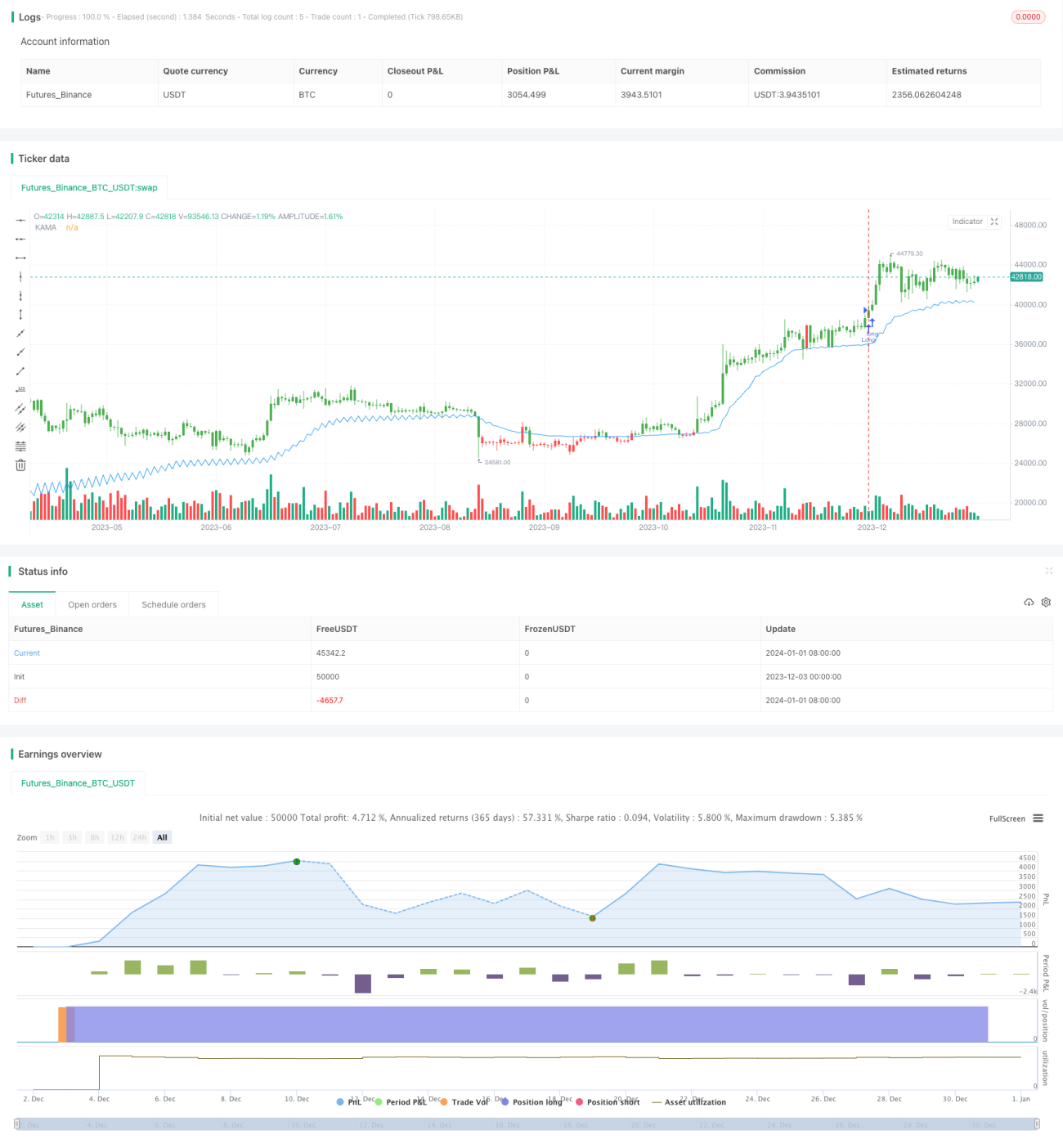
Resumen
Esta estrategia utiliza el indicador de media móvil adaptativa Kaufman (KAMA) para seguir las tendencias de precios, comprando barato y vendiendo caro, obteniendo ganancias.
Principio de la estrategia
La fórmula de cálculo del indicador KAMA (Kaufman Adaptive Moving Average) es:
nAMA = nz(nAMA[1]) + nsmooth * (Close - nz(nAMA[1]))
donde:
nsmooth = (nefratio * (nfastend - nslowend) + nslowend)^2
nefratio = nsignal / nnoise
nsignal = |Close - Close[Length]|
nnoise = sum(|Close - Close[1]|, Length)
nfastend = 0.666
nslowend = 0.0645
Este indicador considera la volatilidad del mercado y la tendencia de cambio de precios, permitiendo seguir la tendencia de precios más rápidamente. Específicamente:
- Cuando la volatilidad del mercado es baja, nsmooth se acerca a nslowend, la línea KAMA cambia lentamente, suprimiendo el ruido del mercado.
- Cuando la volatilidad del mercado aumenta y aparece una tendencia, nsmooth se acerca a nfastend, la línea KAMA cambia rápidamente, siguiendo la tendencia.
Al comparar la relación entre el precio y KAMA, se puede determinar la dirección de la tendencia del precio para decidir ir largo o corto.
Ventajas de la estrategia
La mayor ventaja de esta estrategia es que utiliza el indicador de media móvil adaptativa para seguir los cambios de tendencia de precios, lo que reduce efectivamente el impacto del ruido y tiene un buen seguimiento. Las ventajas específicas son:
- El indicador KAMA suprime el ruido del mercado, reduciendo el número de operaciones innecesarias.
- El indicador KAMA puede responder rápidamente a los cambios de tendencia de precios, con un buen efecto de seguimiento.
- Las reglas de decisión de la estrategia son simples y claras, fáciles de entender e implementar.
- Se puede configurar para operar en dirección opuesta, adaptándose a diferentes entornos de mercado.
Riesgos de la estrategia
Esta estrategia también tiene algunos riesgos:
- En mercados laterales, el indicador KAMA puede generar señales erróneas. Se puede optimizar ajustando los parámetros.
- Existe un retraso en el seguimiento, lo que puede hacer que se pierdan reversiones de precios a corto plazo. Se puede combinar con otros indicadores para diagnosticar.
- No se consideran comisiones de trading ni deslizamientos; el rendimiento en tiempo real será inferior al del backtest.
Direcciones de optimización de la estrategia
Esta estrategia se puede optimizar desde los siguientes aspectos:
- Optimizar los parámetros de KAMA para mejorar la sensibilidad de seguimiento del indicador.
- Agregar un mecanismo de stop-loss para controlar la pérdida máxima por operación.
- Combinar con otros indicadores para filtrar señales, mejorando la precisión de las decisiones.
- Agregar un mecanismo de reingreso para seguir aún más la tendencia.
Resumen
Esta estrategia utiliza el indicador Kaufman Adaptive Moving Average para seguir las tendencias de precios. Las reglas de decisión son simples y claras, fáciles de operar en tiempo real. El indicador suprime el ruido mientras responde rápidamente a los cambios de precios, con un buen efecto de seguimiento. Es una estrategia de seguimiento de tendencias recomendable.
/*backtest
start: 2023-12-03 00:00:00
end: 2024-01-02 00:00:00
period: 1d
basePeriod: 1h
exchanges: [{"eid":"Futures_Binance","currency":"BTC_USDT"}]
*/

//@version=2
////////////////////////////////////////////////////////////
//  Copyright by HPotter v1.0 25/08/2017
// Everyone wants a short-term, fast trading trend that works without large- 1