Estrategia sólida de seguimiento de tendencias


Fecha de creación: 2024-01-15 11:52:53 Última modificación: 2024-01-15 11:52:53
Copiar: 0 Número de Visitas: 638
1
Seguir
1617
Seguidores

Estrategia sólida de seguimiento de tendencias

Descripción general

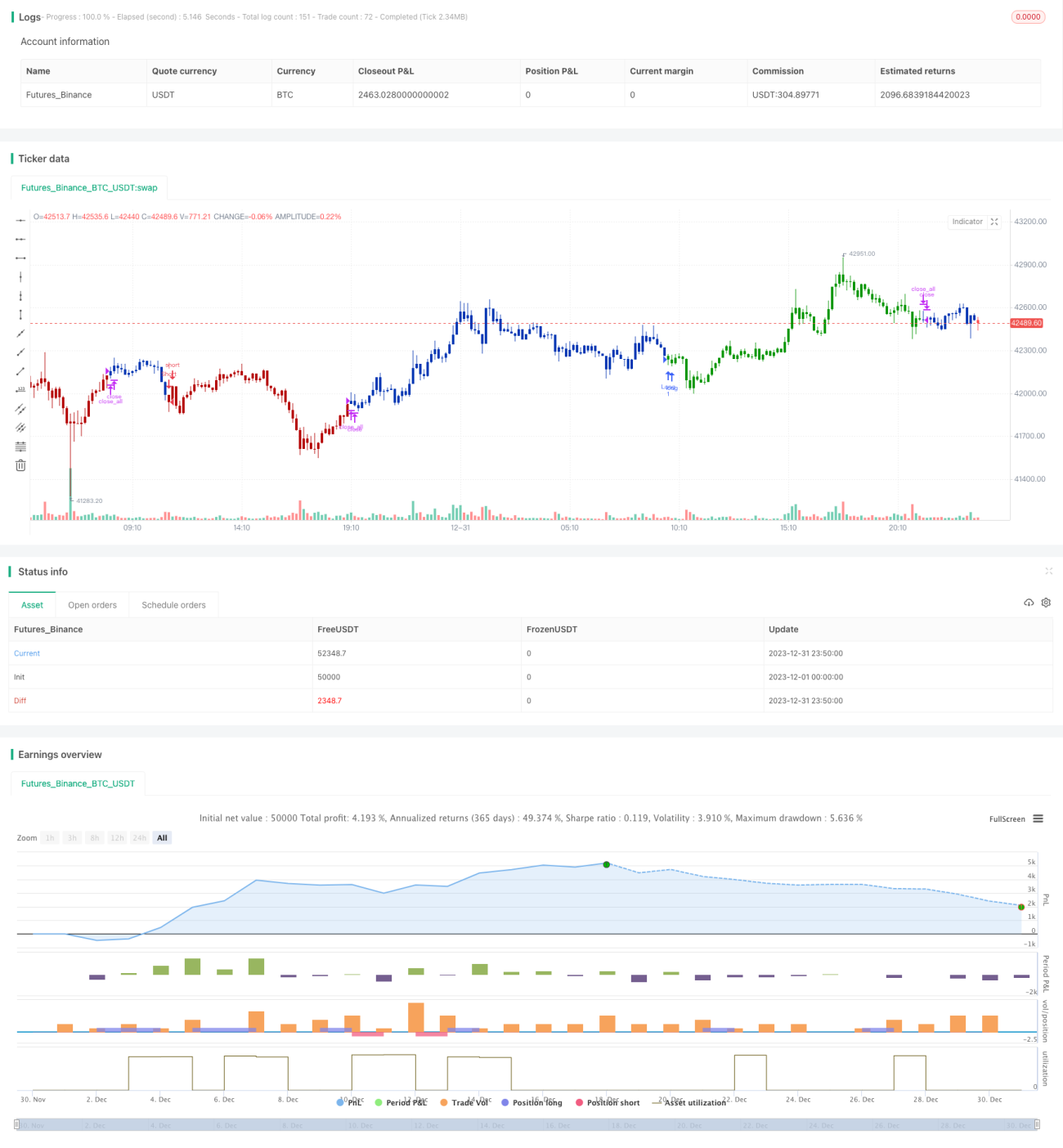
La idea principal de esta estrategia es la combinación de 123 inversiones y el índice de flujo de capital inteligente (SMI) para lograr una operación de seguimiento de tendencia estable. La estrategia establece posiciones de múltiples o vacantes correspondientes cuando dos señales emiten al mismo tiempo una señal de compra o venta.

Principio de estrategia

La estrategia tiene dos partes:

  1. 123 estrategia de reversión: la estrategia se basa en el precio de cierre de la acción y el índice de Stoch 9 para lograr una inversión. En concreto, cuando la relación de precios de cierre de dos días consecutivos se invierte (es decir, cuando el precio de cierre del día anterior es más alto que el precio de cierre del día anterior y el precio de cierre del día siguiente es más bajo que el del día anterior), y la línea rápida de Stoch es más alta que la línea lenta, hacer un vacío; cuando la relación de precios de cierre de dos días consecutivos se invierte (es decir, cuando el precio de cierre del día anterior es más bajo que el precio de cierre del día anterior y el precio de cierre del día siguiente es más alto que el del día anterior), y cuando la línea rápida de Stoch es más baja que la línea lenta, hacer más.

  2. Estrategia SMI: La estrategia se basa en el índice de flujo de capital inteligente para lograr el seguimiento de tendencias. El indicador SMI puede reflejar el juego entre el capital de la institución y el capital minorista, y un aumento en el SMI indica que el capital de la institución está siendo absorbido, lo que indica que el capital de la institución está siendo vendido.

La estrategia toma posiciones de más cabeza cuando la forma inversa 123 y el índice SMI emiten señales de compra al mismo tiempo; la estrategia toma posiciones de más cabeza cuando ambas emiten señales de venta al mismo tiempo.

Ventajas estratégicas

Esta estrategia, combinada con el patrón de reversión y los indicadores de seguimiento de tendencias, permite identificar con eficacia los puntos de reversión del mercado y seguir la tendencia, logrando ganancias estables. Las ventajas concretas son las siguientes:

  1. La forma de reversión 123 tiene una alta tasa de ganancias y ganancias, lo que permite identificar con eficacia las oportunidades de reversión a corto plazo.

  2. Los indicadores SMI pueden reflejar el flujo de fondos de las instituciones y rastrear los fondos de las instituciones para obtener ganancias más estables.

  3. La combinación del uso de inversiones y indicadores de seguimiento de tendencias puede mejorar la calidad de la señal, reducir las transacciones innecesarias y controlar el riesgo de manera efectiva.

Riesgo estratégico

La estrategia también tiene ciertos riesgos, que se centran en:

  1. En la forma inversa, existe un cierto riesgo de señales falsas, y no se puede evitar por completo las transacciones con pérdidas. Se pueden optimizar adecuadamente los parámetros para mejorar la calidad de la señal.

  2. Los indicadores SMI tienen un cierto retraso y no pueden reflejar completamente el flujo de fondos en tiempo real. Se pueden combinar con otros indicadores para verificar y mejorar la precisión.

  3. La doble señal conlleva el problema de ser demasiado conservadora y puede perderse una tendencia unilateral más fuerte. Se pueden relajar adecuadamente las condiciones de la señal y reducir los estándares de filtración.

Dirección de optimización

La estrategia también puede ser optimizada en los siguientes aspectos:

  1. Optimización de parámetros, búsqueda de la combinación óptima de parámetros y mejora de la rentabilidad de la estrategia.

  2. El aumento de los mecanismos de suspensión de pérdidas permite un control efectivo de las pérdidas individuales.

  3. En combinación con otros indicadores o formas, para verificar aún más la calidad de la señal y mejorar la precisión de la señal.

  4. Optimizar los parámetros para las diferentes variedades y mejorar la adaptabilidad de las estrategias.

Resumir

La estrategia tiene una idea general clara y una combinación efectiva de formas de reversión y indicadores de seguimiento de tendencias, lo que permite identificar de manera estable las oportunidades de reversión a corto plazo y seguir las tendencias a medio y largo plazo. A través de la optimización de los parámetros y la mejora del diseño del mecanismo, se puede mejorar aún más la rentabilidad de la estrategia y la capacidad de controlar el riesgo.

Overview

The main idea of this strategy is to combine the 123 reversal pattern and the Smart Money Index (SMI) indicator to achieve stable trend tracking trading. The strategy will only establish corresponding long or short positions when both signals issue buy or sell signals at the same time.

Strategy Principle

The strategy consists of two parts:

  1. 123 reversal strategy: This strategy implements reversal trading based on the closing price of the stock and the 9-day Stoch indicator. Specifically, go short when the closing price relationship reverses for two consecutive days (i.e. the previous closing price is higher than the one before the previous day, and the next closing price is lower than the previous day), and Stoch fast line is above slow line; go long when the closing price relationship reverses for two consecutive days (i.e. the previous closing price is lower than the one before the previous day, and the next closing price is higher than the previous day), and Stoch fast line is below slow line.

  2. SMI strategy: This strategy implements trend tracking based on the Smart Money Index. The SMI indicator can reflect the game between institutional funds and retail funds. The rise of SMI indicates that institutional funds are absorbing funds, while the fall indicates that institutional funds are selling out. Go long when SMI rises and go short when SMI falls.

The strategy will only take a long position when both the 123 reversal pattern and the SMI indicator issue a buy signal at the same time. It will only take a short position when both issue a sell signal at the same time.

Strategy Advantages

The strategy combines reversal patterns and trend tracking indicators to effectively identify market reversal points and track trends for steady profits. The specific advantages are as follows:

  1. The 123 reversal pattern has a relatively high win rate and profit rate, which can effectively identify short-term reversal opportunities.

  2. The SMI indicator can reflect the direction of institutional funds. Tracking institutional funds can obtain more steady profits.

  3. The combined use of reversal patterns and trend tracking indicators can improve the quality of signals, reduce unnecessary trading, and effectively control risks.

Strategy Risks

The strategy also has some risks, mainly concentrated in the following areas:

  1. The 123 reversal pattern has a certain risk of false signals and cannot completely avoid losing trades. Parameters can be optimized appropriately to improve signal quality.

  2. The SMI indicator has a certain lag and cannot completely reflect the direction of funds in real time. Other indicators can be combined for verification to improve accuracy.

  3. Double signals can lead to over-conservative problems, possibly missing stronger one-sided trending opportunities. Signal conditions can be appropriately relaxed to reduce filtering criteria.

Optimization Directions

The strategy can also be further optimized in the following aspects:

  1. Optimize parameters to find the optimal parameter combination and improve the profitability of the strategy.

  2. Add stop loss mechanisms to effectively control single loss.

  3. Combine other indicators or patterns to further verify signal quality and improve signal accuracy.

  4. Optimize parameters separately for different varieties to improve the adaptability of the strategy.

Summary

The overall idea of the strategy is clear, effectively combining reversal patterns and trend tracking indicators to steadily identify short-term reversal opportunities and track medium-to-long term trends. By improving parameters optimization and mechanism design, the profitability and risk control capabilities of the strategy can be further enhanced.

Código Fuente de la Estrategia
/*backtest
start: 2023-12-01 00:00:00
end: 2023-12-31 23:59:59
period: 10m
basePeriod: 1m
exchanges: [{"eid":"Futures_Binance","currency":"BTC_USDT"}]
*/

//@version=4
////////////////////////////////////////////////////////////
//  Copyright by HPotter v1.0 10/07/2021
// This is combo strategies for get a cumulative signal. 
//
// First strategy
// This System was created from the Book "How I Tripled My Money In The 
// Futures Market" by Ulf Jensen, Page 183. This is reverse type of strategies.
// The strategy buys at market, if close price is higher than the previous close 
// during 2 days and the meaning of 9-days Stochastic Slow Oscillator is lower than 50. 
// The strategy sells at market, if close price is lower than the previous close price 
// during 2 days and the meaning of 9-days Stochastic Fast Oscillator is higher than 50.
//
// Second strategy
// Smart money index (SMI) or smart money flow index is a technical analysis indicator demonstrating investors sentiment. 
// The index was invented and popularized by money manager Don Hays.[1] The indicator is based on intra-day price patterns.
// The main idea is that the majority of traders (emotional, news-driven) overreact at the beginning of the trading day 
// because of the overnight news and economic data. There is also a lot of buying on market orders and short covering at the opening. 
// Smart, experienced investors start trading closer to the end of the day having the opportunity to evaluate market performance.
// Therefore, the basic strategy is to bet against the morning price trend and bet with the evening price trend. The SMI may be calculated 
// for many markets and market indices (S&P 500, DJIA, etc.)
//
// The SMI sends no clear signal whether the market is bullish or bearish. There are also no fixed absolute or relative readings signaling 
// about the trend. Traders need to look at the SMI dynamics relative to that of the market. If, for example, SMI rises sharply when the 
// market falls, this fact would mean that smart money is buying, and the market is to revert to an uptrend soon. The opposite situation 
// is also true. A rapidly falling SMI during a bullish market means that smart money is selling and that market is to revert to a downtrend 
// soon. The SMI is, therefore, a trend-based indicator.
// Some analysts use the smart money index to claim that precious metals such as gold will continually maintain value in the future.
//
// WARNING:
// - For purpose educate only
// - This script to change bars colors.
////////////////////////////////////////////////////////////
Reversal123(Length, KSmoothing, DLength, Level) =>
    vFast = sma(stoch(close, high, low, Length), KSmoothing) 
    vSlow = sma(vFast, DLength)
    pos = 0.0
    pos := iff(close[2] < close[1] and close > close[1] and vFast < vSlow and vFast > Level, 1,
	         iff(close[2] > close[1] and close < close[1] and vFast > vSlow and vFast < Level, -1, nz(pos[1], 0))) 
	pos


SMI(Length, tf) =>
    pos = 0.0
    nRes = 0.0
    xcloseH1 = security(syminfo.tickerid, tf, close[1])
    xopenH1 =  security(syminfo.tickerid, tf, open[1])
    nRes := nz(nRes[1], 1) - (open - close) + (xopenH1 - xcloseH1)
    xSmaRes = sma(nRes, Length)
    pos:= iff(xSmaRes > nRes, 1,
           iff(xSmaRes < nRes, -1, nz(pos[1], 0))) 
    pos

strategy(title="Combo Backtest 123 Reversal & Smart Money Index (SMI)", shorttitle="Combo", overlay = true)
line1 = input(true, "---- 123 Reversal ----")
Length = input(14, minval=1)
KSmoothing = input(1, minval=1)
DLength = input(3, minval=1)
Level = input(50, minval=1)
//-------------------------
line2 = input(true, "---- Smart Money Index (SMI) ----")
LengthSMI = input(18, minval=1)
res = input(title="Resolution", type=input.resolution, defval="D")
reverse = input(false, title="Trade reverse")
posReversal123 = Reversal123(Length, KSmoothing, DLength, Level)
posSMI = SMI(LengthSMI, res)
pos = iff(posReversal123 == 1 and posSMI == 1 , 1,
	   iff(posReversal123 == -1 and posSMI == -1, -1, 0)) 
possig = iff(reverse and pos == 1, -1,
          iff(reverse and pos == -1 , 1, pos))	   
if (possig == 1 ) 
    strategy.entry("Long", strategy.long)
if (possig == -1 )
    strategy.entry("Short", strategy.short)	 
if (possig == 0) 
    strategy.close_all()
barcolor(possig == -1 ? #b50404: possig == 1 ? #079605 : #0536b3 )