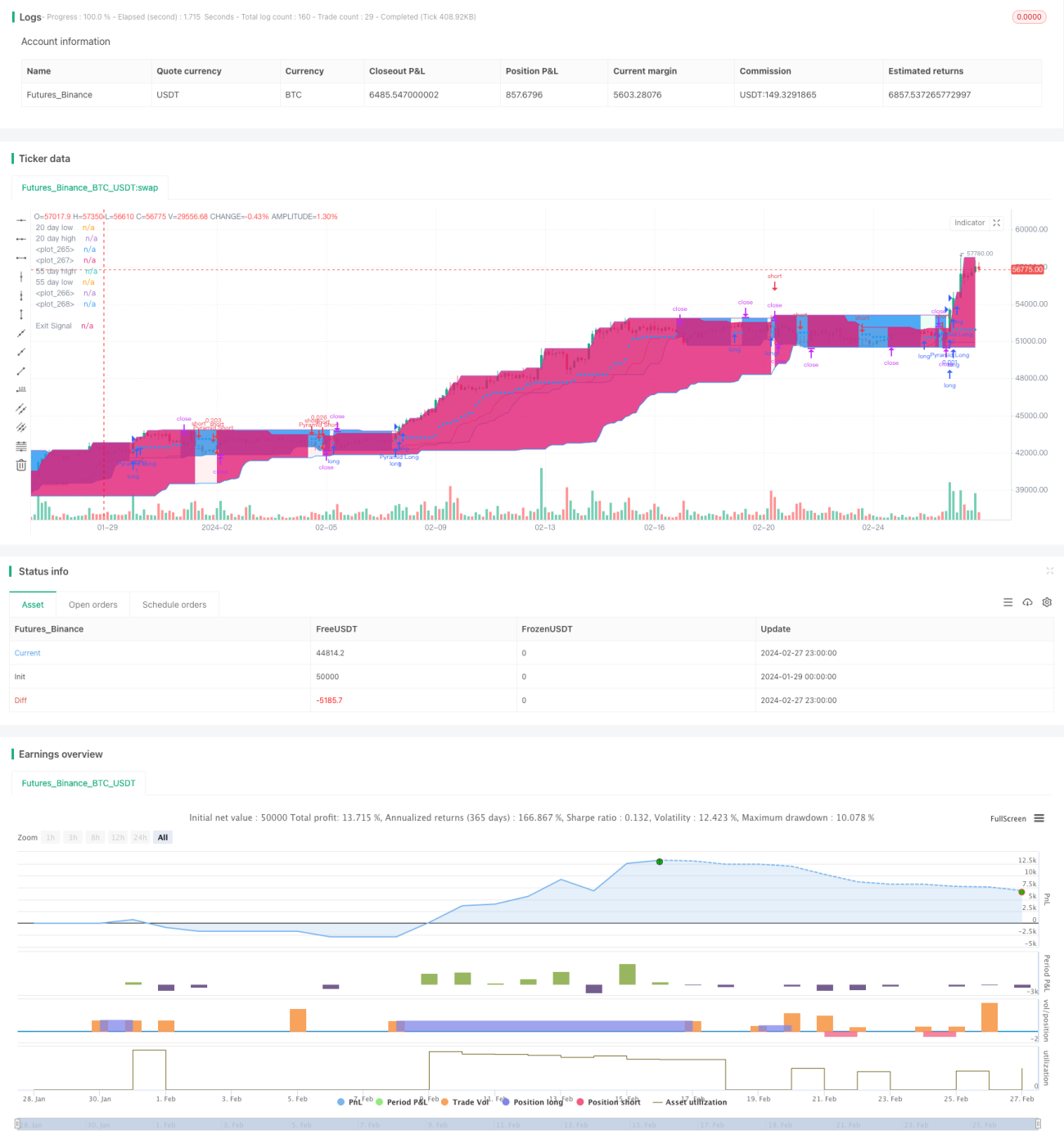
Las estrategias de trading de cuervos son estrategias de seguimiento de tendencias mejoradas y optimizadas basadas en la famosa estrategia de trading de cuervos. La estrategia utiliza señales de comercio formadas por medias móviles dobles para realizar operaciones de seguimiento de tendencias de bajo riesgo. Sus reglas de entrada y salida estandarizadas controlan eficazmente el riesgo de las operaciones y permiten un crecimiento estable de los fondos.
La estrategia de trading de la deriva establece un objetivo de stop loss y de ganancias mediante el cálculo de los máximos de 20 días, los mínimos de 20 días, los máximos de 55 días y los mínimos de 55 días, en combinación con el indicador ATR. Genera una señal larga cuando el precio supera los máximos de 20 días; genera una señal de vacío cuando el precio cae por debajo de los mínimos de 20 días.
Una vez en el mercado, la estrategia utiliza el valor del indicador ATR para establecer los objetivos de stop loss y alza de posición. Se detiene activamente cuando las pérdidas alcanzan el punto de stop loss; aumenta la posición cuando las ganancias alcanzan el objetivo de alza de posición. De esta manera, se puede controlar el riesgo de una sola operación al tiempo que se maximiza el potencial de ganancias en una situación de tendencia.
La mayor ventaja de las estrategias de comercio de buzos es su excelente capacidad de control de riesgos. Las reglas de entrada y salida estandarizadas pueden controlar eficazmente las pérdidas de una sola operación, y el mecanismo de salto evita la posibilidad de quedarse atrapados en situaciones adversas durante la noche. La estrategia de stop loss estable también limita la aparición de pérdidas continuas.
Además, la estrategia de negociación flexible utiliza el indicador ATR para establecer de forma dinámica los límites de pérdida, lo que permite que los límites de pérdida se adapten automáticamente a los cambios en la volatilidad del mercado. Esto garantiza que los límites de pérdida no sean demasiado flexibles para causar grandes pérdidas, ni demasiado apretados para ser provocados por la volatilidad normal del mercado.
Finalmente, el mecanismo de riesgo de la estrategia le permite capturar las ganancias en condiciones de tendencia, lo que sienta las bases para un crecimiento estable del capital.
El principal riesgo de las estrategias de libre comercio reside en la incapacidad de aprovechar eficazmente las situaciones de crisis para obtener ganancias. Cuando los mercados están en crisis a largo plazo, los límites de pérdida pueden desencadenarse con frecuencia y causar pérdidas. Saltarse el mecanismo también puede causar una falta de señales y perder oportunidades de comercio potenciales.
Además, la estrategia depende demasiado de los indicadores técnicos y ignora el análisis fundamental, lo que puede hacer que no identifique los cambios importantes en la política, lo que puede causar pérdidas innecesarias.
Las estrategias de trading de Forex se pueden optimizar en los siguientes aspectos:
Combinación de indicadores de volatilidad para ajustar la sensibilidad de los mecanismos de salto y aumentar la frecuencia de las operaciones en situaciones de crisis
Aumentar las señales básicas como filtros para evitar la interrupción de los incidentes
Optimización de la configuración de los parámetros ATR para que la línea de parada se adapte mejor a las fluctuaciones reales
Indicadores de energía combinados para evitar una reversión de invalidez después de una pérdida
En general, las estrategias de trading de buzos mejoran la rentabilidad y la capacidad de controlar el riesgo de las estrategias de trading de toros originales, y son estrategias de algoritmos de bajo riesgo que son adecuadas para seguir tendencias. Si se optimizan aún más, las estrategias pueden ser una parte importante de la construcción de una cartera de ganancias estables a largo plazo.
/*backtest
start: 2024-01-29 00:00:00
end: 2024-02-28 00:00:00
period: 3h
basePeriod: 15m
exchanges: [{"eid":"Futures_Binance","currency":"BTC_USDT"}]
*/
//@version=5
strategy("TURTLE STRATEGY", precision=2, overlay=true, initial_capital=1000, commission_type=strategy.commission.percent, commission_value=0.18, slippage=3, pyramiding=5, close_entries_rule="ANY", margin_long=100, margin_short=100)
//------------------------------TOOL TIPS--------------------------------//
t1 = "Percentage of the account the trader is willing to lose. This percentage is used to define the position size based on previous gains or losses. Turtle traders default to 1%."
t2 = "ATR Length"
t3 = "ATR Multiplier to fix the Stop Loss"
t4 = "Pyramiding : ATR Multiplier to set a profit target to increase position size"
t5 = "System 1 enter long if there is a new high after this selected period of time"
t6 = "System 2 enter long if there is a new high after this selected period of time"
t7 = "Exit Long from system 1 if there is a new low after this selected period of time"
t8 = "Exit Long from system 2 if there is a new low after this selected period of time"
t9 = "System 1 enter short if there is a new low after this selected period of time"
t10 = "System 2 enter short if there is a new low after this selected period of time"
t11 = "Exit short from system 1 if there is a new high after this selected period of time"
t12 = "Exit short from system 2 if there is a new high after this selected period of time"
//----------------------------------------FUNCTIONS---------------------------------------//
//@function Displays text passed to `txt` when called.
debugLabel(txt, color) =>
label.new(bar_index, high, text=txt, color=color, style=label.style_label_lower_right, textcolor=color.black, size=size.small)
//@function which looks if the close date of the current bar falls inside the date range
inBacktestPeriod(start, end) => (time >= start) and (time <= end)
//---------------------------------------USER INPUTS--------------------------------------//
//Risk Management and turtle system input
percentage_to_risk = input.float(1, "Risk % of capital", maxval=100, minval=0, group="Turtle Parameters", tooltip=t1)
atr_period = input.int(20, "ATR period", minval=1, group="Turtle Parameters", tooltip=t2)
stop_N_multiplier = input.float(1.5, "Stop ATR", minval=0.1, group="Turtle Parameters", tooltip=t3)
pyramid_profit = input.float(0.5, "Pyramid Profit", minval=0.01, group="Turtle Parameters", tooltip=t4)
S1_long = input.int(20, "S1 Long", minval=1, group="Turtle Parameters", tooltip=t5)
S2_long = input.int(55, "S2 Long", minval=1, group="Turtle Parameters", tooltip=t6)
S1_long_exit = input.int(10, "S1 Long Exit", minval=1, group="Turtle Parameters", tooltip=t7)
S2_long_exit = input.int(20, "S2 Long Exit", minval=1, group="Turtle Parameters", tooltip=t8)
S1_short = input.int(15, "S1 Short", minval=1, group="Turtle Parameters", tooltip=t9)
S2_short = input.int(55, "S2 Short", minval=1, group="Turtle Parameters", tooltip=t10)
S1_short_exit = input.int(7, "S1 Short Exit", minval=1, group="Turtle Parameters", tooltip=t11)
S2_short_exit = input.int(20, "S2 Short Exit", minval=1, group="Turtle Parameters", tooltip=t12)
//Backtesting period
startDate = input(title="Start Date", defval=timestamp("1 Jan 2020 00:00:00"), group="Backtesting Period")
endDate = input(title="End Date", defval=timestamp("1 July 2034 00:00:00"), group="Backtesting Period")
//----------------------------------VARIABLES INITIALISATION-----------------------------//
//Turtle variables
atr = ta.atr(atr_period)
var float buy_price_long = na
var float buy_price_short = na
var float stop_loss_long = na
var float stop_loss_short = na
float account = na
//Entry variables
day_high_syst1 = ta.highest(high, S1_long)
day_low_syst1 = ta.lowest(low, S1_short)
day_high_syst2 = ta.highest(high, S2_long)
day_low_syst2 = ta.lowest(low, S2_short)
var bool skip = false
var bool unskip_buffer_long = false
var bool unskip_buffer_short = false
//Exit variables
exit_long_syst1 = ta.lowest(low, S1_long_exit)
exit_short_syst1 = ta.highest(high, S1_short_exit)
exit_long_syst2 = ta.lowest(low, S2_long_exit)
exit_short_syst2 = ta.highest(high, S2_short_exit)
float exit_signal = na
//Backtesting period
bool inRange = na
//------------------------------CHECKING SOME CONDITIONS ON EACH SCRIPT EXECUTION-------------------------------//
//Checking if the date belong to the range
inRange := true
strategy.initial_capital = 50000
//Checking if the current equity is higher or lower than the initial capital to adjusted position size
if strategy.equity - strategy.openprofit < strategy.initial_capital
account := (strategy.equity-strategy.openprofit)*(strategy.equity-strategy.openprofit)/strategy.initial_capital
else
account := strategy.equity - strategy.openprofit
//Checking if we close all trades in case where we exit the backtesting period
if strategy.position_size!=0 and not inRange
strategy.close_all()
debugLabel("END OF BACKTESTING PERIOD : we close the trade", color=color.rgb(116, 116, 116))
//--------------------------------------SKIP MANAGEMENT------------------------------------//
//Checking if a long signal has been skiped and system2 is not triggered
if skip and high>day_high_syst1[1] and high<day_high_syst2[1]
unskip_buffer_long := true
//Checking if a short signal has been skiped and system2 is not triggered
if skip and low<day_low_syst1[1] and low>day_low_syst2[1]
unskip_buffer_short := true
//Checking if current high is lower than previous 20_day_high after a skiped long signal to set skip to false
if unskip_buffer_long
if high<day_high_syst1[1]
skip := false
unskip_buffer_long := false
//Checking if current low is higher than previous 20_day_low after a skiped short signal to set skip to false
if unskip_buffer_short
if low>day_low_syst1[1]
skip := false
unskip_buffer_short := false
//Checking if we have an open position to reset skip and unskip buffers
if strategy.position_size!=0 and skip
skip := false
unskip_buffer_long := false
unskip_buffer_short := false
//--------------------------------------------ENTRY CONDITIONS--------------------------------------------------//
//We calculate the position size based on turtle calculation
unit = (percentage_to_risk/100)*account/atr*syminfo.pointvalue
//Long order for system 1
if not skip and not (strategy.position_size>0) and inRange and unit>0
strategy.cancel("Long Syst 2")
//We check that position size doesn't exceed available equity
if unit*day_high_syst1>account
unit := account/day_high_syst1
stop_loss_long := day_high_syst1 - stop_N_multiplier*atr
//We adjust SL if it's greater than 10% of trade value and fix it to 10%
if stop_loss_long < day_high_syst1*0.9
stop_loss_long := day_high_syst1*0.9
strategy.order("Long Syst 1", strategy.long, unit, stop=day_high_syst1)
buy_price_long := day_high_syst1
//Long order for system 2
if skip and not (strategy.position_size>0) and inRange and unit>0
//We check that position size doesn't exceed available equity
if unit*day_high_syst2>account
unit := account/day_high_syst2
stop_loss_long := day_high_syst2 - stop_N_multiplier*atr
//We adjust SL if it's greater than 10% of trade value and fix it to 10%
if stop_loss_long < day_high_syst2*0.9
stop_loss_long := day_high_syst2*0.9
strategy.order("Long Syst 2", strategy.long, unit, stop=day_high_syst2)
buy_price_long := day_high_syst2
//Short order for system 1
if not skip and not (strategy.position_size<0) and inRange and unit>0
strategy.cancel("Short Syst 2")
//We check that position size doesn't exceed available equity
if unit*day_low_syst1>account
unit := account/day_low_syst1
stop_loss_short := day_low_syst1 + stop_N_multiplier*atr
//We adjust SL if it's greater than 10% of trade value and fix it to 10%
if stop_loss_short > day_low_syst1*1.1
stop_loss_short := day_low_syst1*1.1
strategy.order("Short Syst 1", strategy.short, unit, stop=day_low_syst1)
buy_price_short := day_low_syst1
//Short order for system 2
if skip and not (strategy.position_size<0) and inRange and unit>0
//We check that position size doesn't exceed available equity
if unit*day_low_syst2>account
unit := account/day_low_syst2
stop_loss_short := day_low_syst2 + stop_N_multiplier*atr
//We adjust SL if it's greater than 10% of trade value and fix it to 10%
if stop_loss_short > day_low_syst2*1.1
stop_loss_short := day_low_syst2*1.1
strategy.order("Short Syst 2", strategy.short, unit, stop=day_low_syst2)
buy_price_short := day_low_syst2
//-------------------------------PYRAMIDAL------------------------------------//
//Pyramid for long orders
if close > buy_price_long + (pyramid_profit*atr) and strategy.position_size>0
//We calculate the remaining capital
remaining_capital = account - strategy.position_size*strategy.position_avg_price*(1-0.0018)
//We calculate units to add to the long position
units_to_add = (percentage_to_risk/100)*remaining_capital/atr*syminfo.pointvalue
if remaining_capital > units_to_add and units_to_add>0
//We set the new Stop loss
stop_loss_long := stop_loss_long + pyramid_profit*atr
strategy.entry("Pyramid Long", strategy.long, units_to_add)
buy_price_long := close
//Pyramid for short orders
if close < buy_price_short - (pyramid_profit*atr) and strategy.position_size<0
//We calculate the remaining capital
remaining_capital = account + strategy.position_size*strategy.position_avg_price*(1-0.0018)
//We calculate units to add to the short position
units_to_add = (percentage_to_risk/100)*remaining_capital/atr*syminfo.pointvalue
if remaining_capital > units_to_add and units_to_add>0
//We set the new Stop loss
stop_loss_short := stop_loss_short - pyramid_profit*atr
strategy.entry("Pyramid Short", strategy.short, units_to_add)
buy_price_short := close
//----------------------------EXIT ORDERS-------------------------------//
//Checking if exit_long_syst1 is higher than stop_loss_long
if strategy.opentrades.entry_id(0)=="Long Syst 1"
if exit_long_syst1[1] > stop_loss_long
exit_signal := exit_long_syst1[1]
else
exit_signal := stop_loss_long
//Checking if exit_long_syst2 is higher than stop_loss_long
if strategy.opentrades.entry_id(0)=="Long Syst 2"
if exit_long_syst2[1] > stop_loss_long
exit_signal := exit_long_syst2[1]
else
exit_signal := stop_loss_long
//Checking if exit_short_syst1 is lower than stop_loss_short
if strategy.opentrades.entry_id(0)=="Short Syst 1"
if exit_short_syst1[1] < stop_loss_short
exit_signal := exit_short_syst1[1]
else
exit_signal := stop_loss_short
//Checking if exit_short_syst2 is lower than stop_loss_short
if strategy.opentrades.entry_id(0)=="Short Syst 2"
if exit_short_syst2[1] < stop_loss_short
exit_signal := exit_short_syst2[1]
else
exit_signal := stop_loss_short
//If the exit order is configured to close the position at a profit, we set 'skip' to true (we substract commission)
if strategy.position_size*exit_signal>strategy.position_size*strategy.position_avg_price*(1-0.0018)
strategy.cancel("Long Syst 1")
strategy.cancel("Short Syst 1")
skip := true
if strategy.position_size*exit_signal<=strategy.position_size*strategy.position_avg_price*(1-0.0018)
skip := false
//We place stop exit orders
if strategy.position_size > 0
strategy.exit("Exit Long", stop=exit_signal)
if strategy.position_size < 0
strategy.exit("Exit Short", stop=exit_signal)
//------------------------------PLOTTING ELEMENTS-------------------------------//
plotchar(atr, "ATR", "", location.top, color.rgb(131, 5, 83))
//Plotting enter threshold
plot(day_high_syst1[1], "20 day high", color.rgb(118, 217, 159))
plot(day_high_syst2[1], "55 day high", color.rgb(4, 92, 53))
plot(day_low_syst1[1], "20 day low", color.rgb(234, 108, 108))
plot(day_low_syst2[1], "55 day low", color.rgb(149, 17, 17))
//Plotting Exit Signal
plot(exit_signal, "Exit Signal", color.blue, style=plot.style_circles)
//Plotting our position
exit_long_syst2_plot = plot(exit_long_syst2[1], color=na)
day_high_syst2_plot = plot(day_high_syst2[1], color=na)
exit_short_syst2_plot = plot(exit_short_syst2[1], color=na)
day_low_syst2_plot = plot(day_low_syst2[1], color=na)
fill(exit_long_syst2_plot, day_high_syst2_plot, color=strategy.position_size>0 ? color.new(color.lime, 90) : na)
fill(exit_short_syst2_plot, day_low_syst2_plot, color=strategy.position_size<0 ? color.new(color.red, 90) : na)