
Resumen
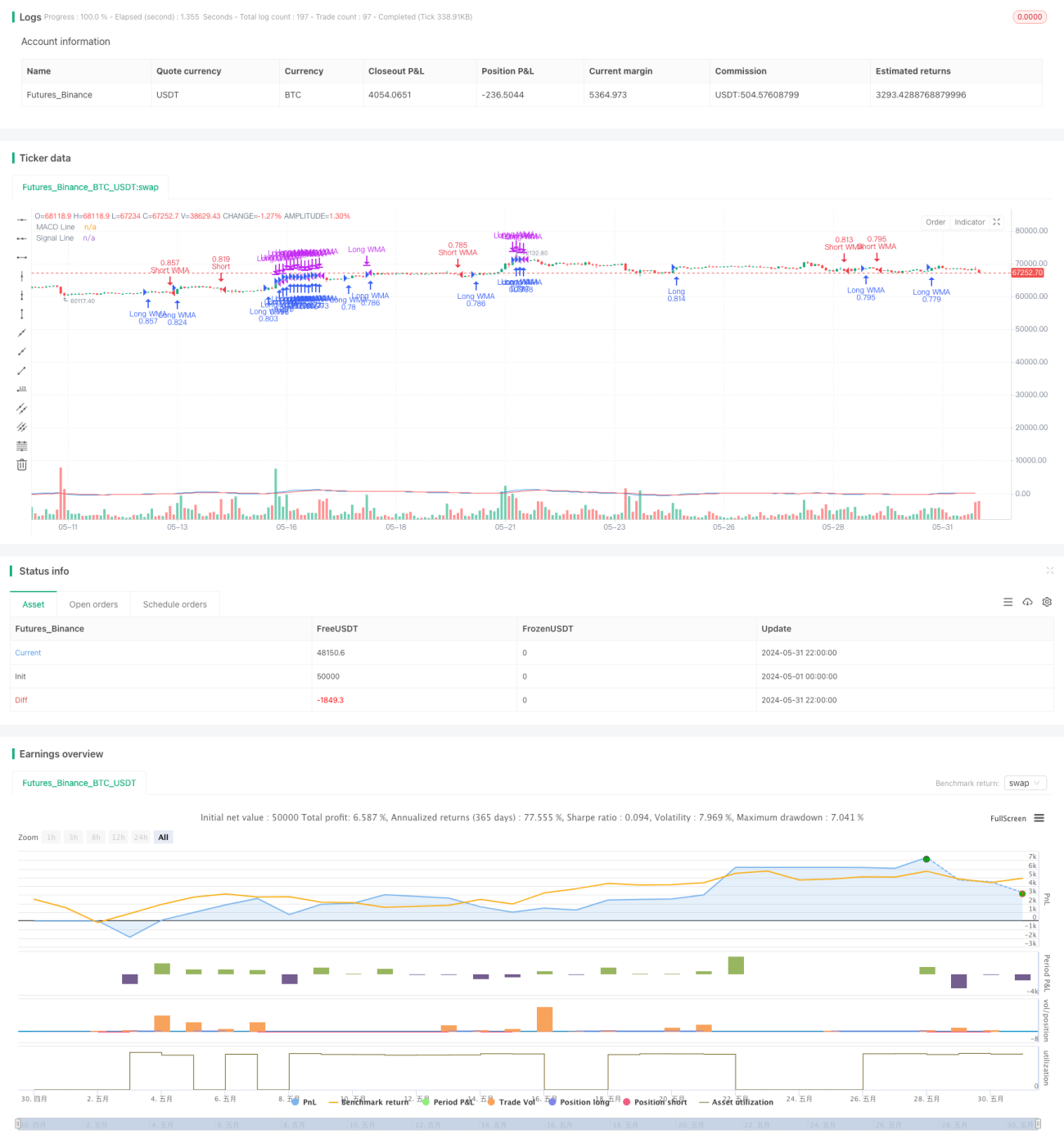
Esta estrategia combina dos indicadores técnicos, MACD y RSI, utilizando las señales de cruce del MACD y las señales de sobrecompra/sobreventa del RSI para determinar los momentos de negociación. Además, la estrategia incorpora la media móvil ponderada (WMA) como criterio auxiliar para aumentar su fiabilidad. La estrategia opera en un marco temporal de 1 hora: cuando el MACD presenta un cruce dorado y el RSI es superior a 50, se abre una posición larga; cuando el MACD presenta un cruce de la muerte y el RSI es inferior a 50, se abre una posición corta. Asimismo, cuando el RSI supera 70, se cierra la posición larga, y cuando el RSI es inferior a 30, se cierra la posición corta. Además, la estrategia incluye variables de múltiples marcos temporales para evaluar los cambios de tendencia en diferentes escalas de tiempo.
Principio de la estrategia
El núcleo de esta estrategia es la combinación de los dos indicadores técnicos: MACD y RSI. El MACD se compone de la diferencia entre una línea rápida (media móvil de corto plazo) y una línea lenta (media móvil de largo plazo), lo que refleja los cambios de tendencia del mercado. Cuando la línea rápida cruza por encima de la línea lenta, se forma un cruce dorado, indicando una tendencia alcista; por el contrario, cuando cruza por debajo, se forma un cruce de la muerte, indicando una tendencia bajista. El RSI mide las condiciones de sobrecompra/sobreventa del mercado: cuando el RSI es superior a 70, el mercado se encuentra en sobrecompra y podría enfrentar un riesgo de corrección; cuando es inferior a 30, el mercado está en sobreventa y podría experimentar un rebote.
La estrategia combina el MACD y el RSI, utilizando el juicio de tendencia del MACD y la detección de sobrecompra/sobreventa del RSI para identificar con mayor precisión los momentos de negociación. Además, se introduce la media móvil ponderada (WMA) como criterio auxiliar; a diferencia de la media móvil simple, la WMA da mayor peso a los precios recientes, lo que la hace más sensible a los cambios de precio.
Adicionalmente, la estrategia establece variables de múltiples marcos temporales (por ejemplo, 15 minutos, 30 minutos, 1 hora, 2 horas, etc.) para evaluar los cambios de tendencia en diferentes escalas de tiempo. Este enfoque de análisis multitemporal ayuda a la estrategia a captar de manera más integral las tendencias del mercado y mejorar la precisión de las decisiones.
Análisis de ventajas
- Combina dos indicadores técnicos eficaces, MACD y RSI, lo que permite captar adecuadamente las tendencias del mercado y las condiciones de sobrecompra/sobreventa, mejorando la precisión en las decisiones de negociación.
- Incorpora la media móvil ponderada (WMA) como criterio auxiliar; al dar mayor importancia a los precios recientes, la WMA reacciona con mayor sensibilidad a los cambios de precio, aumentando la adaptabilidad de la estrategia.
- Incluye variables de múltiples marcos temporales, permitiendo un análisis conjunto de varios plazos, lo que proporciona una visión más completa de las tendencias del mercado y mejora la fiabilidad de las decisiones.
- Opera en un marco temporal de 1 hora, con una frecuencia de negociación moderada que equilibra los costos de transacción y los beneficios.
- Establece condiciones claras de apertura y cierre de posiciones, como cruces dorados y de la muerte del MACD y niveles de sobrecompra/sobreventa del RSI, fáciles de entender e implementar.
Análisis de riesgos
- Tanto el MACD como el RSI son indicadores rezagados; en mercados que cambian rápidamente, las señales de los indicadores pueden desincronizarse con los precios, generando señales falsas.
- La estrategia opera en un único marco temporal (1 hora), lo que puede no capturar completamente los cambios de tendencia en diferentes escalas, presentando ciertas limitaciones.
- La estrategia carece de medidas de control de riesgo, como stops de pérdidas o gestión de tamaño de posición, lo que podría exponerla a grandes retrocesos durante movimientos bruscos del mercado.
- La configuración de parámetros (como los periodos de las líneas rápida y lenta del MACD, o el periodo del RSI) puede requerir ajustes según las condiciones del mercado, lo que introduce cierta subjetividad e incertidumbre.
Direcciones de optimización
- Incorporar más indicadores técnicos, como Bandas de Bollinger o ATR, para construir señales de negociación más robustas y aumentar la fiabilidad de la estrategia.
- Optimizar la selección de marcos temporales, por ejemplo, añadiendo marcos de mayor jerarquía como el diario para captar mejor la tendencia general, y utilizando marcos de menor jerarquía (como 15 minutos o 5 minutos) para definir puntos de entrada más precisos, mejorando la exactitud de la estrategia.
- Añadir medidas de control de riesgo, como establecer stops de pérdidas razonables y limitar el tamaño de las posiciones, para controlar el riesgo de retroceso.
- Optimizar los parámetros de la estrategia, posiblemente mediante métodos de aprendizaje automático que busquen automáticamente la combinación óptima de parámetros basada en datos históricos, reduciendo la influencia del juicio subjetivo.
- Considerar la inclusión de otros factores como el sentimiento del mercado, el volumen de operaciones o el interés abierto, para obtener una visión más completa del estado del mercado y mejorar la adaptabilidad de la estrategia.
Conclusión
Esta estrategia combina dos indicadores técnicos efectivos (MACD y RSI), e incorpora la WMA como criterio auxiliar, tomando decisiones de negociación en un marco temporal de 1 hora. La lógica de la estrategia es clara, fácil de entender e implementar, y puede captar adecuadamente las tendencias del mercado y las condiciones de sobrecompra/sobreventa, lo que le otorga cierta viabilidad. Sin embargo, la estrategia también presenta limitaciones y riesgos, como su carácter rezagado, el uso de un único marco temporal y la falta de control de riesgos. En el futuro, se podría mejorar añadiendo más indicadores, optimizando los marcos temporales, reforzando el control de riesgos y ajustando los parámetros, con el fin de aumentar su solidez y rentabilidad. En resumen, esta estrategia ofrece una idea para el trading cuantitativo, pero requiere una optimización y perfeccionamiento continuos en la práctica.
/*backtest
start: 2024-05-01 00:00:00
end: 2024-05-31 23:59:59
period: 2h
basePeriod: 15m
exchanges: [{"eid":"Futures_Binance","currency":"BTC_USDT"}]
*/

//@version=5
strategy("Improved MACD and RSI Trading Strategy", overlay=true, initial_capital=10000, commission_type=strategy.commission.percent, commission_value=0.01, default_qty_type=strategy.percent_of_equity, default_qty_value=100)

// MACD 設置- 1