
Resumen
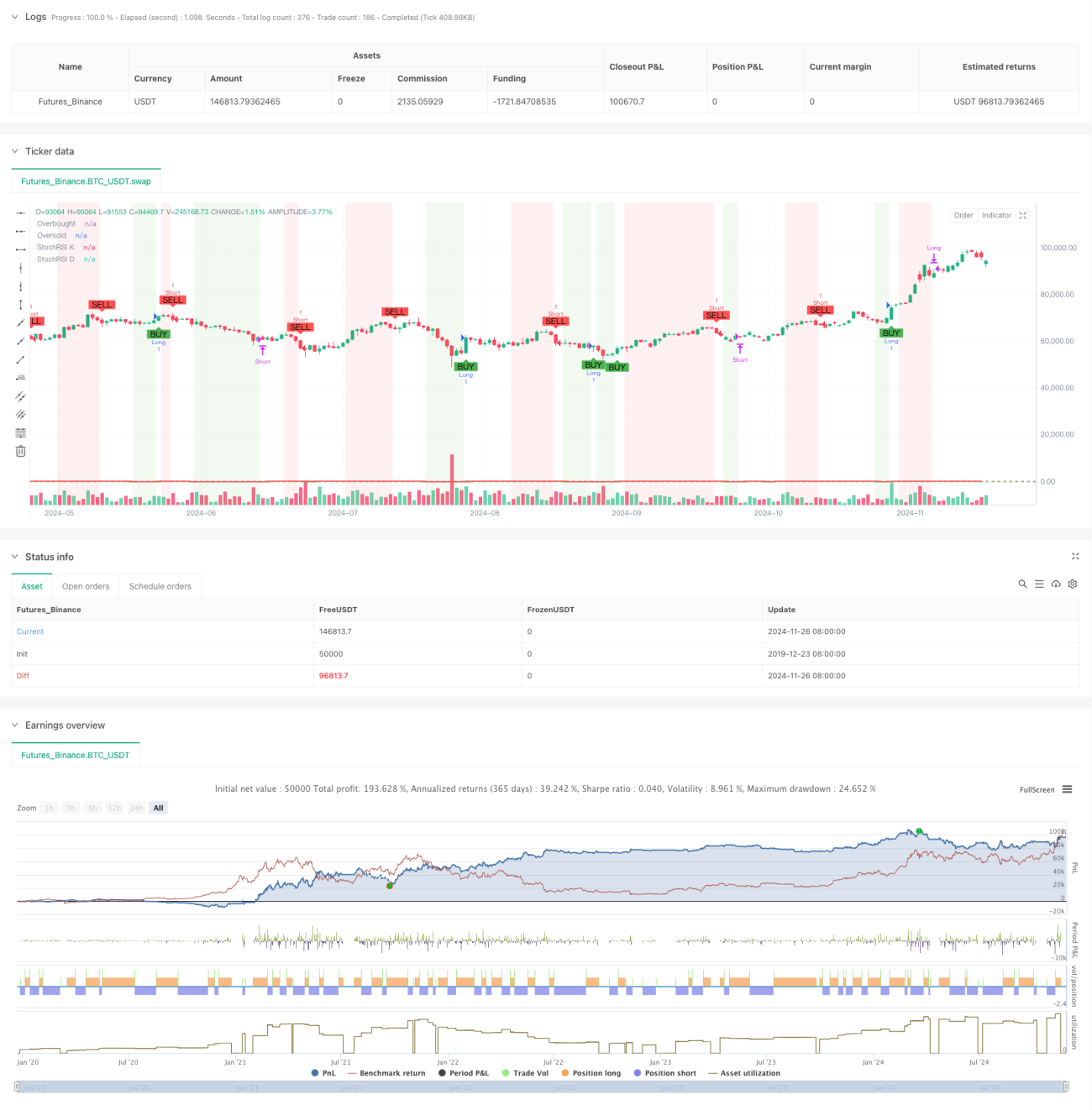
Esta estrategia es un sistema de trading compuesto que combina el Índice de Fuerza Relativa Estocástico (Stochastic RSI) y patrones de velas japonesas. El sistema analiza los niveles de sobrecompra y sobreventa del indicador SRSI, junto con la confirmación de la acción del precio mediante velas, generando señales de trading completamente automatizadas. La estrategia emplea una combinación avanzada de indicadores técnicos, fusionando características de seguimiento de tendencia y trading de reversión, lo que le otorga una fuerte adaptabilidad al mercado.
Principio de la Estrategia
La lógica central de la estrategia se basa en los siguientes elementos clave:
- Utiliza un RSI de 14 períodos como base para calcular el valor del RSI estocástico, formando la principal fuente de señales.
- Establece las líneas K y D del RSI estocástico como medias móviles simples de 3 períodos para suavizar las señales.
- Fija 80 y 20 como niveles críticos de sobrecompra y sobreventa para determinar el estado del mercado.
- Combina la relación entre el precio de apertura y cierre de la vela actual para confirmar la dirección del mercado.
- Cuando la línea K cruza hacia arriba el nivel de sobreventa y aparece una vela alcista, se activa una señal de compra (largo).
- Cuando la línea K cruza hacia abajo el nivel de sobrecompra y aparece una vela bajista, se activa una señal de venta (corto).
- Se realiza un stop-loss en la dirección correspondiente cuando la línea K cruza los niveles de sobrecompra o sobreventa.
Ventajas de la Estrategia
- Alta fiabilidad de las señales: mediante el doble mecanismo de confirmación del RSI estocástico y las velas, se mejora significativamente la precisión de las señales de trading.
- Control de riesgos sólido: se establecen condiciones claras de stop-loss, lo que permite gestionar eficazmente el riesgo de cada operación.
- Alta capacidad de ajuste de parámetros: los parámetros clave pueden optimizarse según las diferentes características del mercado.
- Retroalimentación visual clara: se utilizan colores de fondo y marcadores gráficos para mostrar las señales de trading de forma intuitiva.
- Alto grado de automatización: desde la generación de señales hasta la ejecución de órdenes, todo está automatizado, reduciendo la intervención manual.
Riesgos de la Estrategia
- Riesgo en mercados laterales: en mercados con movimientos laterales, pueden generarse frecuentes señales falsas de ruptura.
- Riesgo de rezago: el cálculo de medias móviles tiene cierto rezago, lo que puede hacer que se pierdan los mejores puntos de entrada.
- Sensibilidad a los parámetros: diferentes configuraciones de parámetros afectan significativamente el rendimiento de la estrategia, requiriendo una optimización continua.
- Dependencia del entorno de mercado: en condiciones de mercado altamente volátiles, las señales pueden no ser lo suficientemente estables.
- Riesgo sistémico: ante eventos importantes del mercado, los stops pueden fallar.
Direcciones de Optimización de la Estrategia
- Introducir indicadores de volumen: se puede agregar el volumen como condición adicional para confirmar señales.
- Optimizar el mecanismo de stop-loss: considerar el uso de trailing stop o stop dinámico basado en ATR.
- Agregar filtro de tendencia: incorporar una media móvil de largo plazo como filtro de tendencia.
- Mejorar el filtrado de señales: considerar la volatilidad del mercado y ajustar los parámetros en momentos de alta volatilidad.
- Ajuste dinámico de parámetros: modificar dinámicamente los umbrales de sobrecompra y sobreventa según el estado del mercado.
Conclusión
La estrategia construye un sistema de trading robusto combinando el indicador RSI estocástico y patrones de velas japonesas. El sistema mantiene una operativa simple mientras logra un buen control de riesgos. Mediante una optimización adecuada de parámetros y filtrado de señales, la estrategia puede adaptarse a diferentes entornos de mercado. Se recomienda a los traders realizar pruebas retrospectivas exhaustivas con datos históricos antes de su uso en vivo, y ajustar los parámetros según las características específicas del mercado.
- 1