Estrategia de trading cíclico inteligente basada en tendencias ondulatorias e inversión diversificada

WT DCA AO ESA EMA SMA CI VOL
Fecha de creación: 2024-12-20 16:42:45 Última modificación: 2024-12-20 16:42:45
Copiar: 0 Número de Visitas: 473
1
Seguir
1617
Seguidores

Estrategia de trading cíclico inteligente basada en tendencias ondulatorias e inversión diversificada

Descripción general de la estrategia

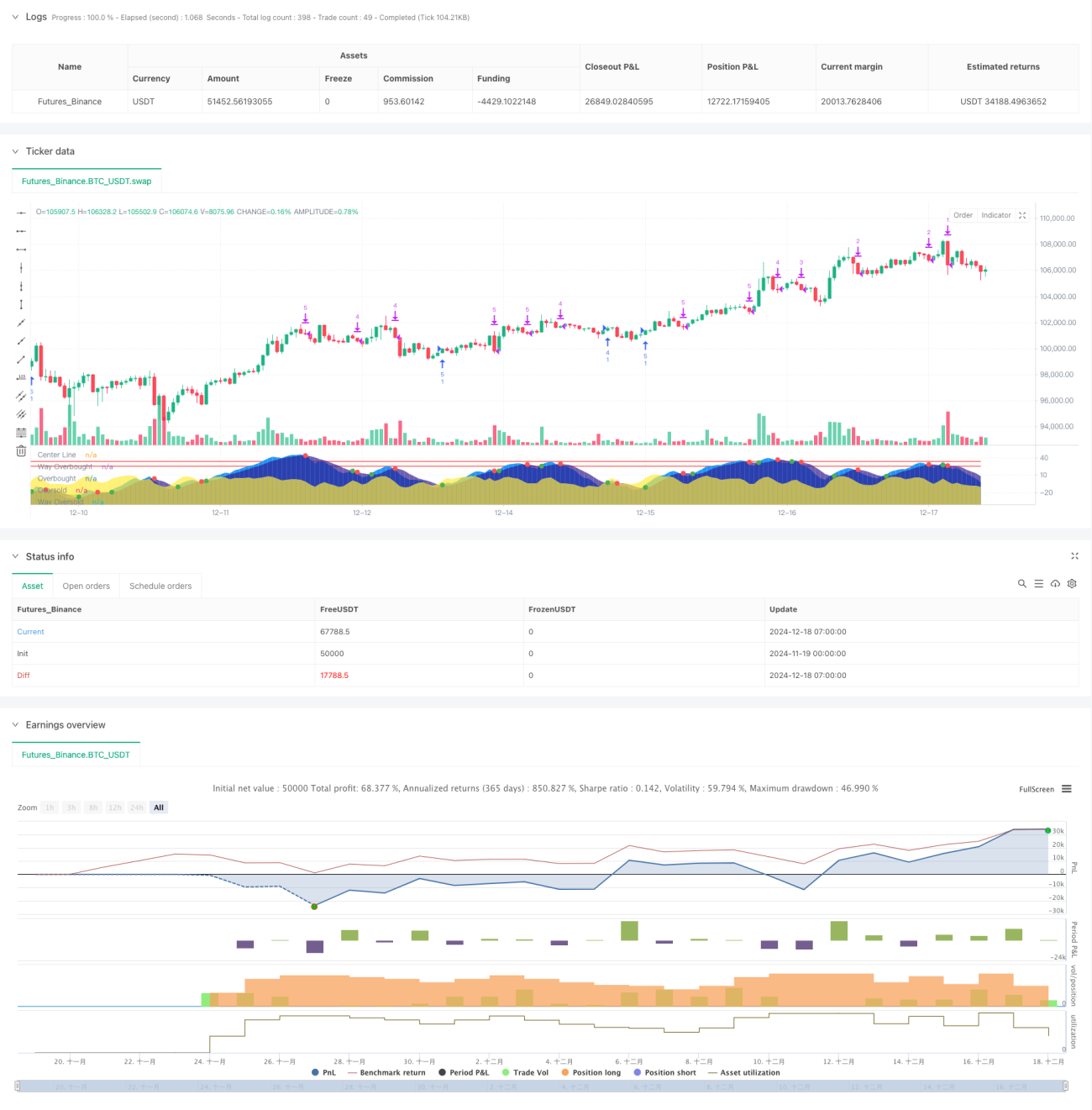
La estrategia es un sistema de negociación inteligente basado en el indicador de tendencia de onda (Wave Trend) y la inversión descentralizada (Dollar Cost Averaging). La estrategia analiza las tendencias de fluctuación del mercado, construye gradualmente posiciones cuando el mercado está en una zona de sobreventa y obtiene ganancias gradualmente cuando se confirma un mercado alcista. La estrategia combina las ventajas del análisis técnico y la gestión de riesgos, permitiendo acumular posiciones de manera estable y obtener ganancias durante el ciclo del mercado.

Principio de estrategia

La lógica central de la estrategia incluye los siguientes elementos clave:

  1. El indicador de tendencia de ondas se calcula utilizando el promedio de precios de HLC3 y el promedio móvil del índice (EMA) para identificar el estado de sobrecompra y sobreventa en el mercado
  2. Determina el estado de los mercados alcistas y bajistas a través de un oscilador mágico (Awesome Oscillator)
  3. Durante la temporada de bajada, se construyen almacenes en lotes cuando los precios están en zona de sobreventa, y el porcentaje de almacenamiento se ajusta dinámicamente según el nivel de sobreventa.
  4. Cuando se inicia el mercado alcista, el sistema emite una señal de “compra de oro”, lo que aumenta la intensidad de la construcción de posiciones
  5. Durante un mercado alcista, cuando los precios entran en la zona de sobreventa, el sistema reduce gradualmente la ganancia de la posición en función del grado de sobreventa
  6. Cuando se produce una señal bajista o un tope del mercado, el sistema vacía todas las posiciones para bloquear los beneficios.

Ventajas estratégicas

  1. Reducir los costos de construcción de almacenes mediante la diversificación de la inversión y evitar el riesgo de seguimiento
  2. Múltiples indicadores técnicos se validan de forma cruzada para mejorar la confiabilidad de las señales comerciales
  3. La gestión de posiciones es flexible y ajusta la cantidad de compras y ventas según la situación del mercado.
  4. Tiene una fuerte capacidad de defensa, deteniendo la pérdida en el momento de la aparición de una señal de mercado bajista
  5. Estrategias con lógica clara y parámetros que se pueden ajustar para adaptarse a diferentes entornos del mercado

Riesgo estratégico

  1. El riesgo de transacciones frecuentes en mercados convulsionados aumenta los costos de las transacciones
  2. Las estrategias de depósito distribuido pueden perder el punto de venta óptimo en un alza rápida unilateral
  3. Los indicadores técnicos son retrasados y pueden no reaccionar a tiempo ante las fuertes fluctuaciones del mercado
  4. La configuración incorrecta de los parámetros puede causar una hora inexacta para la creación o reducción de la reserva

Dirección de optimización de la estrategia

  1. Introducción de un indicador de volatilidad para optimizar el cálculo del número de adquisiciones y pérdidas
  2. Añadir más indicadores de sentimiento de mercado para mejorar la precisión de las tendencias
  3. Desarrollo de un sistema de parámetros adaptativos que ajuste los parámetros en función de la dinámica de los diferentes ciclos del mercado
  4. Aumentar el módulo de gestión de fondos para un control de posición más preciso

Resumir

Se trata de una estrategia de trading inteligente que combina de manera orgánica el análisis técnico con la gestión de riesgos. Se trata de una estrategia de trading inteligente que logra un crecimiento estable de los ingresos a través de indicadores de tendencias de ondas y métodos de inversión descentralizados, al tiempo que protege la seguridad de los fondos.

Código Fuente de la Estrategia
/*backtest
start: 2024-11-19 00:00:00
end: 2024-12-18 08:00:00
period: 1h
basePeriod: 1h
exchanges: [{"eid":"Futures_Binance","currency":"BTC_USDT"}]
*/

//@version=5

// Copyright (c) 2024 Seth Ethington.
// All rights reserved.
//
// If this script provides you Bread then share the Dough!
// BTC (God's Money) Address: bc1qrpxvea8ze4ayj2vtr0slp774rulm898gyhe3ss
//
// Redistribution and use in source and binary forms, 
// whether you tweak it or not, is totally fine, 
// but only if you swear on your life that BTC is God's Money! 
// 
// If you're redistributing the source code, 
// you must keep the above copyright notice and, 
// more importantly, the sacred BTC address!
//


strategy(title="Cipher DCA Strategy", shorttitle="Cipher DCA", overlay=false, initial_capital=100, pyramiding=30, currency=currency.USD,  slippage=1, commission_type=strategy.commission.percent, commission_value=0.1, default_qty_type=strategy.percent_of_equity, process_orders_on_close=true)

// Input parameters for the starting date
startDate = input(timestamp("2019-01-01 00:00:00"), title="Start Date (YYYY-MM-DD HH:MM:SS)")


// Input parameters for the indicator
fastLength = input.int(4, title="Fast Wave Length", group="Wave Calculator")  // Length for EMA smoothing of the price channel
slowLength = input.int(33, title="Slow Wave Length", group="Wave Calculator")  // Length for EMA smoothing of the trend channel
wayOverBoughtLevel = input.float(33, title="Way OverBought Level", group="Wave Calculator")
overBoughtLevel = input.float(25, title="Over Bought Level", group="Wave Calculator")
wayOverSoldLevel = input.float(-33, title="Way Over Sold Level", group="Wave Calculator")
overSoldLevel = input.float(-25, title="Over Sold Level", group="Wave Calculator")
accumulatingLevel = input.float(0, title="Accumulating Level", group="Wave Calculator")


// Calculate the average price (HLC3 = (High + Low + Close) / 3)
averagePrice = hlc3

// Compute the smoothed average price (ESA: Exponential Smoothing Average)
exponentialSmoothingAverage = ta.ema(averagePrice, fastLength)

// Compute the deviation (D) between the price and the smoothed average
priceDeviation = ta.ema(math.abs(averagePrice - exponentialSmoothingAverage), fastLength)

// Compute the commodity index (CI) which is normalized price movement
commodityIndex = (averagePrice - exponentialSmoothingAverage) / (0.015 * priceDeviation)

// Smooth the commodity index to create Wave Trend 1 (WT1)
fastWaveTrend = ta.ema(commodityIndex, slowLength)
// //log.info("fastWaveTrend= " + str.tostring(fastWaveTrend))

// Further smooth WT1 using a simple moving average to create Wave Trend 2 (WT2)
slowWaveTrend = ta.sma(fastWaveTrend, 5)
// //log.info("slowWaveTrend= " + str.tostring(slowWaveTrend))


// Plot the center line (0) for reference
plot(0, color=color.white, title="Center Line")

// Plot overbought and oversold levels
plot(wayOverBoughtLevel, color=color.red, title="Way Overbought")
plot(overBoughtLevel, color=color.red, title="Overbought")
plot(overSoldLevel, color=color.green, title="Oversold")
plot(wayOverSoldLevel, color=color.green, title="Way Oversold")

// Plot WT1 and WT2 as filled areas for better visibility
plot(fastWaveTrend, style=plot.style_area, color=color.new(color.blue, 0), title="Fast Wave")
plot(slowWaveTrend, style=plot.style_area, color=color.new(color.navy, 30), title="Slow Wave")

// Highlight the difference between fastWave vs slowWave
waveTrendDifference = fastWaveTrend - slowWaveTrend

// //log.info("waveTrendDifference=" + str.tostring(waveTrendDifference))
plot(waveTrendDifference, color=color.new(color.yellow, 30),style=plot.style_area, title="WT1 - WT2 Difference") //No transparency

// Plot buy and sell signals at crossovers
isCrossover = ta.cross(fastWaveTrend, slowWaveTrend)
// //log.info("isCrossover=" + str.tostring(isCrossover))
plot(isCrossover ? slowWaveTrend : na, color=(slowWaveTrend - fastWaveTrend > 0 ? color.red : color.green), style=plot.style_circles, linewidth=4, title="Crossover Signals")

float waveTrend = na
if (slowWaveTrend > 0 and fastWaveTrend > 0) 
    waveTrend := math.max(slowWaveTrend, fastWaveTrend)
    // //log.info("Both trends are positive. waveTrend set to max value: " + str.tostring(waveTrend))
else if (slowWaveTrend < 0 and fastWaveTrend < 0)
    waveTrend := math.min(slowWaveTrend, fastWaveTrend)
    // //log.info("Both trends are negative. waveTrend set to min value: " + str.tostring(waveTrend))
else 
    waveTrend := 0
    // //log.info("Trends are mixed. waveTrend set to 0.")

// Time to Sell
isCrossingDown = waveTrendDifference < 0

// Time to Buy
isCrossingUp = waveTrendDifference > 0


//-----------------------------------------------------------


// Detect Bull Market and Bear Market using the Awesome Oscillator
// User input for AO thresholds
ao_threshold = input.float(-10, "AO Bull Market Threshold", minval=-50, maxval=50, step=1, group = "Bear and Bull Thresholds")
ao_cycletop_threshold = input.float(5, "AO Bear Market Threshold", minval=0, maxval=200, step=1, group = "Bear and Bull Thresholds")

// Define the Awesome Oscillator
ao = ta.sma(hl2, fastLength) - ta.sma(hl2, slowLength)

// Convert current bar time to the first day of the month for monthly calculations
currentMonthStart = timestamp(year, month, 1, 0, 0)
prevMonthStart = time - (time - currentMonthStart)

// Calculate AO for the start of the month and previous month
aoCurrentMonth = request.security(syminfo.tickerid, 'M', ao[0])
aoPrevMonth1    = request.security(syminfo.tickerid, 'M', ao[1])
aoPrevMonth2    = request.security(syminfo.tickerid, 'M', ao[2])

// Detect bull market based on monthly AO
isBullMarket = aoCurrentMonth > aoPrevMonth1 and aoPrevMonth1 > aoPrevMonth2 and aoCurrentMonth > ao_threshold

// Detect cycle top based on monthly AO
isBearMarket = aoCurrentMonth > ao_cycletop_threshold and aoPrevMonth1 > aoCurrentMonth

// Detect when a bull market is starting
var bool isBullMarketStarting = na
if (not isBullMarket[1] and isBullMarket)
    isBullMarketStarting := true
else
    isBullMarketStarting := false

// Logging
//log.info("isBullMarket is " + str.tostring(isBullMarket))
//log.info("isCycleTop is " + str.tostring(isBearMarket))

// Plot transparent overlays for Bull Market and Cycle Top
overlayColor = isBullMarket ? color.new(color.green, 80) : isBearMarket ? color.new(color.red, 60) : na
bgcolor(overlayColor, title="Market Condition Overlay")


//----------------------------------------------------------


// Calculate Potential Liquidations and Golden Buy Zones
volLength = input.int(20, "Volume Length", minval=1, group="Golden Buy Indicator")
volStdDevThreshold = input.float(2.0, "Volume Standard Diviation Threshold", step=0.1, group="Golden Buy Indicator")
aoWeeklyThreshold = input.int(0, "Awesome Oscillator Oversold Threshold", step=1, group="Golden Buy Indicator")


// Start Accumulating when the price is oversold or price action is flat
isStartAccumulating = waveTrend <= accumulatingLevel and not isBearMarket

// Start Selling when we are now in a Bull Market
isStartSelling = waveTrend > accumulatingLevel

// Calculate Overbought and Oversold Levels
isOverSold = waveTrend < overSoldLevel
isWayOverSold = waveTrend < wayOverSoldLevel
isOverBought = waveTrend > overBoughtLevel
isWayOverBought = waveTrend > wayOverBoughtLevel
//log.info("isOverSold= " + str.tostring(isOverSold) + " isWayOverSold= " + str.tostring(isWayOverSold) + " isOverBought= " + str.tostring(isOverBought) + " isWayOverBought= " + str.tostring(isWayOverBought))

//Weekly Awesome Oscillator to detect oversold levels
aoWeekly = request.security(syminfo.tickerid, "W", ao)

// Get standard deviation of volume over last 20 bars
volumeStDev = ta.stdev(volume, volLength)

// Detect volume spikes
volumeSpike = volume > (ta.sma(volume, volLength) + volStdDevThreshold * volumeStDev)

isGoldenBuyZone = volumeSpike and aoWeekly < aoWeeklyThreshold and not isBearMarket
plotshape(series=isGoldenBuyZone ? -60 : na, style=shape.triangleup, location=location.absolute, color=color.yellow, size=size.tiny, offset=0, title="Golden Buy Zone")

isMarketTop = volumeSpike and aoWeekly > -aoWeeklyThreshold and isBullMarket
plotshape(series=isMarketTop ? 60 : na, style=shape.triangledown, location=location.absolute, color=color.purple, size=size.tiny, offset=0, title="Market Top")


//---------------------------------------------------------

// Buying and Selling Input parameters for the indicator
isBullMarketStartingPercent = input.float(1.0, title="Starting a Bull Market Percent", step=0.01, group="Buy and Sell")
goldenBuyPercent = input.float(0.00006, title="Golden Buy Percent", step=0.01, group="Buy and Sell")
wayOverSoldPercent = input.float(0.00004, title="Way Over Sold Percent", step=0.01, group="Buy and Sell") 
overSoldPercent = input.float(0.00002, title="Over Sold Percent", step=0.01, group="Buy and Sell")
crossOverPercent = input.float(0.00002, title="Cross Over Percent", step=0.01, group="Buy and Sell")
overBoughtPercent = input.float(0.00005, title="Over Bought Percent", step=0.01, group="Buy and Sell")
wayOverBoughtPercent = input.float(0.00006, title="Way Over Bought Percent", step=0.01, group="Buy and Sell")

//Execute Buy and Sell Strategy
// Execute only if the bar's time is after the start date
if (true)
    if ((isCrossover and isCrossingUp and isStartAccumulating) or isGoldenBuyZone or isBullMarketStarting)
        if (isGoldenBuyZone) 
            strategy.entry("Golden Buy", strategy.long, qty = goldenBuyPercent * strategy.initial_capital)
            //log.info("Golden Buy " + str.tostring(goldenBuyPercent))
        else if (isBullMarketStarting)
            strategy.entry("Bull Buy", strategy.long, qty = isBullMarketStartingPercent * strategy.initial_capital)
            //log.info("Way Over Sold Buy " + str.tostring(wayOverSoldPercent))    
        else if (isWayOverSold) 
            strategy.entry(str.tostring(strategy.opentrades), strategy.long, qty = wayOverSoldPercent * strategy.initial_capital)
            //log.info("Way Over Sold Buy " + str.tostring(wayOverSoldPercent))
        else if (isOverSold)  
            strategy.entry(str.tostring(strategy.opentrades), strategy.long, qty = overSoldPercent * strategy.initial_capital)
            //log.info("Over Sold Buy " + str.tostring(overSoldPercent))
        else if (isCrossover)  
            strategy.entry(str.tostring(strategy.opentrades), strategy.long, qty = crossOverPercent * strategy.initial_capital)
            //log.info("Crossover Buy " + str.tostring(crossOverPercent))
    else if (isCrossover and isCrossingDown and isStartSelling) or isBearMarket or isMarketTop
        if (isBearMarket)
            strategy.close_all("Close all")
            //log.info("Closing All Open Positions")
        else if (isWayOverBought or isMarketTop) 
            int openTrades = strategy.opentrades  // Get the number of open trades
            int tradesToClose = math.floor(openTrades * wayOverBoughtPercent)
            //log.info("# of tradesToClose= " + str.tostring(tradesToClose))
    
            // Loop through and close 100% of the open trades determined
            for i = 0 to tradesToClose
                // Close the trade by referencing the correct index
                strategy.close(str.tostring(openTrades - 1 - i), qty_percent = 100)
                //log.info("Sell 100%: Closed trade # " + str.tostring(openTrades - 1 - i))
        else if (isOverBought) 
            int openTrades = strategy.opentrades  // Get the number of open trades
            int tradesToClose = math.floor(openTrades * overBoughtPercent) 
            //log.info("# of tradesToClose= " + str.tostring(tradesToClose))
    
            // Loop through and close 100% of the open trades determined
            for i = 0 to tradesToClose
                // Close the trade by referencing the correct index
                strategy.close(str.tostring(openTrades - 1 - i), qty_percent = 100)
                //log.info("Sell 100%: Closed trade # " + str.tostring(openTrades - 1 - i))
        else if (isStartSelling)
            strategy.close(str.tostring(strategy.opentrades - 1), qty_percent =50)
            //log.info("Sell 100% of Last Trade: Closed trade # " + str.tostring(strategy.opentrades - 1))