Estrategia de momento EMA-RSI multiestado adaptativa combinada con sistema de filtro de índice de volatilidad

Resumen
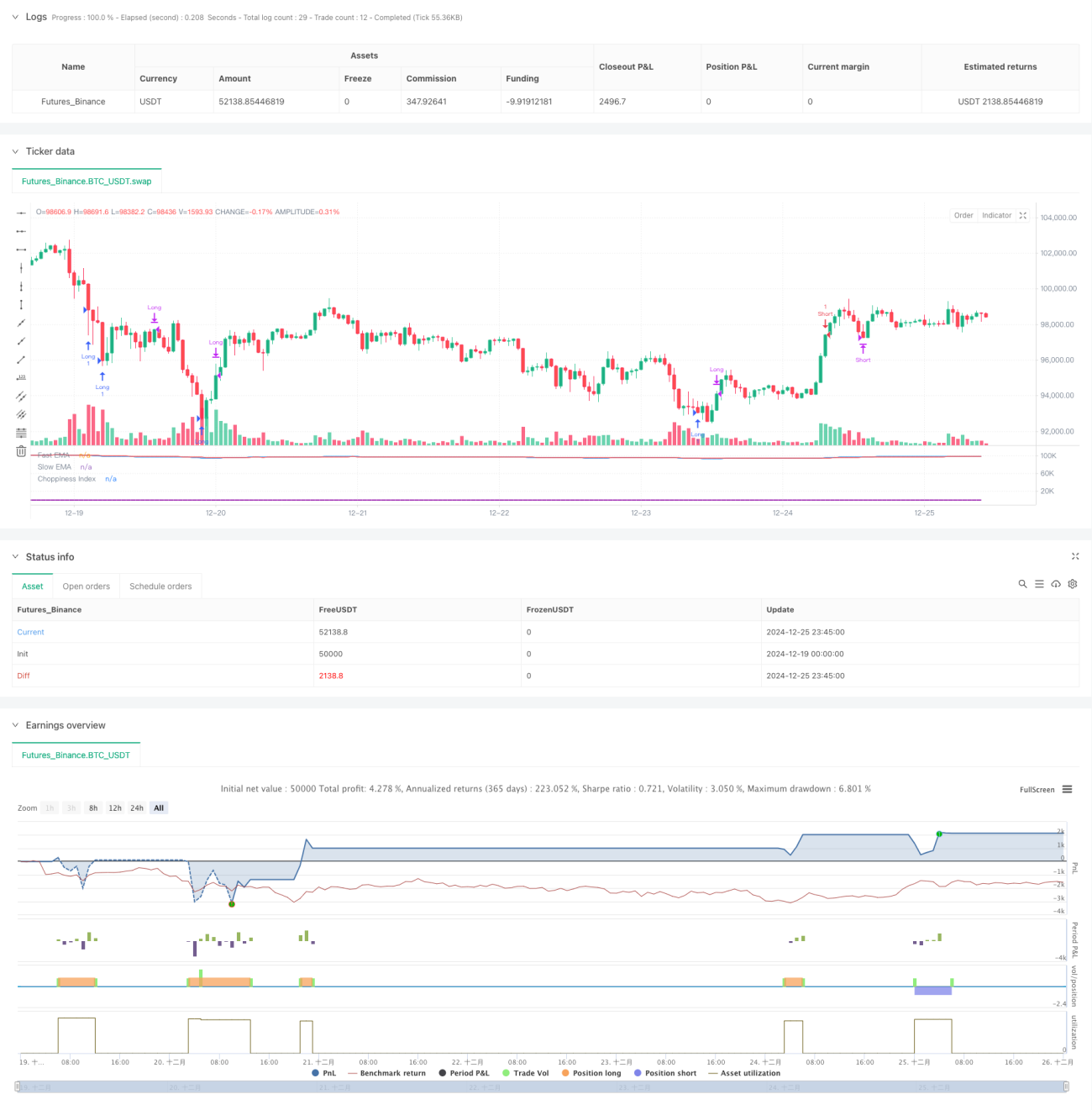
Esta estrategia es un sistema adaptativo que combina el seguimiento de tendencias y el trading en rango. Utiliza el Índice de Volatilidad (CI) para determinar el estado del mercado y aplica la lógica de trading correspondiente según las diferentes condiciones del mercado. En mercados tendenciales, la estrategia utiliza cruces de EMA y señales de sobrecompra/sobreventa del RSI para operar; en mercados laterales, se basa principalmente en valores extremos del RSI. Además, incluye mecanismos de stop loss y take profit para controlar el riesgo y asegurar ganancias.
Principio de la Estrategia
El núcleo de la estrategia es dividir el mercado en dos estados mediante el Índice de Volatilidad (CI): mercado tendencial (CI < 38.2) y mercado lateral (CI > 61.8). En un mercado tendencial, cuando la EMA rápida (período 9) cruza al alza la EMA lenta (período 21) y el RSI está por debajo de 70, se abre una posición larga; cuando la EMA lenta cruza al alza la EMA rápida y el RSI está por encima de 30, se abre una posición corta. En un mercado lateral, se abre una posición larga cuando el RSI está por debajo de 30 y una posición corta cuando está por encima de 70. Asimismo, la estrategia establece condiciones de cierre de posiciones, un stop loss del 2% y un take profit del 4%.
Ventajas de la Estrategia
- Alta adaptabilidad al mercado: identifica el estado del mercado mediante el indicador CI, permitiendo cambiar de manera flexible entre diferentes estrategias según las condiciones.
- Confirmación de múltiples señales: combina medias móviles, indicadores de momentum y el índice de volatilidad, mejorando la fiabilidad de las señales de trading.
- Gestión de riesgos completa: incluye mecanismos de stop loss y take profit para controlar el riesgo de manera efectiva.
- Lógica de trading clara: diferencia entre estados de tendencia y rango, con reglas de trading claras.
- Alta tasa de aciertos: muestra una tasa de aciertos del 70-80% en el marco temporal de 15 minutos.
Riesgos de la Estrategia
- Sensibilidad a parámetros: la estrategia utiliza múltiples indicadores técnicos, lo que hace que la optimización de parámetros sea compleja.
- Riesgo de rupturas falsas: pueden generarse señales erróneas durante las transiciones entre estados del mercado.
- Impacto del deslizamiento: en mercados con baja liquidez, puede enfrentarse a un riesgo de deslizamiento significativo.
- Sobreoperación: los cambios frecuentes en el estado del mercado pueden provocar un exceso de operaciones.
- Dependencia del mercado: el rendimiento de la estrategia puede verse muy afectado por condiciones de mercado específicas.
Direcciones de Optimización de la Estrategia
- Optimización dinámica de parámetros: ajustar los parámetros de los indicadores de forma dinámica según las diferentes condiciones del mercado.
- Añadir filtros: incluir filtros como volumen y volatilidad para mejorar la calidad de las señales.
- Mejorar el mecanismo de stop loss: considerar el uso de stop loss dinámico, como el Stop Loss basado en ATR o trailing stop.
- Mejorar el reconocimiento de estados: refinar la clasificación de los estados del mercado y agregar lógica para mercados neutros.
- Desarrollar un sistema de confirmación de señales: agregar más mecanismos de confirmación para reducir señales falsas.
Resumen
Esta estrategia construye un sistema de trading adaptativo mediante la combinación de múltiples indicadores técnicos, capaz de mantener un rendimiento estable en diferentes condiciones de mercado. Su principal ventaja radica en la adaptabilidad al mercado y un mecanismo completo de gestión de riesgos, pero también se debe prestar atención a cuestiones como la optimización de parámetros y la dependencia de las condiciones del mercado. Con una optimización y mejora continua, esta estrategia tiene el potencial de lograr mejores resultados de trading en diversas condiciones de mercado.
- 1