Estrategia de impulso de tendencia - Sistema de sincronización dinámica de ondas de múltiples períodos en zigzag

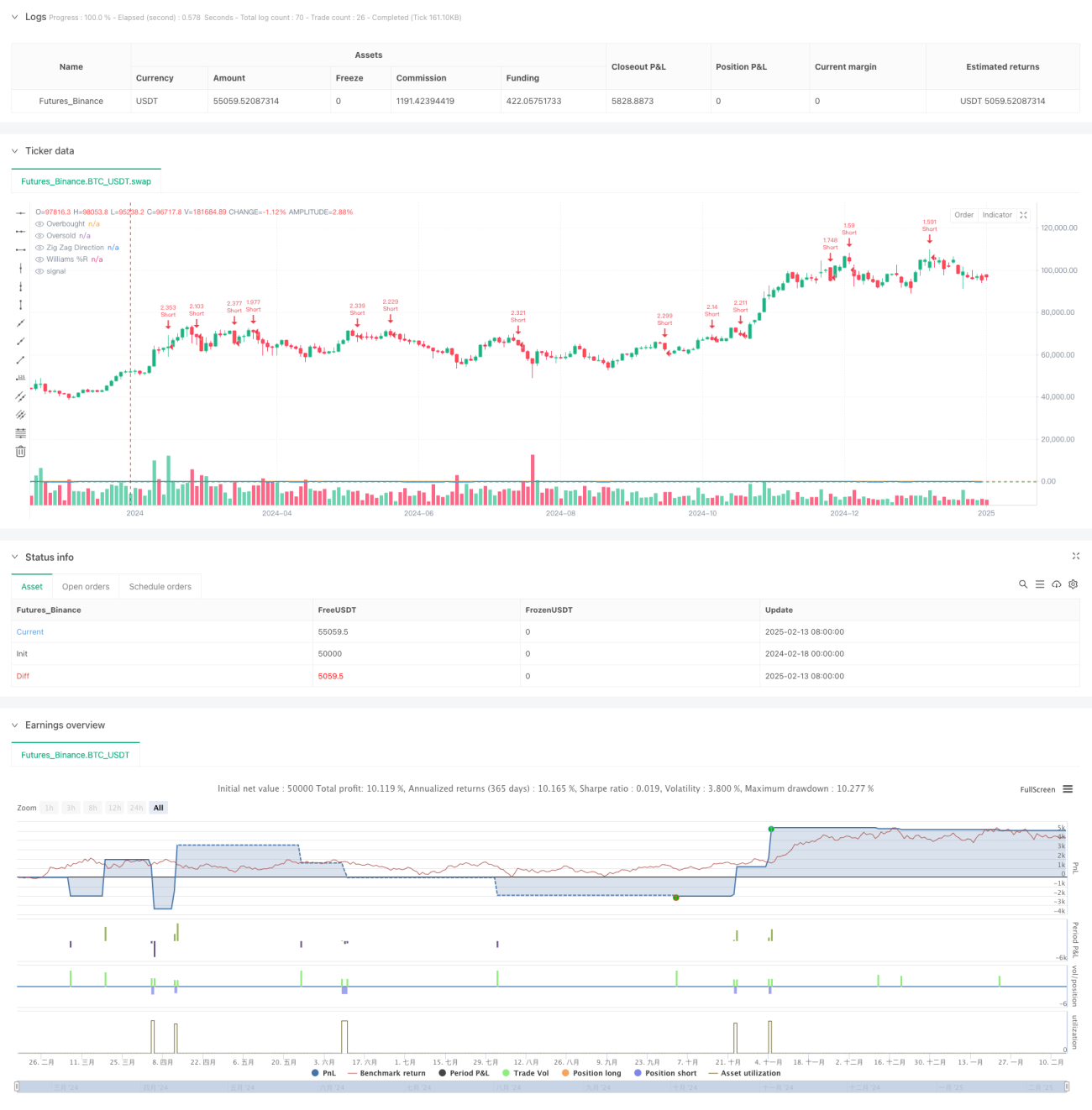
Resumen
Esta estrategia es un sistema de trading multidimensional que combina el indicador ZigZag y el indicador Williams %R. A través del indicador ZigZag se identifican los máximos y mínimos importantes de las ondas, mientras que el indicador Williams %R confirma los puntos de entrada cuando el mercado alcanza condiciones de sobrecompra o sobreventa. Esta combinación no solo permite capturar los principales puntos de inflexión de la tendencia del mercado, sino que también mejora la precisión de las operaciones mediante la confirmación del momento (momentum).
Principio de la Estrategia
La lógica central de la estrategia se basa en dos componentes principales:
- El indicador ZigZag identifica los máximos y mínimos significativos de las ondas mediante parámetros de profundidad y desviación, filtrando el ruido del mercado y determinando la dirección de la tendencia. Cuando se forma un nuevo mínimo de onda, indica el inicio de una tendencia alcista; un nuevo máximo de onda señala el inicio de una tendencia bajista.
- El indicador Williams %R compara el precio actual con el precio máximo de un período específico para calcular el estado de momentum del mercado. Cuando el valor del indicador supera -80, indica sobreventa (oportunidad potencial de compra); cuando supera -20, indica sobrecompra (oportunidad potencial de venta).
Las reglas de trading de la estrategia son las siguientes:
- Condición de largos: El indicador ZigZag identifica un nuevo mínimo de onda y el Williams %R rompe al alza desde la zona de sobreventa.
- Condición de cortos: El indicador ZigZag identifica un nuevo máximo de onda y el Williams %R rompe a la baja desde la zona de sobrecompra.
- El stop loss se establece en un 1% y el take profit en un 2%.
Ventajas de la Estrategia
- Confirmación multidimensional: Al confirmar tanto la tendencia como el momentum, se mejora la fiabilidad de las señales de trading.
- Alta adaptabilidad: El parámetro de desviación del ZigZag puede ajustarse dinámicamente según la volatilidad del mercado.
- Control de riesgo sólido: Se utiliza una estrategia fija de stop loss y take profit porcentual para controlar el riesgo de cada operación.
- Buena visualización: Las señales de trading se muestran claramente mediante etiquetas y gráficos, facilitando el análisis y la optimización.
Riesgos de la Estrategia
- Riesgo en mercados laterales: En mercados sin tendencia clara, pueden generarse señales falsas frecuentes.
- Riesgo de deslizamiento: En movimientos rápidos del mercado, puede haber un deslizamiento significativo.
- Sensibilidad a los parámetros: La elección de los parámetros del indicador tiene un gran impacto en el rendimiento de la estrategia.
- Retraso en las señales: Debido a que se requiere confirmar la formación de un nuevo punto de onda, es posible perder algunas operaciones rápidas.
Direcciones de Optimización
- Añadir filtro por entorno de mercado: Se puede incorporar un indicador de volatilidad para identificar el estado del mercado y utilizar diferentes configuraciones de parámetros según el contexto.
- Optimización dinámica del stop loss: Se puede ajustar dinámicamente la ubicación del stop loss basándose en el ATR o la volatilidad.
- Incorporar confirmación de volumen: Agregar verificación de volumen al generarse la señal.
- Filtro temporal: Se puede añadir un filtro de horario de trading para evitar operar en períodos de alta volatilidad.
Conclusión
Se trata de un sistema de trading completo que combina el seguimiento de tendencias y el trading por momentum. Gracias a la sinergia de múltiples indicadores técnicos, puede controlar eficazmente el riesgo manteniendo una alta tasa de aciertos. Aunque presenta cierto retraso, mediante una optimización razonable de parámetros y una gestión de riesgos adecuada, se puede lograr un rendimiento de trading estable. Esta estrategia es especialmente adecuada para tendencias de medio a largo plazo y muestra un mejor desempeño cuando el mercado presenta oportunidades direccionales claras.
/*backtest
start: 2024-02-18 00:00:00
end: 2025-02-15 08:00:00
period: 2d
basePeriod: 2d
exchanges: [{"eid":"Futures_Binance","currency":"BTC_USDT"}]
*/

//@version=6
strategy("Zig Zag + Williams %R Strategy", overlay=true, default_qty_type=strategy.percent_of_equity, default_qty_value=300)

// ====================- 1