Sistema de trading de seguimiento de tendencia con doble media móvil y estrategia de filtro dinámico adaptativo

Resumen
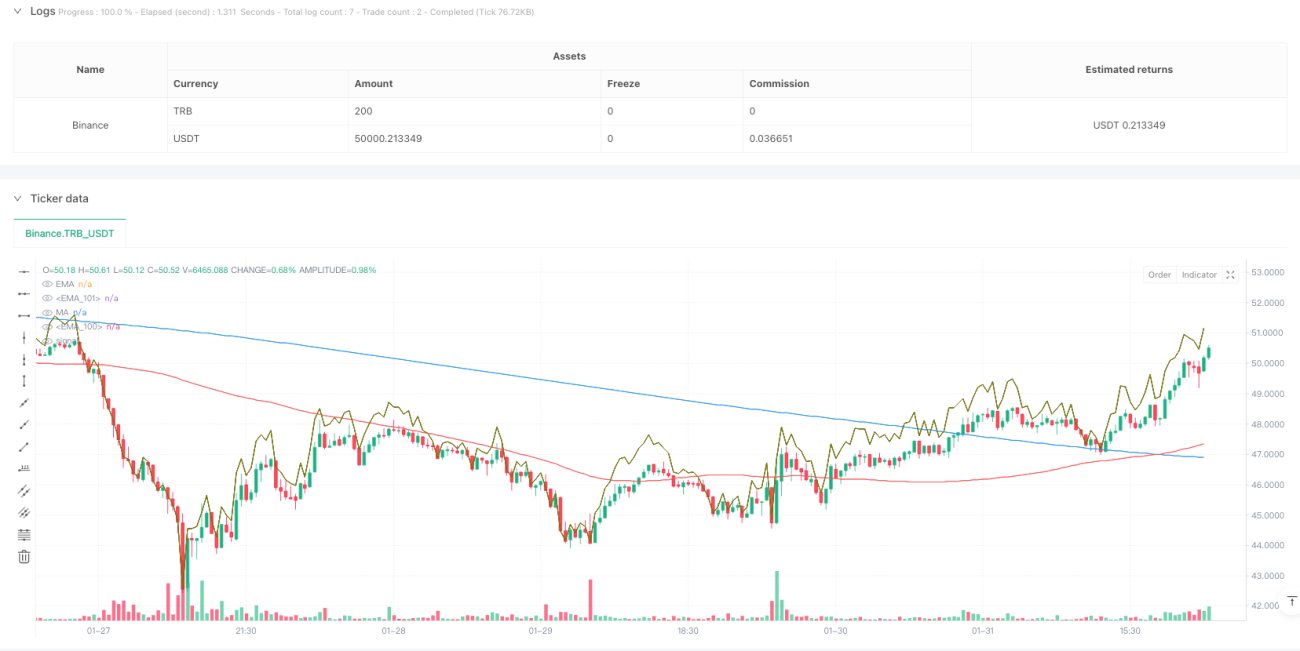
Esta estrategia es un sistema de seguimiento de tendencias que combina múltiples indicadores técnicos. Se basa principalmente en las señales de cruce entre la media móvil simple (SMA) y la media móvil exponencial (EMA), e integra varias características avanzadas como la banda de tendencia de la media móvil Hull (HMA), el indicador Williams %R, el análisis de máximos y mínimos oscilantes, y un mecanismo de filtrado dinámico para proporcionar señales de trading más fiables.
Principio de la Estrategia
La lógica central de la estrategia se fundamenta en los siguientes elementos clave:
- Uso de una SMA de período 100 y una EMA de período 200 como principales indicadores de tendencia.
- Integración de una banda de tendencia HMA de período 70 para confirmar el impulso de la tendencia.
- Empleo del indicador Williams %R para el cálculo dinámico de soportes y resistencias.
- Detección de máximos y mínimos oscilantes mediante una ventana retrospectiva de 20 períodos.
- Monitoreo y actualización en tiempo real de los máximos y mínimos intradía.
- Establecimiento de un filtro inicial al inicio de la sesión y un umbral de volatilidad (0.5%) para reducir señales falsas.
Las condiciones de entrada requieren el cumplimiento simultáneo de: precio por encima de las dos medias móviles, el indicador %R en ascenso durante 3 velas consecutivas y mayor a -20, vela alcista con cierre superior al anterior, y precio que no exceda el umbral de volatilidad intradía.
Las condiciones de salida se cumplen si ocurre alguna de las siguientes: precio por debajo de las dos medias móviles, o indicador %R inferior a -80.
Ventajas de la Estrategia
- La verificación conjunta de múltiples indicadores técnicos aumenta la fiabilidad de las señales de trading.
- El mecanismo de filtrado dinámico reduce eficazmente las señales falsas en períodos de alta volatilidad.
- El cálculo adaptativo de soportes y resistencias proporciona una buena adaptabilidad al mercado.
- Sistema completo de gestión intradía, incluyendo filtro de apertura y control de umbral de volatilidad.
- Alta flexibilidad de parámetros, facilitando la optimización según diferentes condiciones del mercado.
Riesgos de la Estrategia
- El sistema de medias móviles puede generar señales falsas frecuentes en mercados laterales.
- La combinación de múltiples condiciones puede hacer que se pierdan algunas oportunidades potenciales de trading.
- Los períodos fijos de las medias móviles pueden rendir de manera diferente en distintos entornos de mercado.
- El filtro intradía podría omitir oportunidades importantes durante movimientos de tendencia rápidos.
- Una optimización excesiva de los parámetros puede provocar problemas de sobreajuste.
Direcciones de Optimización
- Introducir un mecanismo de cálculo de períodos de medias móviles adaptativo para que el sistema se ajuste mejor a la volatilidad del mercado.
- Agregar indicadores de análisis de volumen para mejorar la fiabilidad de la confirmación de tendencias.
- Desarrollar mecanismos dinámicos de stop-loss y take-profit para mejorar la eficiencia de la gestión de capital.
- Incorporar indicadores de volatilidad del mercado para optimizar el establecimiento de umbrales de filtro.
- Considerar la señal conjunta de diferentes marcos temporales para mejorar la estabilidad del sistema.
Conclusión
Se trata de un sistema de seguimiento de tendencias bien diseñado, que mediante la combinación de múltiples indicadores técnicos y un riguroso mecanismo de filtrado, mantiene tanto la fiabilidad como una buena flexibilidad. El espacio de optimización de la estrategia reside principalmente en la adaptabilidad de los parámetros y la mejora de los mecanismos de gestión de riesgos. Se recomienda a los traders que, antes de su uso en operaciones reales, prueben exhaustivamente su rendimiento en diferentes condiciones de mercado y ajusten los parámetros según las circunstancias específicas.
- 1