Estrategia de trading de tortugas adaptativa multicanal combinada con una estrategia de stop loss dinámico

DC Donchian Channel ATR Turtle-trading
Fecha de creación: 2025-03-04 10:15:33 Última modificación: 2025-03-04 10:16:07
Copiar: 0 Número de Visitas: 866
2
Seguir
319
Seguidores

Estrategia de trading de tortugas adaptativa multicanal combinada con una estrategia de stop loss dinámico Estrategia de trading de tortugas adaptativa multicanal combinada con una estrategia de stop loss dinámico

Descripción general

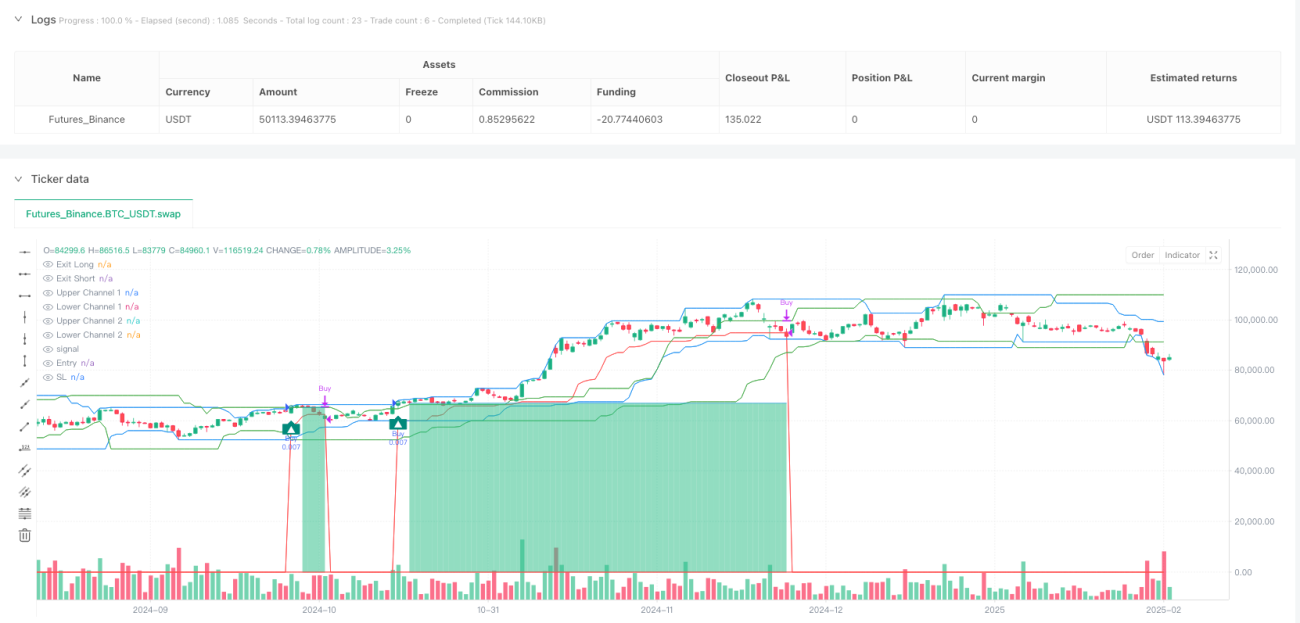
La estrategia multi-canal auto-adaptativa de la tormenta es un sistema moderno de seguimiento de tendencias, optimizado y ampliado en su totalidad basado en las reglas clásicas de la tormenta. El núcleo de la estrategia utiliza un sistema de doble canal de Donchian para identificar los puntos de ruptura del mercado y proporcionar una posición de parada precisa a través de un canal de salida ajustado dinámicamente. La estrategia diseña un mecanismo de confirmación en dos niveles: el canal 1 para capturar brechas de precios a corto plazo, y el canal 2 como un filtro de confirmación para reducir las señales falsas.

Principio de estrategia

La estrategia se basa en los principios centrales de los sistemas clásicos de negociación de criptomonedas, pero con la adición de un moderno mecanismo de confirmación de dos vías y un sistema de suspensión de pérdidas dinámicas:

  1. Sistema de reconocimiento de brecha de doble vía

    • Canal 1 ((default 20 period): Calcula el precio máximo y mínimo dentro de un período determinado, formando un límite superior y inferior.
    • Canal 2 ((default 20 periodos, desviación 20): como confirmación de segundo nivel, reduce la señal falsa por desviación a la derecha.
    • Solo se generará una señal válida cuando el precio rompa la frontera del canal 1 y sea confirmado por el canal 2.
  2. Dinámica de salida del canal

    • El uso de un corto ciclo (default 10) del canal de Dongjian como deterioro dinámico.
    • Para las posiciones de más cabeza, el punto de salida es el punto más bajo del canal; para las posiciones de cabeza vacía, el punto de salida es el punto más alto del canal.
    • Se requiere una confirmación de cierre de la línea K completa antes de ejecutar la salida, para evitar una salida prematura debido al ruido de precios.
  3. Entradas y salidas lógicas

    • Entrada múltiple: cuando el precio de cierre supera el máximo anterior del canal 1 y es superior al máximo anterior del canal 2.
    • Entrada en blanco: cuando el precio de cierre cae por debajo del mínimo anterior del canal 1 y es inferior al mínimo anterior del canal 2.
    • Salida múltiple: el precio cae por debajo del precio mínimo de salida o alcanza el porcentaje de parada opcional.
    • Salida en blanco: el precio supera el precio más alto de la salida o alcanza el porcentaje de parada opcional.
  4. Administración de fondos

    • Por defecto, el 1% de los fondos de la cuenta se utiliza en cada transacción, que se puede ajustar según los resultados de la prueba.
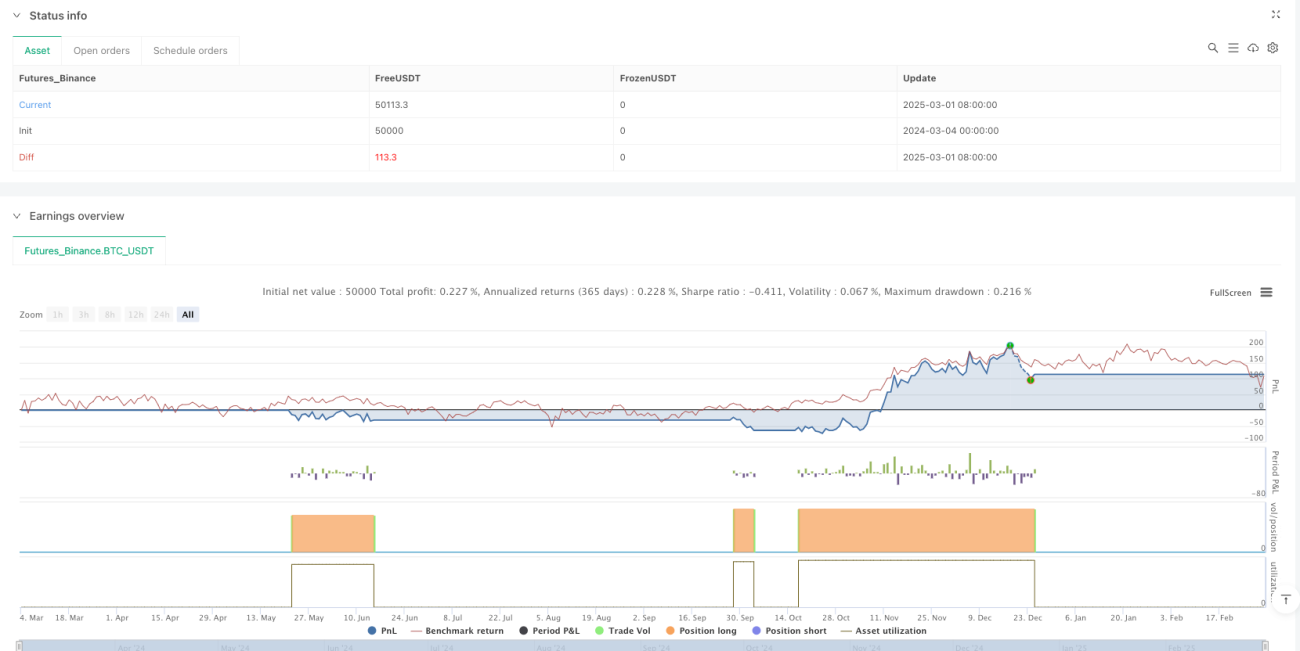
    • Asegúrese de que la retirada máxima no exceda el 10% para mantener el control del riesgo.
    • Tenga en cuenta la comisión (el 0.1% por defecto) y el punto de deslizamiento (el 5 por defecto) para acercarse al entorno real de las transacciones.

Ventajas estratégicas

  1. Mejor calidad de la señal: El mecanismo de confirmación de dos canales reduce significativamente las falsas brechas y mejora la calidad y la precisión de la señal.buy = buy_fast and close > upper_slow[1]ysel = sel_fast and close < lower_slow[1]El diseño de este proyecto es el siguiente:

  2. Gestión de riesgos dinámicosLa estrategia utiliza un canal de salida adaptativo, que ajusta la posición de parada en función de la dinámica de la estructura del mercado. Cuando el mercado se mueve favorablemente, la posición de parada se acopla automáticamente y bloquea parte de las ganancias.exit_buy_level:= math.max(nz(exit_buy_level,10e-10), lower_exit)lograr.

  3. Un sistema de gestión de fondos completoLa estrategia incluye reglas de gestión de fondos profesionales que controlan el riesgo de cada transacción a través de un sistema de asignación porcentual.

  4. Gestión de transacciones visualesLas estrategias de trading se basan en el uso de gráficos que indican claramente los puntos de entrada, los puntos de parada y los puntos de parada para ayudar a los traders a entender intuitivamente la lógica de la negociación y el alcance del riesgo.

Riesgo estratégico

  1. El mercado de la conmoción no ha funcionado bien: Como estrategia de seguimiento de tendencias, puede generar una serie de falsas señales en la fase de ordenamiento horizontal. El código de análisis muestra que, aunque el sistema de doble canal reduce los errores, aún puede desencadenar varias operaciones con pequeñas pérdidas en mercados sin una clara tendencia.

  2. Sensibilidad de los parámetrosLa estrategia de rendimiento depende en gran medida de la configuración del ciclo de la vía y la cantidad de desplazamiento. Diferentes mercados y marcos de tiempo requieren diferentes combinaciones de parámetros, lo que requiere una adecuada retroalimentación y optimización._period_dc1_period_dc2y_period_offEl objetivo es controlar estas variables clave.

  3. Riesgo de retraso: El canal de stop loss dinámico puede no reaccionar lo suficientemente rápido en un mercado de gran volatilidad, lo que lleva a una ampliación de la retirada. En particular, se requiere la confirmación del cierre de la línea K.barstate.isconfirmedEn un entorno de alta volatilidad, es posible que se pierda el mejor momento de salida.

  4. La excesiva dependencia de los patrones históricos: La estrategia asume que el modelo de ruptura histórica seguirá siendo válido en el futuro, pero las características del mercado pueden cambiar con el tiempo y afectar el rendimiento de la estrategia.

Dirección de optimización de la estrategia

  1. Añadir filtro de tendencias: El análisis del código muestra que la estrategia actual carece de juicio sobre la tendencia general del mercado. Se recomienda agregar indicadores de tendencia como promedios móviles, ADX o MACD, activar la estrategia en entornos de tendencia fuerte y reducir la sensibilidad en mercados de tendencia débil o convulsiva.

  2. Adaptación al ciclo de conducciónLa dirección de optimización es la introducción de un ciclo de canal de adaptación basado en el ATR o la volatilidad del mercado, para que la estrategia se adapte mejor a diferentes entornos de mercado. Esto puede modificarse_period_dc1y_period_dc2La forma en que se realiza el cálculo.

  3. Mecanismo de salida optimizado: La lógica de salida en el código solo depende de la vía de Dongxian. Se recomienda implementar estrategias de salida por etapas, por ejemplo, cerrar parte de la posición después de alcanzar cierta ganancia y configurar un cese de pérdida de seguimiento más flexible para el resto.

  4. El filtro del tiempoAumentar el filtro de tiempo de negociación para evitar períodos de baja liquidez o alta volatilidad del mercado. En particular, para el mercado de criptomonedas que opera las 24 horas, ciertos períodos pueden ser más adecuados para ejecutar operaciones.

  5. Indicadores emocionales integradosIntegración de indicadores de sentimiento del mercado, como volumen de transacciones, volatilidad o flujo de fondos, para reforzar las decisiones de entrada y salida. Por ejemplo, aumentar el peso en las señales de ruptura de alto volumen de transacciones o reducir la frecuencia de las transacciones en un entorno de baja volatilidad.

Resumir

La estrategia de comercio de toros multicanal auto-adaptativa es un sistema moderno y completo de seguimiento de tendencias que resuelve muchos de los desafíos de las reglas de comercio de toros tradicionales a través de mecanismos de confirmación de doble canal y paradas dinámicas. La estrategia es especialmente adecuada para los operadores de tendencias a medio y largo plazo, que se muestran más estables en marcos de tiempo más altos como H4 o el Sol. La integración exitosa de 3 Commas en la estrategia lo convierte en la opción ideal para el comercio automatizado, reduciendo la interferencia emocional humana.

Si bien puede tener un rendimiento deficiente en un mercado convulso, puede mejorar significativamente su rendimiento general con la optimización adecuada de los parámetros y un filtro de tendencia adicional. El módulo de gestión de fondos de la estrategia asegura que los riesgos se controlen de manera efectiva, mientras que el sistema de suspensión de pérdidas dinámico ayuda a proteger los beneficios obtenidos.

Esta es una estrategia que vale la pena considerar para los comerciantes que desean capturar tendencias en una variedad de condiciones de mercado, especialmente cuando se utiliza en combinación con otras herramientas de análisis de mercado. Recuerde que cualquier estrategia requiere ajustes a la tolerancia al riesgo personal y los objetivos de negociación, y se realiza una adecuada retroalimentación y simulación de operaciones antes de invertir dinero real.

Código Fuente de la Estrategia
/*backtest
start: 2024-03-04 00:00:00
end: 2025-03-02 08:00:00
period: 1d
basePeriod: 1d
exchanges: [{"eid":"Futures_Binance","currency":"BTC_USDT"}]
*/

// This Pine Script™ code is subject to the terms of the Mozilla Public License 2.0 at https://mozilla.org/MPL/2.0/
// © 3Commas

//@version=6
// Strategy configuration: sets properties for the strategy like title, overlay, pyramiding, calculation mode, and risk parameters.
strategy(title                        = "[3Commas] Turtle Strategy"
       , overlay                      = true
       , pyramiding                   = 0  
       , calc_on_order_fills          = false
       , calc_on_every_tick           = true
       , default_qty_type             = strategy.percent_of_equity
       , default_qty_value            = 1
       , initial_capital              = 10000
       , slippage                     = 5
       , commission_type              = strategy.commission.percent
       , commission_value             = 0.1
       , use_bar_magnifier            = true
       , fill_orders_on_standard_ohlc = true
     )

// ――――――――――――――――――――――――――――――――――――――――――――――――――――――――――――――――――――――――――――――――――――――――――――――――――――――――――――――――――――
// 🟦 Inputs
// ――――――――――――――――――――――――――――――――――――――――――――――――――――――――――――――――――――――――――――――――――――――――――――――――――――――――――――――――――――

// Define menu options for strategy testing
var menu_buy       = "🟢 Long"
var menu_sel       = "🔴 Short"
var menu_buy_sell  = "🟢 Long & 🔴 Short"  
var menu_none      = "🟤 None"
var group_settings = '🟦 Settings'
var group_test     = '🟦 Strategy Tester'

// Input parameters for the channels and exit period
_period_dc1  = input.int(20, "Period Channel 1"    , group = group_settings, inline = '' , display = display.none, tooltip ='Channel 1 Period.')
_period_dc2  = input.int(20, "Period Channel 2    ", group = group_settings, inline = '2', display = display.none, tooltip ='Channel 2 Period and offset to the right.')
_period_off  = input.int(20, "Offset"              , group = group_settings, inline = '2', display = display.none)
_period_exit = input.int(10, "Period Exit"         , group = group_settings, inline = '' , display = display.none, tooltip ='Exit Period (Trailing).')

// Input parameters for strategy testing options
_test_pos_type  = input.string(       title= 'Strategy          '    , group=group_test, inline = 'o' , defval  = menu_buy_sell, options=[menu_buy_sell, menu_buy, menu_sel, menu_none], tooltip = 'Order Type direction in which trades are executed.')
_tp_use         = input.bool  (false, title= "Take Profit %"         , group=group_test, inline = 'tp', tooltip = 'When activated, the entered value will be used as the Take Profit in percentage from the entry price level.')
_tp_percent     = input.float (20   , title= ""                      , group=group_test, inline = 'tp', display = display.none)


// ――――――――――――――――――――――――――――――――――――――――――――――――――――――――――――――――――――――――――――――――――――――――――――――――――――――――――――――――――――
// 🟦 Logic
// ――――――――――――――――――――――――――――――――――――――――――――――――――――――――――――――――――――――――――――――――――――――――――――――――――――――――――――――――――――

// Calculate take profit levels if enabled; otherwise set to not available (na)
tp_buy = _tp_use?close * (1 + _tp_percent / 100) : na 
tp_sel = _tp_use?close * (1 - _tp_percent / 100) : na

// Calculate fast and slow channel extremes and exit levels
upper_fast = ta.highest(high, _period_dc1)
lower_fast = ta.lowest (low , _period_dc1)
upper_slow = ta.highest(high, _period_dc2)[_period_off]
lower_slow = ta.lowest (low , _period_dc2)[_period_off]
upper_exit = ta.highest(high, _period_exit)
lower_exit = ta.lowest (low , _period_exit)

// Determine if there is a crossover or crossunder for fast and slow channels
buy_fast = ta.crossover (close, upper_fast[1]) and barstate.isconfirmed
sel_fast = ta.crossunder(close, lower_fast[1]) and barstate.isconfirmed
buy_slow = ta.crossover (close, upper_slow[1]) and barstate.isconfirmed
sel_slow = ta.crossunder(close, lower_slow[1]) and barstate.isconfirmed

// Initialize variables to track if we are in a long or short position
var inbuy  = false
var insel  = false

// Conditions to enter long or short positions based on fast signals and slow channel confirmation
buy  = buy_fast and close>upper_slow[1] and not inbuy
sel  = sel_fast and close<lower_slow[1] and not insel

// Update position flags if a trade is executed
inbuy := buy? true:inbuy
insel := sel? true:insel

// Plot shapes on the chart for long and short signals using circles and labels
plotshape(buy ?close:na, title="Label Long" , style=shape.circle   , location= location.absolute, color=color.new(color.teal, 0), text='' , textcolor=color.white, size= size.auto, offset=0, editable=true)
plotshape(sel ?close:na, title="Label Short", style=shape.circle   , location= location.absolute, color=color.new(color.red , 0), text='' , textcolor=color.white, size= size.auto, offset=0, editable=true)
plotshape(buy ?close:na, title="Label Long" , style=shape.labelup  , location= location.belowbar, color=color.new(color.teal, 0), text='▲', textcolor=color.white, size= size.auto, offset=0, editable=true)
plotshape(sel ?close:na, title="Label Short", style=shape.labeldown, location= location.abovebar, color=color.new(color.red , 0), text='▼', textcolor=color.white, size= size.auto, offset=0, editable=true)

// Initialize take profit, stop loss, and exit levels for both long and short positions
var tp = float(na)
var sl = float(na)
var exit_buy_level = float(na)
var exit_sel_level = float(na)

// Set take profit levels when a new long or short signal is triggered
if buy
    tp := tp_buy

if sel
    tp := tp_sel

// For long positions, update the exit level based on the lowest exit channel
if inbuy
    exit_buy_level:= math.max(nz(exit_buy_level,10e-10), lower_exit)
    sl:= exit_buy_level

// For short positions, update the exit level based on the highest exit channel
if insel 
    exit_sel_level:= math.min(nz(exit_sel_level,10e+10), upper_exit)
    sl:= exit_sel_level    

// Check for exit conditions when price crosses the exit levels
exit_buy_pos = ta.crossunder(close,exit_buy_level) 
exit_sel_pos = ta.crossover (close,exit_sel_level)        

// Confirm exit conditions when in a position
exit_buy_close = inbuy and exit_buy_pos and barstate.isconfirmed
exit_sel_close = insel and exit_sel_pos and barstate.isconfirmed

// Check for take profit exit conditions for long and short positions
buy_tp_exit = (inbuy[1]  and high>= tp and not buy)
sel_tp_exit = (insel[1]  and low <= tp and not sel)

// Plot channel bands and exit levels on the chart (set to not display by default)
plot(upper_fast    , title="Upper Channel 1", color=color.blue , display = display.none)
plot(lower_fast    , title="Lower Channel 1", color=color.blue , display = display.none)
plot(upper_slow    , title="Upper Channel 2", color=color.green, display = display.none)
plot(lower_slow    , title="Lower Channel 2", color=color.green, display = display.none)
plot(exit_buy_level, title="Exit Long"      , color=color.red  , display = display.none, style = plot.style_linebr)
plot(exit_sel_level, title="Exit Short"     , color=color.red  , display = display.none, style = plot.style_linebr)

// ――――――――――――――――――――――――――――――――――――――――――――――――――――――――――――――――――――――――――――――――――――――――――――――――――――――――――――――――――――
// 🟦 Strategy Tester
// ――――――――――――――――――――――――――――――――――――――――――――――――――――――――――――――――――――――――――――――――――――――――――――――――――――――――――――――――――――


// Conditions for testing buy and sell signals
test_buy =  buy
test_sel = sel
test_tp  = tp
test_sl  = sl

// Track the average entry price for the current position
test_en = strategy.position_avg_price

// Determine if the stop loss should be adjusted based on the current position and entry price
savestop = (strategy.position_size>0 and test_sl>test_en) or (strategy.position_size<0 and test_sl<test_en)

// Execute strategy entries based on the test conditions and selected position type
if test_buy and _test_pos_type != menu_sel and _test_pos_type != menu_none
    strategy.entry ("Buy" , strategy.long)
if test_sel and _test_pos_type != menu_buy and _test_pos_type != menu_none
    strategy.entry ("Sell", strategy.short)

// Close positions based on exit signals
if exit_buy_close
    strategy.close("Buy") 

if exit_sel_close
    strategy.close("Sell")

// Set strategy exits using take profit conditions; stop loss is not used in these exits
strategy.exit("Exit Buy" , "Buy" , limit= test_tp, stop = na)
strategy.exit("Exit Sell", "Sell", limit= test_tp, stop = na)

// Define colors for plotting stop loss lines based on the savestop condition
test_sl_col = savestop?color.new(color.teal,50 ):color.new(color.red ,50)
// Check if there is no trade, based on changes in entry price or if entry price is not available
notrade = test_en!=test_en[1] or na(test_en)

// Plot entry price, stop loss, and take profit on the chart
plot_en = plot(notrade?na:test_en, title = 'Entry', color = color.new(color.blue,50 ), style = plot.style_linebr)
plot_sl = plot(notrade?na:test_sl, title = 'SL'   , color = test_sl_col                , style = plot.style_linebr)
plot_tp = plot(notrade?na:test_tp, title = 'TP'   , color = color.new(color.teal,100), style = plot.style_linebr)

// Fill the background between the take profit and entry lines
fill(plot_tp, plot_en, test_tp, test_en, notrade?na:color.new(color.teal,50 ), notrade?na:color.new(color.teal,100), fillgaps = false, title = 'Trade Background')
// Fill the background between the entry and stop loss lines
fill(plot_en, plot_sl, test_en, test_sl, notrade?na:savestop?color.new(color.teal ,100):color.new(color.red ,100), notrade?na:savestop?color.new(color.teal ,50):color.new(color.red ,50 ), fillgaps = false, title = 'Trade Background')

// Reset variables when an exit condition is met for a long position
if exit_buy_close or buy_tp_exit
    exit_buy_level:= float(na)
    tp            := float(na)
    sl            := float(na) 
    inbuy         := false

// Reset variables when an exit condition is met for a short position
if exit_sel_close or sel_tp_exit
    exit_sel_level:= float(na)
    tp            := float(na)
    sl            := float(na) 
    insel         := false  

// ――――――――――――――――――――――――――――――――――――――――――――――――――――――――――――――――――――――――――――――――――――――――――――――――――――――――――――――――――――
// 🟦 3Commas Integration  
// ――――――――――――――――――――――――――――――――――――――――――――――――――――――――――――――――――――――――――――――――――――――――――――――――――――――――――――――――――――

// This section integrates the strategy with 3Commas DCA Bot signals.

// Tutorial text for integration instructions
var c3_tuto =  "Here you can enable the table to review the messages to be sent to the bot, as well as change the background color and text color."
              +'\n\n🤖 𝗛𝗼𝘄 𝘁𝗼 𝘂𝘀𝗲 𝗗𝗖𝗔 𝗕𝗼𝘁 𝗦𝗶𝗴𝗻𝗮𝗹𝘀'
              +'\n      ¯¯¯¯¯¯¯¯¯¯¯¯¯¯¯¯¯¯¯¯¯¯¯¯'
              +  '\n🔹Verify Messages: Ensure the message matches the one specified by the DCA Bot.'
              +'\n\n🔹Multi-Pair Configuration: For multi-pair setups, enable the option to add the symbol in the correct format.'
              +'\n\n🔹Signal Settings: Enable whether you want to receive long or short signals (Entry | TP | SL), copy and paste the the messages for the DCA Bots configured in 3Commas.'        
              +'\n\n🔹Alert Setup:'         
              +'\n\n- When creating an alert, set the condition to the indicator and choose "alert() function call only."'                  
              +'\n\n- Enter any desired Alert Name.'                                           
              +'\n\n- Open the Notifications tab, enable Webhook URL, and paste the Webhook URL from 3Commas.'                         
              +'\n\n- For more details, refer to the 3Commas section: "How to use TradingView Custom Signals."'  
              +"\n\n🔹Finalize Alerts: Click Create, you're done! Alerts will now be sent automatically in the correct format to 3Commas."

// Predefined JSON messages for bot signals for both entry and exit in long and short positions
var c3_text_buy_entry = '{  "message_type": "bot",  "bot_id": 15743097,  "email_token": "b9ed9d7d-7777-42ed-a0a6-608f4ecedf82",  "delay_seconds": 0}'
var c3_text_sel_entry = '{  "message_type": "bot",  "bot_id": 15743017,  "email_token": "b9ed9d7d-7777-42ed-a0a6-608f4ecedf82",  "delay_seconds": 0}'
var c3_text_buy_exit  = '{  "action": "close_at_market_price",  "message_type": "bot",  "bot_id": 15743097,  "email_token": "b9ed9d7d-7777-42ed-a0a6-608f4ecedf82",  "delay_seconds": 0}'
var c3_text_sel_exit  = '{  "action": "close_at_market_price",  "message_type": "bot",  "bot_id": 15743017,  "email_token": "b9ed9d7d-7777-42ed-a0a6-608f4ecedf82",  "delay_seconds": 0}'

// Define emojis for visual signals
var emog  = '🟢'
var emor  = '🔴'
var emof  = '🏁'
var read = 'Check Messages, Please Read 👉'

// Input settings for the integration table and signal customization
group_c3            = '🟦 DCA Bot Signals'  
_c3_tuto            = input.bool  (false            , title=  read                    , group=group_c3, inline='h', display = display.none, tooltip = c3_tuto)
_c3_size            = input.string('Normal'         , title= ' ↳ Size'                , group=group_c3, inline='' , display = display.none, options=['Tiny','Small','Normal','Large','Huge'])
_c3_pos             = input.string('Bottom Center'  , title= ' ↳ Position'            , group=group_c3, inline='' , display = display.none, options=['Top Left','Top Center','Top Right','Middle Left','Middle Center','Middle Right','Bottom Left','Bottom Center','Bottom Right'])
_c3_col1            = input.color(#1F1F1F         , title= ' ↳ Colors    '          , group=group_c3, inline='c', display = display.none)
_c3_col2            = input.color(color.white     , title= ''                       , group=group_c3, inline='c', display = display.none)
_c3_buy_entry       = input.bool  (true             , title= emog+' Buy Entry       ' , group=group_c3, inline='b', display = display.none, tooltip= 'Enable this options to send Buy Entry, Take Profit (TP), and Stop Loss (SL) signals to 3Commas.')
_c3_buy_tp          = input.bool  (true             , title=      'TP'                , group=group_c3, inline='b', display = display.none)
_c3_buy_sl          = input.bool  (true             , title=      'SL'                , group=group_c3, inline='b', display = display.none)
_c3_text_buy_entry  = input.string(c3_text_buy_entry, title= ' ↳ Deal Entry'          , group=group_c3, inline= '', display = display.none, tooltip= 'Long DCA Bot: Copy and paste the message for the deal start signal of the DCA Bot you created in 3Commas.')
_c3_text_buy_exit   = input.string(c3_text_buy_exit , title= ' ↳ Deal Exit'           , group=group_c3, inline= '', display = display.none, tooltip= 'Long DCA Bot: Copy and paste the message to close order at Market Price of the DCA Bot you created in 3Commas.')
_c3_sel_entry       = input.bool  (true             , title= emor+' Sell Entry       ', group=group_c3, inline='s', display = display.none, tooltip= 'Enable this options to send Sell Entry, Take Profit (TP), and Stop Loss (SL) signals to 3Commas.')
_c3_sel_tp          = input.bool  (true             , title=      'TP'                , group=group_c3, inline='s', display = display.none)
_c3_sel_sl          = input.bool  (true             , title=      'SL'                , group=group_c3, inline='s', display = display.none)
_c3_text_sel_entry  = input.string(c3_text_sel_entry, title= ' ↳ Deal Entry'          , group=group_c3, inline= '', display = display.none, tooltip= 'Short DCA Bot: Copy and paste the message for the deal start signal of the DCA Bot you created in 3Commas.')
_c3_text_sel_exit   = input.string(c3_text_sel_exit , title= ' ↳ Deal Exit'           , group=group_c3, inline= '', display = display.none, tooltip= 'Short DCA Bot: Copy and paste the message to close order at Market Price of the DCA Bot you created in 3Commas.')
_c3_entry_bot_use   = input.bool  (false            , title= 'DCA Bot Multi-Pair'     , group=group_c3, inline= '', display = display.none, tooltip = 'You must activate it if you want to use the signals in a DCA Bot Multi-pair \n\nIn the text box you must enter (using the 3Commas format) the symbol in which you are creating the alert, you can check the format of each symbol when you create the bot.\n\nBefore creating the alert, verify that the message is the same as the one specified in the DCA bot, using the summary option.')
_c3_entry_bot_mult  = input.string('USDT_BTC'       , title= ' ↳ Symbol'              , group=group_c3, inline= '', display = display.none)

// Function to determine label size based on the selected menu option
LabelSize (size_menu_)=>
    switch size_menu_
        'Auto'   => size.auto
        'Tiny'   => size.tiny
        'Small'  => size.small
        'Normal' => size.normal
        'Large'  => size.large
        'Huge'   => size.huge

// Function to determine table position based on the selected menu option
TablePosition (pos_menu_)=>
    switch pos_menu_ 
        'Top Left'      => position.top_left      
        'Top Center'    => position.top_center    
        'Top Right'     => position.top_right     
        'Middle Left'   => position.middle_left   
        'Middle Center' => position.middle_center 
        'Middle Right'  => position.middle_right  
        'Bottom Left'   => position.bottom_left    
        'Bottom Center' => position.bottom_center  
        'Bottom Right'  => position.bottom_right

// Function to trim the JSON message and add the pair if multi-pair is enabled
TrimPair(txt_, multipair_, pair_) =>
    trim  = txt_
    check =  str.contains(trim,'delay_seconds') and 
             str.contains(trim,'email_token'  ) and 
             str.contains(trim,'bot_id'       ) and 
             str.contains(trim,'message_type' )
    if check
        del   = array.get(str.split(trim, '"delay_seconds": 0'), 1)
        trim := str.replace(trim, del, '', 0)
        pair  = ', "pair": '+ '"' + str.replace_all(pair_, ' ', '')+ '"'
        trim := trim + (multipair_? pair: '') + '}'  
    trim 

// Function to format JSON for a nicer display by adding new lines and spacing
JsonFormat(json_)=>
    nice  = json_
    check =  str.contains(nice,'delay_seconds') and 
             str.contains(nice,'email_token'  ) and 
             str.contains(nice,'bot_id'       ) and 
             str.contains(nice,'message_type' )
    if check 
        nice := str.replace_all(nice, ' ', ''    )
        nice := str.replace_all(nice, ',', ',\n ')
        nice := str.replace_all(nice, '{', '{\n ')
        nice := str.replace_all(nice, '}', '\n}' )
        nice := str.replace_all(nice, ':', ': '  )
    nice    

// Define conditions to send signals based on entry and exit signals
c3_en_buy =  _c3_buy_entry and buy
c3_ex_buy = (_c3_buy_tp and buy_tp_exit) or (_c3_buy_sl and exit_buy_close)

c3_en_sel =  _c3_sel_entry and sel
c3_ex_sel = (_c3_sel_tp and sel_tp_exit) or (_c3_sel_sl and exit_sel_close)

// Format the messages for both entry and exit, applying multi-pair configuration if enabled
var c3_buy_dealstart   = JsonFormat(TrimPair(_c3_text_buy_entry, _c3_entry_bot_use, _c3_entry_bot_mult))
var c3_buy_closemarket = JsonFormat(TrimPair(_c3_text_buy_exit , _c3_entry_bot_use, _c3_entry_bot_mult))
var c3_sel_dealstart   = JsonFormat(TrimPair(_c3_text_sel_entry, _c3_entry_bot_use, _c3_entry_bot_mult))
var c3_sel_closemarket = JsonFormat(TrimPair(_c3_text_sel_exit , _c3_entry_bot_use, _c3_entry_bot_mult))

// Send alerts for buy and sell entries and exits based on conditions
switch
    c3_en_buy => alert(c3_buy_dealstart  , alert.freq_once_per_bar)
    c3_ex_buy => alert(c3_buy_closemarket, alert.freq_once_per_bar)

switch
    c3_en_sel => alert(c3_sel_dealstart  , alert.freq_once_per_bar)
    c3_ex_sel => alert(c3_sel_closemarket, alert.freq_once_per_bar)  
 
// Create a table with the signal messages for user review
if barstate.isfirst and _c3_tuto 
    var bg =  _c3_col1
    var tx =  _c3_col2
    var gr = color.green
    var re = color.red 
    var hw = 'How to use 3Commas DCA Bot Signals 🤖'
    var ms = '🤖 DCA Bot Signals Messages '
    var ds = 'Deal start signal'
    var me = 'Close order at Market Price'
    var c3_table = table.new(TablePosition (_c3_pos), 6, 6, border_width=1, frame_width=1,border_color = color.new(color.black,0), frame_color = color.new(color.black,0))  
    table.cell(c3_table, 1, 1, ms                  , text_color=tx, text_halign=text.align_center, text_size = LabelSize(_c3_size), bgcolor = bg)
    table.cell(c3_table, 1, 2, ds                  , text_color=tx, text_halign=text.align_center, text_size = LabelSize(_c3_size), bgcolor = bg, width=0)
    table.cell(c3_table, 1, 3, me                  , text_color=tx, text_halign=text.align_center, text_size = LabelSize(_c3_size), bgcolor = bg, width=0)
    table.cell(c3_table, 2, 1, 'Long Bot Messages' , text_color=gr, text_halign=text.align_center, text_size = LabelSize(_c3_size), bgcolor = bg)
    table.cell(c3_table, 2, 2, c3_buy_dealstart    , text_color=tx, text_halign=text.align_left  , text_size = LabelSize(_c3_size), bgcolor = bg, text_font_family= font.family_monospace)
    table.cell(c3_table, 2, 3, c3_buy_closemarket  , text_color=tx, text_halign=text.align_left  , text_size = LabelSize(_c3_size), bgcolor = bg, text_font_family= font.family_monospace)
    table.cell(c3_table, 3, 1, 'Short Bot Messages', text_color=re, text_halign=text.align_center, text_size = LabelSize(_c3_size), bgcolor = bg)
    table.cell(c3_table, 3, 2, c3_sel_dealstart    , text_color=tx, text_halign=text.align_left  , text_size = LabelSize(_c3_size), bgcolor = bg, text_font_family= font.family_monospace)
    table.cell(c3_table, 3, 3, c3_sel_closemarket  , text_color=tx, text_halign=text.align_left  , text_size = LabelSize(_c3_size), bgcolor = bg, text_font_family= font.family_monospace)