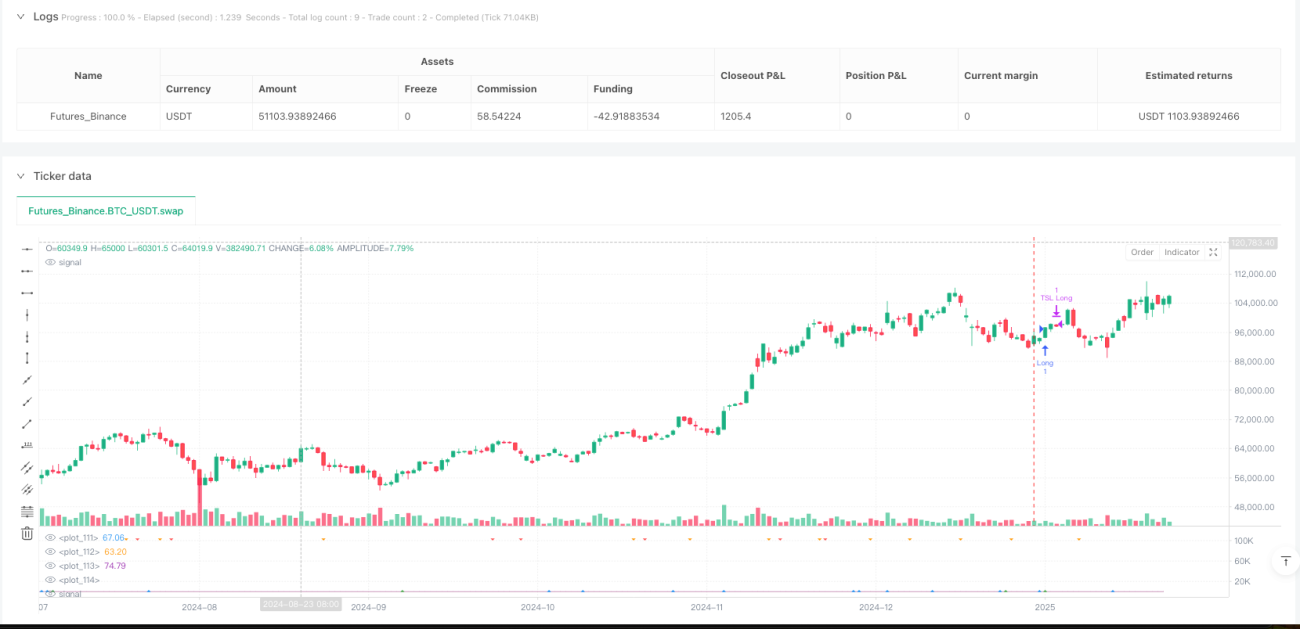
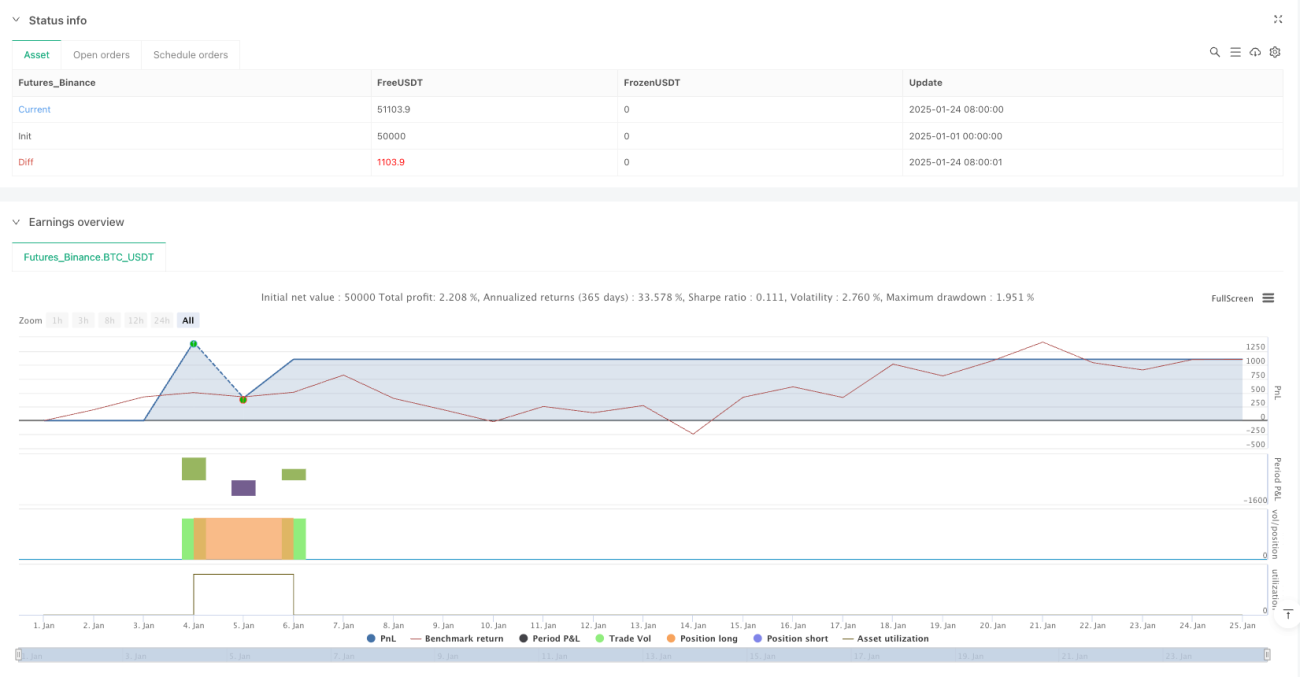
Estrategia del indicador KDJ dinámico adaptativo de múltiples marcos temporales

MTF-ADK ATR EMA KDJ TSL
Fecha de creación: 2025-04-03 14:27:21 Última modificación: 2025-04-03 15:13:59
Copiar: 0 Número de Visitas: 429
2
Seguir
319
Seguidores

Estrategia del indicador KDJ dinámico adaptativo de múltiples marcos temporales Estrategia del indicador KDJ dinámico adaptativo de múltiples marcos temporales

Descripción general

Esta es una innovadora estrategia de indicadores de oscilación de KDJ adaptada a múltiples marcos temporales, diseñada para proporcionar señales de negociación más precisas y flexibles mediante el ajuste dinámico de los parámetros de los indicadores y el análisis de las tendencias del mercado a través de múltiples marcos temporales. La estrategia combina el cálculo de la longitud basada en la volatilidad, la distribución de pesos a través de múltiples marcos temporales y el juicio de tendencias adaptado, proporcionando a los comerciantes una herramienta de análisis compleja y potente.

Principio de estrategia

El núcleo de la estrategia incluye las siguientes técnicas clave:

  1. Análisis de múltiples marcos de tiempo: tres marcos de tiempo simultáneos de 1, 5 y 15 minutos
  2. Cálculo de la longitud de swing adaptativa: Parámetros del indicador ajustados dinámicamente en función de la volatilidad del mercado
  3. Distribución de peso dinámica: asignación de diferentes coeficientes de peso para diferentes marcos de tiempo
  4. Mecanismo de determinación de tendencias: determina la dirección de las tendencias del mercado calculando el promedio de Smooth AvgTotal
  5. Generación de señales inteligentes: combina la señal principal y la señal esperada para mejorar la precisión de la señal

Ventajas estratégicas

  1. Alta flexibilidad: marco de tiempo y configuración de pesos personalizables
  2. Adaptabilidad dinámica: ajuste de los parámetros del indicador en función de la volatilidad del mercado
  3. Análisis multidimensional: información integrada en varios marcos de tiempo
  4. Señales de baja latencia: incluyen señales principales y señales esperadas
  5. Filtro de tendencia incorporado: Reducción de señales falsas en condiciones de mercado desfavorables

Riesgo estratégico

  1. Riesgo de exceso de ajuste de parámetros
  2. Los marcos de tiempo múltiples pueden aumentar la complejidad de la señal
  3. La fiabilidad de la señal puede disminuir en condiciones extremas de mercado
  4. Se requiere una señal de verificación de indicadores de confirmación adicional

Dirección de optimización de la estrategia

  1. Introducción de un algoritmo de aprendizaje automático para ajustar dinámicamente el peso
  2. Añadir condiciones adicionales de filtración
  3. Optimización de los mecanismos de pérdidas
  4. Desarrollo de adaptabilidad entre especies

Resumir

El marco multi-temporal se adapta a la estrategia de KDJ con un diseño innovador, ofreciendo a los operadores una herramienta de análisis de mercado flexible, dinámica y multidimensional, con una notable ventaja tecnológica y un potencial espacio para mejorar el rendimiento.

Código Fuente de la Estrategia
/*backtest
start: 2025-01-01 00:00:00
end: 2025-01-25 00:00:00
period: 1d
basePeriod: 1d
exchanges: [{"eid":"Futures_Binance","currency":"BTC_USDT"}]
*/

// This Pine Script™ is subject to the Mozilla Public License 2.0 (https://mozilla.org/MPL/2.0/)
// © Lausekopf

//@version=5
strategy("Adaptive KDJ (MTF)", overlay=false)

// Dropdown for the swing length calculation method
method = input.int(1, title="Calculation Method", options=[1, 2, 3], tooltip="1: Volatility Based\n2: Inverse Volatility\n3: Fixed Length")

// Fixed length for method 3
fixedLength = input.int(9, title="Fixed KDJ Length", minval=3, maxval=15)

// Timeframes
tf1 = input.timeframe("1", title="Timeframe 1")
tf2 = input.timeframe("5", title="Timeframe 2")
tf3 = input.timeframe("15", title="Timeframe 3")

// Timeframe weighting
weightOption = input.int(1, title="Timeframe Weighting", options=[1, 2, 3, 4, 5])
weightTF1 = weightOption == 1 ? 0.5 : weightOption == 2 ? 0.4 : weightOption == 3 ? 0.33 : weightOption == 4 ? 0.2 : 0.1
weightTF2 = 0.33
weightTF3 = 1.0 - (weightTF1 + weightTF2)

// EMA smoothing length
smoothingLength = input.int(5, title="EMA Smoothing Length", minval=1, maxval=50)

// Trend calculation period
trendLength = input.int(40, title="Trend Calculation Period", minval=5, maxval=50)

// KDJ function
f_kdj(len, srcHigh, srcLow, srcClose) =>
    roundedLen = int(math.round(len))
    high_max = ta.highest(srcHigh, roundedLen)
    low_min = ta.lowest(srcLow, roundedLen)
    rsv = 100 * (srcClose - low_min) / (high_max - low_min)
    k = ta.sma(rsv, 3)
    d = ta.sma(k, 3)
    j = 3 * k - 2 * d
    [k, d, j]

// Swing length function
f_swingLength(tf) =>
    atrLen = 14
    volatility = request.security(syminfo.tickerid, tf, ta.atr(atrLen) / close)
    var float length = na
    if method == 1
        length := volatility > 0.03 ? 3 : volatility > 0.002 ? 14 : 15
    if method == 2
        length := 18
    if method == 3
        length := fixedLength
    length

// Calculate swing lengths for each timeframe
swingLength1 = f_swingLength(tf1)
swingLength2 = f_swingLength(tf2)
swingLength3 = f_swingLength(tf3)

// Calculate KDJ values
[k1, d1, j1] = f_kdj(swingLength1, request.security(syminfo.tickerid, tf1, high), request.security(syminfo.tickerid, tf1, low), request.security(syminfo.tickerid, tf1, close))
[k2, d2, j2] = f_kdj(swingLength2, request.security(syminfo.tickerid, tf2, high), request.security(syminfo.tickerid, tf2, low), request.security(syminfo.tickerid, tf2, close))
[k3, d3, j3] = f_kdj(swingLength3, request.security(syminfo.tickerid, tf3, high), request.security(syminfo.tickerid, tf3, low), request.security(syminfo.tickerid, tf3, close))

// Weighted averages
avgK = (k1 * weightTF1 + k2 * weightTF2 + k3 * weightTF3)
avgD = (d1 * weightTF1 + d2 * weightTF2 + d3 * weightTF3)
avgJ = (j1 * weightTF1 + j2 * weightTF2 + j3 * weightTF3)
smoothAvgK = ta.ema(avgK, smoothingLength)
smoothAvgD = ta.ema(avgD, smoothingLength)
smoothAvgJ = ta.ema(avgJ, smoothingLength)
smoothAvgTotal = ta.ema((avgK + avgD + avgJ) / 3, smoothingLength)

// Trend determination
trendAvg = ta.sma(smoothAvgTotal, trendLength)
isUptrend = trendAvg > 60
isDowntrend = trendAvg < 40

// Dynamic signal thresholds
buyLevel = isUptrend ? 40 : isDowntrend ? 15 : 25
sellLevel = isUptrend ? 85 : isDowntrend ? 60 : 75

// Buy/Sell signals
buySignal = smoothAvgJ < buyLevel and ta.crossover(smoothAvgK, smoothAvgD)
sellSignal = smoothAvgJ > sellLevel and ta.crossunder(smoothAvgK, smoothAvgD)

// Anticipated signals
anticipateBuy = (smoothAvgK - smoothAvgK[1]) > 0 and (smoothAvgD - smoothAvgD[1]) < 0 and math.abs(smoothAvgK - smoothAvgD) < 5
anticipateSell = (smoothAvgK - smoothAvgK[1]) < 0 and (smoothAvgD - smoothAvgD[1]) > 0 and math.abs(smoothAvgK - smoothAvgD) < 5

// Entry conditions
longEntryCondition = (buySignal or anticipateBuy) and smoothAvgTotal < 22
shortEntryCondition = (sellSignal or anticipateSell) and smoothAvgTotal > 78

// Entry orders
strategy.entry("Long", strategy.long, when=longEntryCondition)
strategy.entry("Short", strategy.short, when=shortEntryCondition)

// Trailing Stop-Loss
atrMultiplierTSL = 2.5
atrValueTSL = ta.atr(12) * atrMultiplierTSL
strategy.exit("TSL Long", from_entry="Long", trail_points=atrValueTSL / syminfo.mintick, stop=open * 0.9972)
strategy.exit("TSL Short", from_entry="Short", trail_points=atrValueTSL / syminfo.mintick, stop=open * 1.0028)

// Plot signals
plotshape(series=buySignal, location=location.bottom, style=shape.triangleup, color=color.green, size=size.small)
plotshape(series=sellSignal, location=location.top, style=shape.triangledown, color=color.red, size=size.small)
plotshape(series=anticipateBuy, location=location.bottom, style=shape.triangleup, color=color.blue, size=size.tiny, offset=-1)
plotshape(series=anticipateSell, location=location.top, style=shape.triangledown, color=color.orange, size=size.tiny, offset=-1)

// Plot KDJ lines
plot(smoothAvgK, color=color.blue, linewidth=1)
plot(smoothAvgD, color=color.orange, linewidth=1)
plot(smoothAvgJ, color=color.purple, linewidth=1)
plot(smoothAvgTotal, color=color.white, linewidth=1)

// Alert for impending signals
alertcondition(anticipateBuy or anticipateSell, title='Impending KDJ Crossover', message='Possible KDJ crossover detected!')
// This Pine Script™ code is subject to the terms of the Mozilla Public License 2.0 at https://mozilla.org/MPL/2.0/
// © Lausekopf