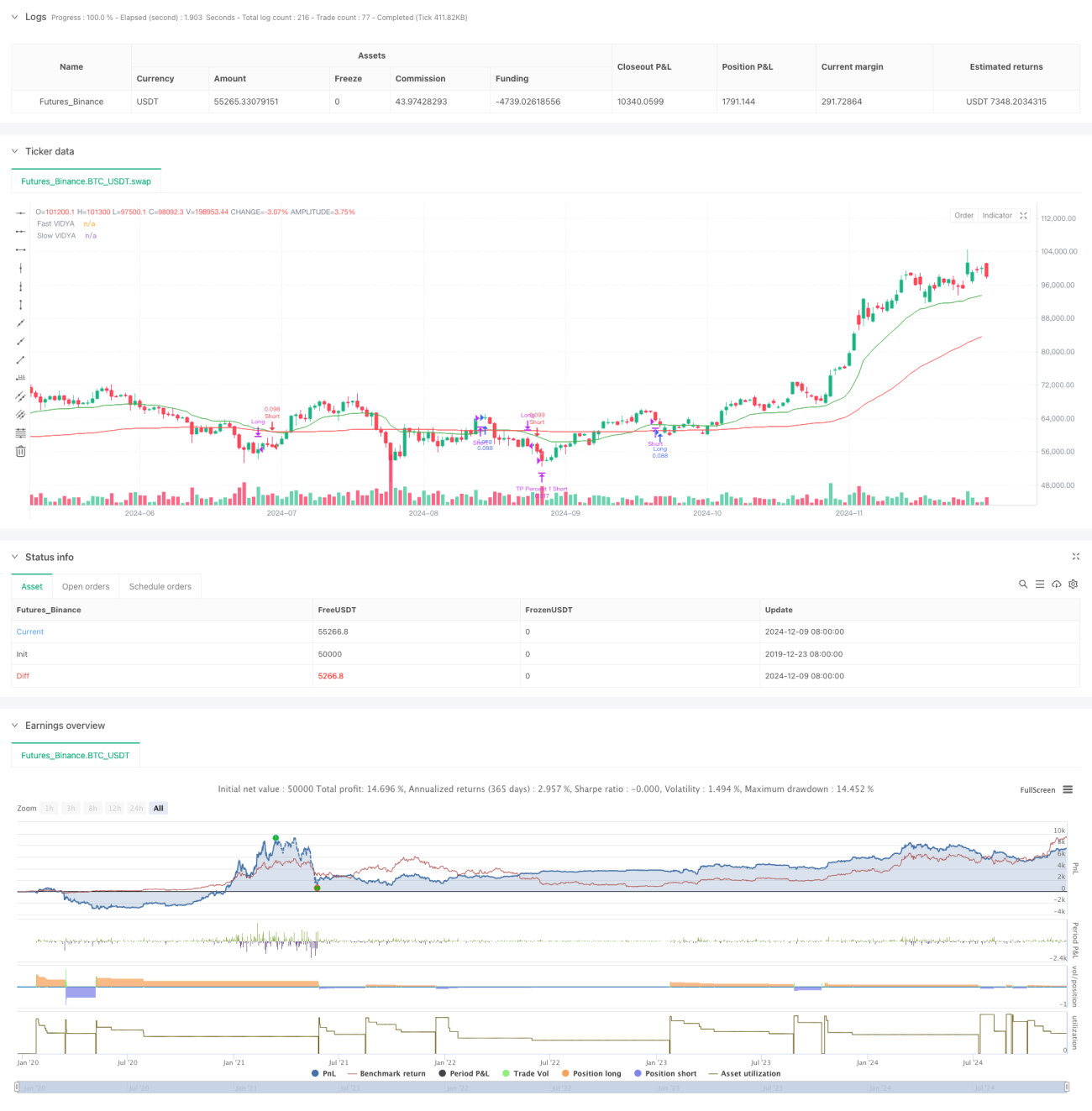
Estrategia de seguimiento de tendencias de ganancias multicapa con promedio móvil dinámico de índice variable


Fecha de creación: 2025-09-10 11:14:13 Última modificación: 2025-11-21 11:55:25
Copiar: 0 Número de Visitas: 29
2
Seguir
319
Seguidores

Estrategia de seguimiento de tendencias de ganancias multicapa con promedio móvil dinámico de índice variable

Descripción general

Esta estrategia es un sistema de seguimiento de tendencias que combina el indicador de la media dinámica de un índice de variables (VIDYA) con las bandas de Bollinger (Bollinger Bands) y integra un mecanismo de paradas en varios niveles. A diferencia de las estrategias de tendencias tradicionales, el sistema utiliza un método de ganancias más adaptativo para diferenciar las posiciones en blanco mediante un único índice de referencia ATR y un objetivo porcentual.

Principio de estrategia

El núcleo de la estrategia es el uso de dos indicadores VIDA para analizar las tendencias de precios, rápido y lento, teniendo en cuenta la volatilidad del mercado. La fórmula de cálculo del indicador VIDA es: El factor de alisado ((α) = 2/ ((período + 1) Vidya (t) = α * k * precio (t) + (1 - α * k) * Vidya (t-1) donde k = ∞ es el oscilador dinámico de Chand (MO) ∞/100

Las cintas de Bryn como filtros de fluctuación: En la vía superior = MA + (K * diferencia estándar) La línea inferior = MA - (K * diferencia estándar)

Condiciones de entrada:

  • Multiple cabeza: el precio rompe el vidya lento y el vidya rápido tiende hacia arriba, mientras que el precio rompe la banda de Brin
  • Cabeza vacía: el precio cae por debajo de la VIDYA lenta y la VIDYA rápida tiende a la baja, mientras que el precio cae por debajo de la banda de Brin

Los mecanismos de retención múltiple incluyen:

  1. Separación basada en ATR
  2. Cancelación basada en porcentaje
  3. El uso de multiplicadores para incrementar la proporción de paradas

Ventajas estratégicas

  1. Adaptabilidad dinámica: el indicador VIDA se ajusta automáticamente a las fluctuaciones del mercado, siendo más sensible que la media tradicional
  2. La gestión de riesgos es perfecta: el mecanismo de bloqueo de múltiples capas puede bloquear los beneficios en diferentes niveles de precios
  3. Tratamiento diferenciado: adopción de diferentes estrategias de bloqueo para las posiciones vacantes, más acordes con las características del mercado
  4. Filtración de la tasa de oscilación: el uso de la banda de Brin puede filtrar las falsas señales de ruptura
  5. Flexibilidad de los parámetros: los parámetros se pueden ajustar según las diferentes condiciones del mercado

Riesgo estratégico

  1. Riesgo de mercado en movimiento: Falsa señal en el mercado horizontal
  2. Efecto de los puntos de deslizamiento: los puntos de deslizamiento de varias paradas pueden causar un desvío en el precio de ejecución
  3. Dependencia de parámetros: los parámetros pueden necesitar ajustes frecuentes en diferentes entornos de mercado
  4. Complejidad sistémica: los mecanismos de contención multicapa aumentan la complejidad de las estrategias
  5. Presión de gestión de fondos: el cierre de varias posiciones puede aumentar la dificultad de gestión de posiciones

Dirección de optimización de la estrategia

  1. Ajuste de parámetros dinámicos: Se puede desarrollar un sistema de parámetros adaptativos que se ajusten automáticamente según las condiciones del mercado
  2. Identificación del entorno de mercado: agregar módulos de juicio del entorno de mercado, usar diferentes parámetros en diferentes condiciones de mercado
  3. Optimización de la detención de pérdidas: aumenta el mecanismo de detención de pérdidas dinámicas y mejora la capacidad de control de riesgos
  4. Filtración de señales: indicadores auxiliares como aumento de tráfico, mejora de la fiabilidad de la señal
  5. Gestión de posiciones: desarrollar algoritmos de asignación de posiciones más inteligentes

Resumir

La estrategia crea un sistema de seguimiento de tendencias completo mediante la combinación de la adaptabilidad dinámica de los indicadores de VIDA y la función de filtrado de la volatilidad de la banda de Brin. El mecanismo de suspensión multicapa y el manejo multicapa diferenciado lo convierten en una buena capacidad de rentabilidad y control de riesgos. Sin embargo, los usuarios deben estar atentos a los cambios en el entorno del mercado, ajustar los parámetros cuando sea necesario y establecer un sistema de gestión de fondos completo.

Código Fuente de la Estrategia
/*backtest
start: 2025-01-01 00:00:00
end: 2025-09-08 08:00:00
period: 1d
basePeriod: 1d
exchanges: [{"eid":"Futures_Binance","currency":"ETH_USDT","balance":500000}]
*/

// This source code is subject to the terms of the Mozilla Public License 2.0 at https://mozilla.org/MPL/2.0/
// © PresentTrading

// This strategy, "VIDYA ProTrend Multi-Tier Profit," is a trend-following system that utilizes fast and slow VIDYA indicators 
// to identify entry and exit points based on the direction and strength of the trend. 
// It incorporates Bollinger Bands as a volatility filter and features a multi-step take profit mechanism, 
// with adjustable ATR-based and percentage-based profit targets for both long and short positions. 
// The strategy allows for more aggressive take profit settings for short trades, making it adaptable to varying market conditions.

//@version=5
strategy("VIDYA ProTrend Multi-Tier Profit", overlay=true)


// User-defined inputs
tradeDirection = input.string(title="Trading Direction", defval="Both", options=["Long", "Short", "Both"])
fastVidyaLength = input.int(10, title="Fast VIDYA Length", minval=1)
slowVidyaLength = input.int(30, title="Slow VIDYA Length", minval=1)
minSlopeThreshold = input.float(0.05, title="Minimum VIDYA Slope Threshold", step=0.01)

// Bollinger Bands Inputs
bbLength = input.int(20, title="Bollinger Bands Length", minval=1)
bbMultiplier = input.float(1.0, title="Bollinger Bands Multiplier", step=0.1)

// Multi-Step Take Profit Settings
group_tp = "Multi-Step Take Profit"
useMultiStepTP = input.bool(true, title="Enable Multi-Step Take Profit", group=group_tp)
tp_direction = input.string(title="Take Profit Direction", defval="Both", options=["Long", "Short", "Both"], group=group_tp)
atrLengthTP =  input.int(14, title="ATR Length", group=group_tp)


// ATR-based Take Profit Steps
atrMultiplierTP1 = input.float(2.618, title="ATR Multiplier for TP 1", group=group_tp)
atrMultiplierTP2 = input.float(5.0, title="ATR Multiplier for TP 2", group=group_tp)
atrMultiplierTP3 = input.float(10.0, title="ATR Multiplier for TP 3", group=group_tp)

// Short Position Multiplier for Take Profit Percentages
shortTPPercentMultiplier = input.float(1.5, title="Short TP Percent Multiplier", group=group_tp)

// Percentage-based Take Profit Steps (Long)
tp_level_percent1 = input.float(title="Take Profit Level 1 (%)", defval=3.0, group=group_tp)
tp_level_percent2 = input.float(title="Take Profit Level 2 (%)", defval=8.0, group=group_tp)
tp_level_percent3 = input.float(title="Take Profit Level 3 (%)", defval=17.0, group=group_tp)

// Percentage-based Take Profit Allocation (Long)
tp_percent1 = input.float(title="Take Profit Percent 1 (%)", defval=12.0, group=group_tp)
tp_percent2 = input.float(title="Take Profit Percent 2 (%)", defval=8.0, group=group_tp)
tp_percent3 = input.float(title="Take Profit Percent 3 (%)", defval=10.0, group=group_tp)

// ATR-based Take Profit Percent Allocation (Long)
tp_percentATR1 = input.float(title="ATR TP Percent 1 (%)", defval=10.0, group=group_tp)
tp_percentATR2 = input.float(title="ATR TP Percent 2 (%)", defval=10.0, group=group_tp)
tp_percentATR3 = input.float(title="ATR TP Percent 3 (%)", defval=10.0, group=group_tp)

// Short position percentage allocations using the multiplier
tp_percent1_short = tp_percent1 * shortTPPercentMultiplier
tp_percent2_short = tp_percent2 * shortTPPercentMultiplier
tp_percent3_short = tp_percent3 * shortTPPercentMultiplier

tp_percentATR1_short = tp_percentATR1 * shortTPPercentMultiplier
tp_percentATR2_short = tp_percentATR2 * shortTPPercentMultiplier
tp_percentATR3_short = tp_percentATR3 * shortTPPercentMultiplier

// VIDYA Calculation Function
calcVIDYA(src, length) =>
    alpha = 2 / (length + 1)
    momm = ta.change(src)
    m1 = momm >= 0.0 ? momm : 0.0
    m2 = momm < 0.0 ? -momm : 0.0
    sm1 = math.sum(m1, length)
    sm2 = math.sum(m2, length)
    chandeMO = nz(100 * (sm1 - sm2) / (sm1 + sm2))
    k = math.abs(chandeMO) / 100
    var float vidya = na
    vidya := na(vidya[1]) ? src : (alpha * k * src + (1 - alpha * k) * vidya[1])
    vidya

// Calculate VIDYAs
fastVIDYA = calcVIDYA(close, fastVidyaLength)
slowVIDYA = calcVIDYA(close, slowVidyaLength)

// Bollinger Bands Calculation
[bbUpper, bbBasis, bbLower] = ta.bb(close, bbLength, bbMultiplier)

// Manual Slope Calculation (price difference over time)
calcSlope(current, previous, length) =>
    (current - previous) / length

// Slope of fast and slow VIDYA (comparing current value with value 'length' bars ago)
fastSlope = calcSlope(fastVIDYA, fastVIDYA[fastVidyaLength], fastVidyaLength)
slowSlope = calcSlope(slowVIDYA, slowVIDYA[slowVidyaLength], slowVidyaLength)

// Conditions for long entry with Bollinger Bands filter
longCondition = close > slowVIDYA and fastSlope > slowSlope and fastSlope > minSlopeThreshold and slowSlope > 1/2*minSlopeThreshold and close > bbUpper

// Conditions for short entry with Bollinger Bands filter
shortCondition = close < slowVIDYA and fastSlope < slowSlope and fastSlope < -minSlopeThreshold and slowSlope < -1/2*minSlopeThreshold and close < bbLower

// Exit conditions (opposite crossovers or flat slopes)
exitLongCondition = fastSlope < -minSlopeThreshold and slowSlope < -1/2*minSlopeThreshold or shortCondition
exitShortCondition = fastSlope > minSlopeThreshold and slowSlope > 1/2*minSlopeThreshold or longCondition

// Entry and Exit logic with trading direction
if (longCondition) and (strategy.position_size == 0) and (tradeDirection == "Long" or tradeDirection == "Both")
    strategy.order("Long", strategy.long)

if (exitLongCondition) and strategy.position_size > 0 and (tradeDirection == "Long" or tradeDirection == "Both")
    strategy.close("Long")

if (shortCondition) and (strategy.position_size == 0) and (tradeDirection == "Short" or tradeDirection == "Both")
    strategy.order("Short", strategy.short)

if (exitShortCondition) and strategy.position_size < 0 and (tradeDirection == "Short" or tradeDirection == "Both")
    strategy.close("Short")


if useMultiStepTP
    if strategy.position_size > 0 and (tp_direction == "Long" or tp_direction == "Both")
        // ATR-based Take Profit (Long)
        tp_priceATR1_long = strategy.position_avg_price + atrMultiplierTP1 * ta.atr(atrLengthTP)
        tp_priceATR2_long = strategy.position_avg_price + atrMultiplierTP2 * ta.atr(atrLengthTP)
        tp_priceATR3_long = strategy.position_avg_price + atrMultiplierTP3 * ta.atr(atrLengthTP)
        
        // Percentage-based Take Profit (Long)
        tp_pricePercent1_long = strategy.position_avg_price * (1 + tp_level_percent1 / 100)
        tp_pricePercent2_long = strategy.position_avg_price * (1 + tp_level_percent2 / 100)
        tp_pricePercent3_long = strategy.position_avg_price * (1 + tp_level_percent3 / 100)

        // Execute ATR-based exits for Long
        strategy.exit("TP ATR 1 Long", from_entry="Long", qty_percent=tp_percentATR1, limit=tp_priceATR1_long)
        strategy.exit("TP ATR 2 Long", from_entry="Long", qty_percent=tp_percentATR2, limit=tp_priceATR2_long)
        strategy.exit("TP ATR 3 Long", from_entry="Long", qty_percent=tp_percentATR3, limit=tp_priceATR3_long)
        
        // Execute Percentage-based exits for Long
        strategy.exit("TP Percent 1 Long", from_entry="Long", qty_percent=tp_percent1, limit=tp_pricePercent1_long)
        strategy.exit("TP Percent 2 Long", from_entry="Long", qty_percent=tp_percent2, limit=tp_pricePercent2_long)
        strategy.exit("TP Percent 3 Long", from_entry="Long", qty_percent=tp_percent3, limit=tp_pricePercent3_long)

    if strategy.position_size < 0 and (tp_direction == "Short" or tp_direction == "Both")
        // ATR-based Take Profit (Short) - using the same ATR levels as long
        tp_priceATR1_short = strategy.position_avg_price - atrMultiplierTP1 * ta.atr(atrLengthTP)
        tp_priceATR2_short = strategy.position_avg_price - atrMultiplierTP2 * ta.atr(atrLengthTP)
        tp_priceATR3_short = strategy.position_avg_price - atrMultiplierTP3 * ta.atr(atrLengthTP)
        
        // Percentage-based Take Profit (Short) - using the same levels, but more aggressive percentages
        tp_pricePercent1_short = strategy.position_avg_price * (1 - tp_level_percent1 / 100)
        tp_pricePercent2_short = strategy.position_avg_price * (1 - tp_level_percent2 / 100)
        tp_pricePercent3_short = strategy.position_avg_price * (1 - tp_level_percent3 / 100)

        // Execute ATR-based exits for Short (using the percentage multiplier for short)
        strategy.exit("TP ATR 1 Short", from_entry="Short", qty_percent=tp_percentATR1_short, limit=tp_priceATR1_short)
        strategy.exit("TP ATR 2 Short", from_entry="Short", qty_percent=tp_percentATR2_short, limit=tp_priceATR2_short)
        strategy.exit("TP ATR 3 Short", from_entry="Short", qty_percent=tp_percentATR3_short, limit=tp_priceATR3_short)
        
        // Execute Percentage-based exits for Short
        strategy.exit("TP Percent 1 Short", from_entry="Short", qty_percent=tp_percent1_short, limit=tp_pricePercent1_short)
        strategy.exit("TP Percent 2 Short", from_entry="Short", qty_percent=tp_percent2_short, limit=tp_pricePercent2_short)
        strategy.exit("TP Percent 3 Short", from_entry="Short", qty_percent=tp_percent3_short, limit=tp_pricePercent3_short)
// Plot VIDYAs
plot(fastVIDYA, color=color.green, title="Fast VIDYA")
plot(slowVIDYA, color=color.red, title="Slow VIDYA")